
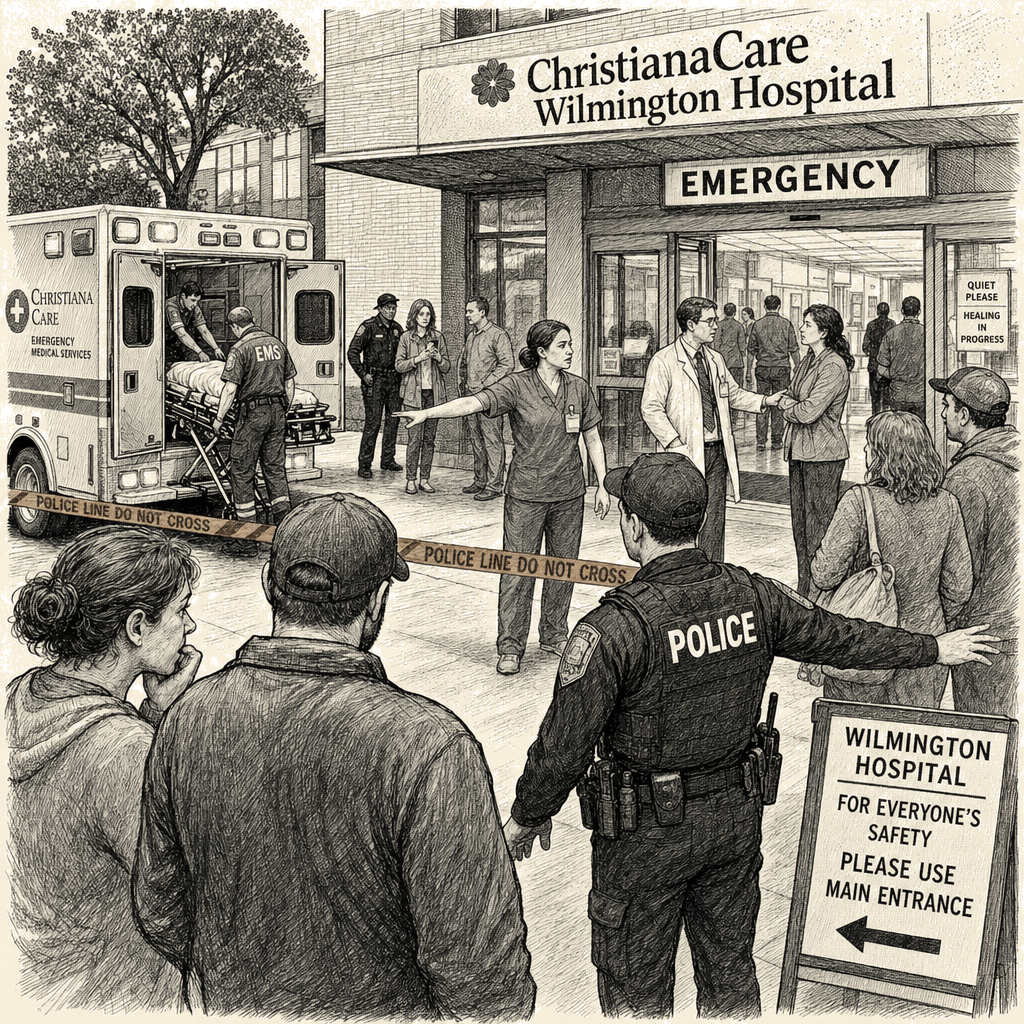
American hospital corporations profit from the understaffing and absent security that make hospital shootings inevitable. On Tuesday afternoon in Wilmington, Delaware, the inevitable arrived on schedule. Police Chief Wilfredo Campos stood at the microphone and did what American police chiefs have become practiced at doing — describing a shooting inside a hospital with the bureaucratic composure of a man who has given this press conference before, in other cities, for other hospitals, and will give it again. Two people shot at Wilmington Hospital, operated by ChristianaCare. One dead. The other in unknown condition. The suspect walked out of the building and disappeared. The hospital diverted patients from its emergency department. The lockdown was lifted by nightfall. By Wednesday morning, the story was already leaving the national feed.
The Guardian reported the basics — a shooting at 3:30 p.m. inside a hospital in a city of 71,000 twenty-five miles south of Philadelphia. The report contained one sentence of context that deserves to be the headline of every hospital-shooting story published in America: “Violence has been a persistent problem at hospitals across the US.” Persistent. Not emerging, not growing, not alarming — persistent. The word the industry has learned to live with.
The pattern does not require sophisticated analysis to name. Healthcare workers in the United States experience workplace violence at rates that dwarf every other industry the Bureau of Labor Statistics tracks. OSHA has published guidelines for preventing violence in healthcare settings — voluntary guidelines, because the hospital industry successfully resisted mandatory federal standards. Congress has introduced legislation to require safety standards in healthcare facilities; the legislation stalls, session after session, because the hospital industry’s trade associations — the American Hospital Association chief among them — lobby against mandatory standards with the money and the message discipline that the gun lobby perfected and every concentrated industry since has borrowed. The quiet confidence behind the lobbying is this: the American attention span will do the rest. The shooting will leave the national feed. The legislation will die in committee. The next quarterly earnings report will not include a line item for the safety of the people who were shot.
Five weeks ago, a police officer was killed and another critically injured inside a Chicago hospital. That shooting left the national feed too. The feed moves. The bodies do not. And barely a week before the Wilmington shooting, mass-casualty gunfire tore through summer gatherings in Midland and Toledo. The geography rotates; the institutional failure is constant. Hospitals, festivals, schools, supermarkets — the same loophole-riddled security architecture, the same regulatory void, the same consequence-free aftermath in which the industry offers “thoughts and prayers” and then waits for the next dateline to displace the last one.
What makes the hospital violence specifically damning is that the warning system has been screaming for years. The American Hospital Association published a report in 2025 cataloguing the financial and human costs of violence against healthcare workers. The Journal of Hospital Medicine argued in early 2026 that security investments alone were failing because they treated shootings as local security lapses rather than systemic design flaws. Federal legislation — the Save Healthcare Workers Act — has been kicking around Congress, promising to make violence against medical staff a federal crime, but the hospital lobby has not exactly been breaking down doors to get it passed, because a federal mandate would mean federal compliance costs, and federal compliance costs cut into the margins that have made American healthcare the most expensive death-care system on earth.
The cui-bono trace on hospital violence is not complicated, and the people who pretend it is complicated are the people who benefit from the confusion. Hospital corporations — and American hospitals are increasingly corporations, consolidated through decades of mergers into systems that operate hundreds of facilities under a single balance sheet — extract profit by controlling costs. Staffing is a cost. Security is a cost. Mental health infrastructure is a cost. Environmental design — the kind that makes a building harder to shoot people in — is a cost. Each of these cost centers, when cut, produces a documented increase in the risk of violence inside the facility. The corporation books the savings. The healthcare worker, the patient, the visitor — they absorb the risk. When the risk materializes, as it did Tuesday afternoon in Wilmington, the corporation issues a statement about “taking all appropriate steps to ensure the safety of our patients, caregivers and visitors.” The steps it declined to take before the shooting — adequate staffing ratios, trained security personnel, weapons screening, environmental redesign, crisis intervention teams — do not appear in the statement. They are not appropriate steps. They are expensive steps. And the difference between “appropriate” and “expensive” is the profit margin.
This is the textbook structure of what this publication’s analytical voices have been tracing across every sector of American economic life: the concentrated benefit extracted by the few who control the apparatus, the diffuse cost absorbed by the many who live inside it, and the public framing that obscures the transfer. The hospital corporation’s quarterly earnings are the concentrated benefit. The bullet in the emergency department is the diffuse cost. And the press conference where the police chief describes the shooting in measured terms is the apparatus protecting itself. The Wilmington shooter, whoever they turn out to be, pulled a trigger inside a building that knew it was vulnerable and had decided, at an institutional level, that hardening itself against the last ten hospital shootings was not worth the price. That decision was not made by a lone administrator; it is embedded in an industry-wide calculus in which security is a line item to be minimized, not a duty of care. When ChristianaCare emailed reporters that it was “taking all appropriate steps to ensure the safety of our patients, caregivers and visitors,” it was performing the ritual — the same ritual every hospital chain performs after the fact — while the structural question of why American hospitals need active-shooter protocols in the first place remains cordoned off from anyone with the power to answer it.
King told the congregation at Riverside Church in April 1967 that a nation which spends more on military defense than on programs of social uplift is approaching spiritual death. The diagnosis travels. A nation that spends more on hospital executive compensation than on hospital security — that treats the physical safety of nurses, doctors, patients, and visitors as a cost center to be minimized rather than an obligation to be met — is approaching something King would have recognized. The triple evils he named that evening — racism, extreme materialism, and militarism — are not separate pathologies from the one that produced Tuesday’s shooting in Wilmington. They are the same pathology, wearing different institutional clothes. Materialism is the engine: the corporation that runs the hospital extracts profit from the conditions that endanger everyone inside it. Militarism is the downstream product: when the violence arrives, the institutional response is more armed security, more lockdown drills, more “active shooter protocols” — all of which treat the symptom while leaving the structural cause untouched, because treating the structural cause would reduce the profit margin. And racism is the structural frame, the one that rarely makes the news coverage: the communities where hospital violence concentrates are not the communities where hospital executives make their homes.
The bad-faith moves that protect this system are cataloged and recurring, and they operate with the regularity of a machine refined through repetition.
The first is a familiar false choice: either we accept hospital shootings as the inevitable cost of an open society, or we turn hospitals into armed fortresses with metal detectors at every door. This framing omits the entire middle ground — mandatory staffing ratios, weapons screening, environmental redesign, mental health crisis teams, gun access restrictions, federal workplace violence standards — because including the middle ground would implicate the specific actors who blocked each of those interventions. The false dichotomy functions by narrowing the options to two, one absurd and one dystopian, so that the structural reforms never enter the conversation.
The second is the deflection to mental health. Every hospital shooting produces a conversation about mental health that is sincere in the abstraction and useless in the specificity, because the same political actors who invoke mental health after a shooting are the ones who defund mental health before one. The hospital has become America’s mental health system of last resort — the place where people in crisis land because every upstream intervention has been cut, defunded, or privatized into ineffectiveness. The hospital was not designed for this role. The hospital corporation did not staff for this role. The people working inside the hospital did not sign up to absorb the consequences of a mental health infrastructure that exists, in most American cities, primarily as a concept. The shooting in Wilmington is what happens when the institution built for one purpose is forced to absorb the functions of every institution that was dismantled around it.
The third is the technique the catalog calls frame-engineered relabeling — the euphemistic drift from “shooting” to “security incident” to “active shooter situation” to whatever next dilution the institution’s communications department prefers. Each relabeling does the same work: it protects the institution from the plain English description of what happened. Someone walked into a hospital on Tuesday afternoon and shot two people, killing one. The plainness of the sentence is the point. The euphemism is the apparatus protecting the apparatus.
What would a real answer require? A federal hospital-security standard with teeth — mandatory barriers, controlled access points, armed response protocols, staff training mandates — enforced by an agency that can strip accreditation from facilities that treat workplace violence as a public-relations problem. It would require naming the industry lobby that has quietly fought every regulatory push, and the lawmakers who have accepted its contributions and run interference. It would require a press corps that stops covering hospital shootings as discrete tragedies and starts covering them as the serial consequence of a policy choice.
The press, of course, is not going to do that, because the structural story is slow and the active-shooter story is a ratings engine. So the burden falls on anyone still committed to the idea that a hospital ought to be the safest building in a community, not the building where you are statistically more likely to be shot than in a parking lot at midnight.
Malcolm X, addressing the Ford Auditorium in Detroit in February 1965 — less than twenty-four hours after his own home had been firebombed — delivered a ninety-minute structural lecture, not an outburst. When the audience expected anger, he gave them analysis. When they expected personal grievance, he gave them the apparatus. “You can’t hate the roots of a tree and not hate the tree,” he said. The discipline of that sentence is what the Wilmington shooting demands. The root is the system — corporate healthcare consolidation, legislative capture by the hospital industry, the gun lobby’s standing veto on safety policy, the defunding of every upstream institution that once absorbed the crisis before it reached the emergency room door. The tree is the shooting in Wilmington, and the one in Chicago five weeks before it, and the next one, which will come, because the roots are intact and no one with the power to pull them has chosen to do so.
The arc of the moral universe is long, but it bends toward justice — King said that, and he was right, and he was incomplete. The arc bends only when the apparatus holding it straight is broken at its joints. The hospital corporations that profit from understaffing are one joint. The legislators who block safety mandates are another. The lobbyists who ensure the conditions persist are a third. The breaking is what gets done now, or the arc does not bend now.
The people of Wilmington deserve a hospital where the emergency department is not diverted because someone brought a gun into the building and used it. The healthcare workers of America deserve a workplace where the question is not whether they will be shot but whether their employer will staff the floor adequately enough for them to eat lunch. The patients of America deserve a system that treats their physical safety as an obligation rather than a quarterly line item to be optimized. None of this is complicated. All of it is blocked. The blocking is the story. The shooting is the symptom. And the next shooting, which the apparatus will call a tragedy while doing nothing to prevent it, is already on the schedule the system keeps.
The Wilmington shooting has already begun its fade into the archive, and the next one will arrive before the funeral flowers wilt. That is the design. That is the policy. The only thing “breaking” about it is the silence of the people who could stop it.