
Clara is an aide on the memory-care floor of the assisted-living facility I own outside Zanesville, Ohio. She is sixty-eight. She bathes her residents, changes their linens, lifts them when they fall, and makes twelve-seventy-five an hour — the cheapest rate I can post and still pull a woman off her sofa when her Social Security check fails and the mortgage payment comes due. Clara works for me because Clara cannot afford to stop. And the editors at National Review have just handed me the arithmetic that will keep her on my floor until her body gives out, at a rate that improves with every cut.
Rafael is a floor refinisher on my crew outside Hazard, sixty-one, his hands starting to shake by the third room. He earns $12 an hour. I pay him to finish floors. You walked across one last week and admired the gloss. Between them — the aide and the finisher, the memory-care floor and the hardwood — the arithmetic is the same arithmetic, and the editorial is the same gift.
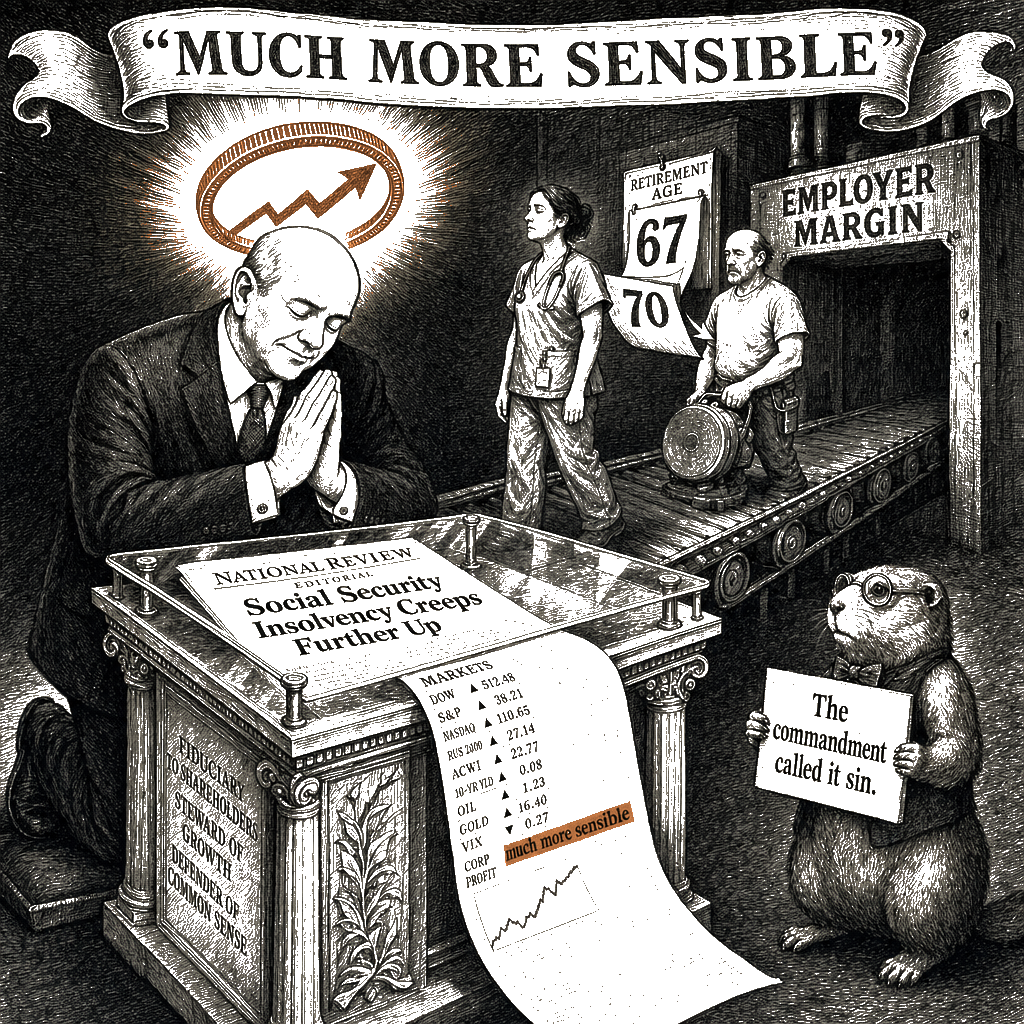
The National Review board argued that the retirement trust fund will be exhausted by late 2032, that beneficiaries face an automatic 22% cut, and that the solution is to raise the retirement age and slow benefit growth. They call the trust fund “an accounting fiction.” They call their own proposal “much more sensible.” I agree with every word, and I want to show you exactly why, because the number is the only thing that ever mattered, and the editors just delivered it clean.
Start with Rafael and walk it slowly. At $12 an hour, 2,600 hours a year — no overtime premium, no benefits beyond what the state requires — that is $31,200 in labor I capture annually. My share of his Social Security tax, the part I’d otherwise remit to a system that would return it to him, is $1,934 a year. Raise the retirement age 3 years, and $5,802 stays on my operating line instead of moving onto the federal ledger. Hector is Rafael with a different floor and a colder state — a mover on my line in southern Ohio, fifty-eight, his knees bone-on-bone — and his numbers are a mirror: $5,561 in employer Social Security tax I retain, plus the Medicare match that lifts both men together to $14,021 across 3 years. That is the money Congress would let me keep because the editors decided a body should work longer. Now follow the cost where I put it. Rafael’s healthcare runs roughly $4,800 a year through a subsidized marketplace plan the taxpayers underwrite. If he stops working and draws full benefits, the public cost rises — Social Security plus Medicaid as his joints fail. If he stays on my floor, the near-term public cost is lower. I keep the yield. The state keeps the maintenance. I have arranged for the public to fund the gap between what I pay him and what it costs to keep him breathing, and now the editors have arranged for him to continue breathing on my floor for three extra years. Watch the shape of it: the cost I externalize and the margin I retain are the same money, separated only by which column the spreadsheet puts them in.
Now Clara. Her full‑time counterpart — a market‑rate hire with a clean back — would cost $22.50 an hour plus a benefits package I have to sticker at $8,400 a year. Clara costs $12.75. I save $9.75 an hour, $389 a week, $20,228 a year — and that is before the trust fund cuts. After the cuts, I will dock her to $12.25, because a woman whose federal check just lost $500 a month has a revised reservation wage, and it is my job to discover it. I do not call that cruelty. I call that price discovery, and it is the most important lesson I teach my students at Warden University. One of them — a young man who sat in the third row and graded out at the top of his seminar — now runs the compensation desk at the hospital network that competes with my facility for the same labor pool. He has already modeled the trust fund’s depletion into his next round of staffing offers. He’s pricing home‑health aides at $11.95 an hour, pre‑cut, so that the new federal shortfall lands as margin, not as cost. I taught him to run the number before the news hits the floor. He ran it faster than I did. I am, genuinely, proud.
Read the next sentence twice. The trust fund was a lien on the unborn — a promise the government could honor only as long as the supply of new workers kept growing faster than the line of old ones waiting for checks. The birth rate broke the promise before Clara ever opened her first statement. Now the bill arrives, and the editors propose that workers like Rafael and Hector absorb the consequence — longer careers, smaller benefits, thinner margins of rest — while the capital gains rate is untouched and the dividend tax is untouched. The money workers paid in was borrowed and spent on tax cuts that accrued to capital, on military procurement that benefited shareholders, on keeping the general fund solvent while income taxes on the productive class were cut and cut again. The man who paid in for 40 years gets a letter saying his retirement age just moved. The man whose taxes were cut with the borrowed surplus gets a quarterly statement saying his portfolio is fine.
Now pull back with me, because the lesson is bigger than 2 men on two floors.
Moses recorded the instruction thirty-four centuries ago: “You shall not oppress a hired servant who is poor and needy… You shall give him his wages on the same day, before the sun sets, for he is poor and sets his heart on it, lest he cry against you to the Lord, and you be guilty of sin.” That commandment does not describe a market failure. It describes the market. Wages held past sundown. Servants poor and needy by definition. The law against the oppression is the proof the oppression was already the default — the thing that needed prohibiting was the thing already happening, already priced, already profitable. The religion has changed. The sundown has moved. The mechanism has not. Rafael and Clara are the hired servants in your land. The editors propose to extend the sundown by 3 years and call it “much more sensible.” The commandment calls it sin. I keep the margin either way.
Cato the Elder, whose estate-management manual I assign every fall, gave a disposer exactly one instruction: “Sell the worn‑out oxen, the blemished cattle, the old wagon, the old slave, the sickly slave, and whatever else is superfluous.” The old slave and the sickly slave in the same list as the worn‑out wagon. Congress, for a hundred years, tried to pretend the old worker was not a write‑down. The trust fund was the accounting fiction that let them keep pretending. Now the pretense ends, and the disposal list reopens. Clara is not a tragedy. She is a line item whose price has just come down.
I have not traced what happens when a woman whose check shrank by $500 becomes my resident a decade later because she couldn’t afford the hip replacement that would have kept her upright. That arithmetic is in a folder I have never opened. I do not need to open it. The facility’s margin goes to 22% on the new staffing rates, and I am already pricing the next round of cuts into the five‑year projection.
The apostle wrote: “Slaves, obey your earthly masters with fear and trembling.” The trustees’ report just fired Clara’s retirement savings. Rafael’s hands will shake by the third room on Monday morning. I will keep the $5,802. The state will keep his lungs. Clara will pick up a Sunday shift at $13 flat and thank me for it. In 3 years, when Rafael’s body finally fails, he will draw the reduced benefit the editors prescribed, and the money will have been reinvested in the quarterly number, which exceeded every projection.
I do not model that column.
Sterling A. Varice holds the Hayek-Friedman Chair and serves as Dean of Instruction at Warden University’s College of Business and Economics in Richmond, Virginia. He is the author of three textbooks: Divine Mandates for Labor Utilization, Social Obligations for Profit Maximization, and Calibrated Deprivation: A Manager’s Guide to Employee Motivation.