The Trump administration is using the federal courts to channel money to people who assaulted police officers on January 6.
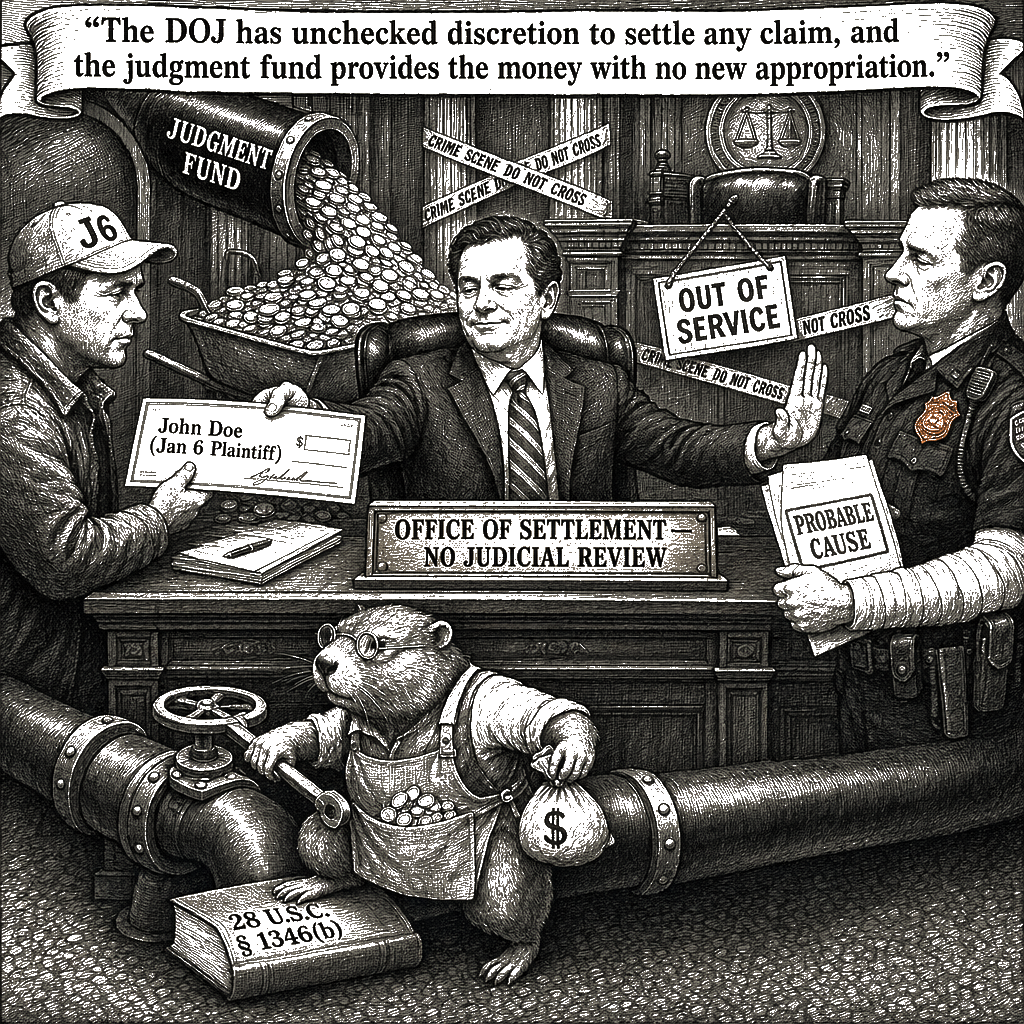
The vehicle is the Federal Tort Claims Act (FTCA), 28 U.S.C. §§ 1346(b), 2671–2680, a statute that allows individuals harmed by the government to seek monetary damages. The statute gives the Department of Justice complete, unchecked discretion over whether to settle or defend against claims. There is no judicial review of the DOJ’s settlement decision. Congressional oversight of which claims the DOJ chooses to resolve is minimal — Treasury provides annual after-the-fact reports on payments, but Congress has no prospective control over settlement decisions. The money comes from the judgment fund — a perpetual appropriation authorized by Congress at 31 U.S.C. § 1304, the same pot of money the administration’s $1.8 billion “anti-weaponization fund” would have drawn from before bipartisan objection forced its retreat.
The administration has already demonstrated how the mechanism works. The DOJ agreed to settle FTCA claims filed by Michael Flynn, a former national security adviser, and Carter Page, a foreign policy adviser to Trump, for $1.25 million each earlier this year. The DOJ did not defend against the suits. Peter Ticktin, a Florida attorney who is a longtime friend of Trump, says he has filed around 400 FTCA claims on behalf of January 6 defendants and expects to start filing lawsuits now that the six-month waiting period has expired. Mark McCloskey, a Missouri attorney representing many of the defendants, says the FTCA offers advantages over the scrapped anti-weaponization fund: “The FTCA gives you a statute with teeth that you can, as long as you can prove your claim, you have a right to recovery.”
Among those seeking payouts are Kenneth Joseph Thomas, an Ohio man sentenced to nearly five years in prison after a jury found him guilty of assaulting several police officers — video showed him shoving officers and throwing himself into a police line while shouting for other rioters to “hold the fucking line.” John George Todd III, a Missouri man sentenced to five years after conviction on charges including injuring a Capitol police officer. Both are among nine plaintiffs seeking at least $1 million each in an FTCA lawsuit filed May 29 in Washington. Andrew Taake, a Houston man who pleaded guilty to assaulting officers with bear spray and a whip-like weapon and was sentenced to six years, is pursuing at least $2.5 million in an FTCA lawsuit filed last September in Washington, his lawyers claiming damages for inadequate medical treatment and an unfair trial.
The claims are, on their own terms, not strong. The malicious-prosecution theory founders on the existence of grand-jury indictments, guilty pleas, and judicial sentencing — elements that courts treat as strong evidence of probable cause and regularity. As Rupa Bhattacharyya, former director of the civil division’s tort branch at the DOJ and now legal director at Georgetown Law’s Institute for Constitutional Advocacy and Protection, told the Guardian: “Most of these plaintiffs were indicted by grand juries, brought before a court. Many of them pled guilty, others were convicted, they were sentenced by judges, and so those sorts of malicious prosecution claims are eminently defensible.” McCloskey says the guilty pleas were coerced “based on threats of life imprisonment and threats against their family.” There is no evidence of coercion in the January 6 prosecutions.
In Taake’s case, a federal prosecutor in Washington has moved to dismiss the claims on procedural grounds. But the DOJ’s defense of individual claims is not the structural question. The structural question is what happens when the DOJ does not defend. The DOJ has unchecked discretion over whether to settle, the judgment fund provides a perpetual appropriation with no annual authorization requirement, and no court can compel the DOJ to defend against a claim it chooses not to contest. The channel is open. The money flows when the DOJ decides it flows.
Congress is attempting to close the channel. Senator Adam Schiff has introduced legislation to amend the FTCA to prohibit anyone pardoned for actions related to January 6 from being eligible for claims. “President Donald Trump still wants to pay off violent insurrectionists who attacked police officers on January 6th,” Schiff said. “Our taxpayer dollars should not be used to pay out criminals.” The bill names what an honest application of the judgment fund requires: that taxpayer money not be channeled to people who assaulted police officers at the direction of a political ally.
What this documents is not a one-time maneuver. It is the architecture. The same doctrinal structure that insulates executive killing from judicial review — the DOJ’s unchecked discretion, the judgment fund’s perpetual appropriation, the absence of any judicial check on the settlement decision — operates here to channel money to political allies through the courts. The immunity the Court found in the conduct of a commander-in-chief — unreviewable discretion, a funding source that requires no new appropriation, and no forum to challenge the decision — is precisely what the administration now deploys to compensate its supporters. The Court built the regime for the executive’s use. The January 6 defendants are the regime in operation.