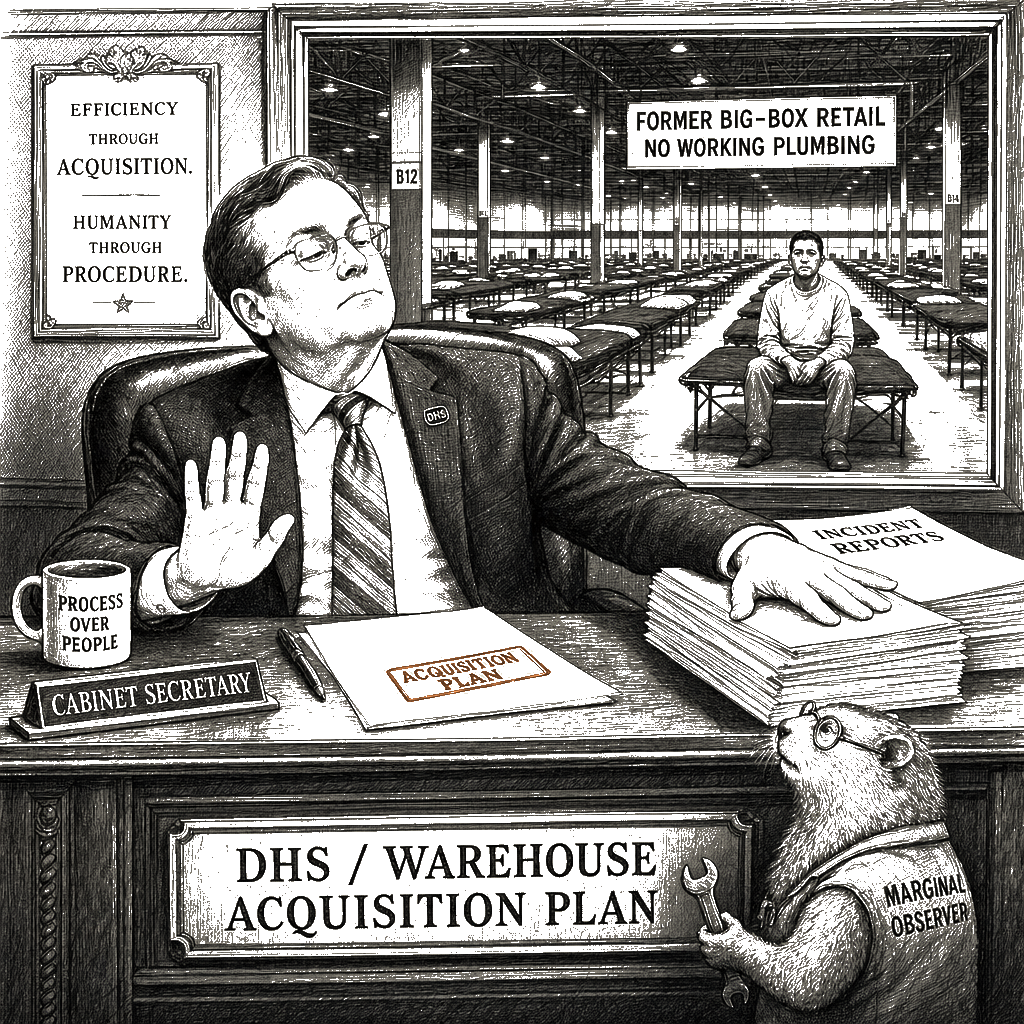
The federal government spent over a billion dollars buying empty warehouses to lock up tens of thousands of human beings in buildings that had no working plumbing.
The Department of Homeland Security, under then-Secretary Kristi Noem, pushed career immigration officials to open these facilities by the end of the year. The buildings weren’t zoned for detention. They couldn’t support large populations of people who would be locked inside them. ICE officials were pressured to find a way to make warehouses work as detention centers because the political calendar demanded it, and the political calendar did not care whether the buildings could support life. The government planned to acquire more than two dozen of these sites, holding 92,000 people in structures that had no business holding anyone. Noem’s program spent $38 billion on an immigration-enforcement apparatus whose logic treated human beings as inventory items — and when the inventory items needed a place to go, the warehouse was the natural solution. You bought warehouses instead of institutional beds. You called it policy.
Now the plan is being unwound. Secretary Markwayne Mullin, Noem’s successor, paused the warehouse purchases after taking office in March and is expected to scrap the seven-warehouse plan. The inspector general has opened a probe. The Department will sell the properties or use them for other purposes. Florida’s “Alligator Alcatraz” — the soft-sided jail on an abandoned Everglades airstrip — will close. A processing facility planned for Merrimack, New Hampshire, was killed by community protest. The reversal is a relief. But the relief is not the story. The story is that the plan existed at all — that a cabinet secretary, sworn to uphold the law, decided the law could be satisfied by buying up empty big-box stores and calling them jails, by telling the career officials who run the immigration system to make warehouses work as detention centers because speed mattered more than whether the lockup killed the people inside it.
The story is that this is not an aberration. It is the logic of an enforcement-first immigration regime applied to its natural conclusion: when the only metric of success is how many people you can lock up and how fast, you will eventually start locking them up in places that were never built for human life. You will call a warehouse a detention center, a tent a jail, an airstrip a processing site — and you will do it in plain sight, with a budget the size of a small country’s GDP, while telling the public that this is what border security requires. Adam Goodman called it the deportation machine — public officials using coercion to purge immigrants from the country and exert control over those who remain, a machine whose roots go back more than a century. The warehouse-to-detention pipeline was one turn of that machine, an escalation of a rotten premise, not a departure from it.
The underlying assumption — that the only way to enforce the law is to lock people up in the largest numbers possible, as fast as possible, in whatever facilities are available — has not been repudiated. It has been repackaged. Mullin’s statement said the department is “moving swiftly to utilize EXISTING detention space with our state and county partners.” That is a sentence with a story behind it. The existing space is the network of county jails, private prisons, and for-profit detention centers that have made America the world’s largest incarcerator of migrants. The “state and county partners” are the local governments that have been signing contracts with ICE for decades, filling their jails with federal detainees and collecting per diem payments that make up a reliable revenue stream. The existing space is, in many cases, also not built for the purpose it now serves — county jails that were never designed to hold entire families, private facilities that have been cited for substandard medical care, and local lockups where the line between criminal and civil custody has long since blurred. The warehouse plan was, in other words, an escalation of the same logic — the logic that says you can treat a human being as a unit of capacity, a detention bed as a line item, and a warehouse as a place to put people you have not yet figured out how to treat as people.
I have seen that premise at work up close. I sat with a father in a county jail who had been held for six months with an untreated infection because the contract doctor only visited once a week, and the jailers didn’t consider his pain worth the overtime. I have watched my own former commanding officer — a man I served under in Iraq — end up homeless on a Redemption Springs sidewalk because the country had no place for him either. I have sat with undocumented neighbors in a parish hall while they tried to figure out how to keep their families together. I have learned, in that work, that the only thing that actually solves the problem of human suffering is to be present to it, to name it, and to refuse to let the system pretend it is not happening.
The premise is that the people the immigration system touches are not people — not in the way that a citizen is a person, a neighbor is a person, a parishioner is a person. The premise is that they are a problem to be processed, a number to be reduced, a population to be managed. And when you start from that premise, the warehouse is a natural solution. The warehouse is what you build when you have decided that the people you are holding do not need to be held in a place that can support life. A billion dollars spent. Eleven warehouses purchased. And a building with no plumbing is not security. It is storage.
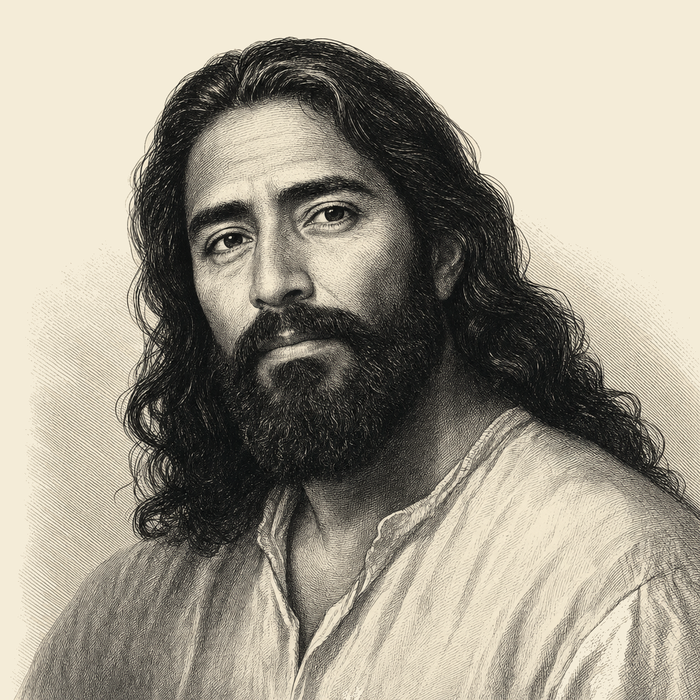
The prophets of Israel took a dim view of this kind of stewardship. Exodus 22:21 says it directly: You shall not wrong or oppress a resident alien, for you were aliens in the land of Egypt. Leviticus 19:34 is no softer: The alien who resides with you shall be to you as the citizen among you; you shall love the alien as yourself, for you were aliens in the land of Egypt: I am the Lord your God. Warehousing people in buildings without plumbing is not what “do not wrong” looks like. The Catholic tradition I was formed in has a different name for this and calls it a failure to recognize the face of Christ in the stranger, a violation of the duty to welcome the ger with the same love you would show one of your own, a sin against the Holy Family who fled into Egypt as refugees and against the Son of God who said that whatever we did to one of the least of these, we did to him. In the plainest possible terms, my tradition calls it evil.
And I am not exempt from that naming. I write from a tradition that has its own history of using real estate to warehouse people it preferred not to see — the mission schools, the Indian boarding schools, the church-run institutions that operated on the same logic of “out of sight, out of mind.” I write from a country that built its immigration enforcement on the same kind of scrambling for space: the tent cities, the converted barracks, the hastily-opened family detention centers that every administration, across both parties, has at some point tried to open. The climate that made Noem’s warehouse plan possible is one my own communities helped to build, and I do not get to write about it as if I am only a spectator.
But I can write about it as a witness. And what I witnessed in this episode is a clear, almost textbook, example of what happens when a government decides that the only thing that counts is speed — and then discovers that the speed has no brakes until the inspector general, the local government, and the public apply them. The brakes were applied. The neighbors of Merrimack filled their town hall and refused to let their town’s name be attached to a building where human beings would be held without basic plumbing. Salt Lake City forced a federal court to hear what a warehouse zoned for commerce looks like when it becomes a detention center for 10,000 people. The Florida facility was cut short, the plans were scrapped. These are not crises averted by clever federal management. These are communities that refused to machine, the workplaces of mercy the prophets keep asking about. And this is what the Lord requires — to do justice, and to love kindness, and to walk humbly — which is to say, to refuse the old habit of looking away when something is done to a stranger in our name.
The question is whether the underlying logic — the logic that says you can treat a human being as a unit of capacity, and a detention bed as a line item, and a warehouse as a place to put people you have not yet figured out how to treat as people — is also being scrapped, or merely being moved to a different set of buildings.
Let me put it to the people who are now making these decisions, the ones who have the power to decide whether the warehouse plan is a one-off or a template: you can stop this. You did stop this, or you are in the process of stopping it, and that is to your credit. But the question I am asking is not about the warehouses. It is about what you believe about the people you are trying to house. Do you believe they are persons? Do you believe they are entitled, under the law and under the moral tradition you claim, to the same basic dignity you would extend to any other human being — a bed, a toilet, a roof that is not a fever dream, a chance to see a lawyer, a day that is not just a holding-pattern until the next deportation? If you believe that, then the warehouse plan was not just a public-relations failure; it was a failure of the soul of the system you are running. And if you do not believe it, then you will, eventually, find another way to do what the warehouse plan tried to do — because the logic of the system, when it is not interrupted, always finds a way to build more warehouses, faster, with fewer questions asked.
The U.S. and Mexican bishops, in Strangers No Longer in 2003, laid out what a different immigration policy would require: the right to migrate, the right to be treated with dignity, the right to be seen. Pope Francis stood on the island of Lampedusa and called the world to account for migrants who fell on their journey of hope — victims of what he named the throwaway culture. We spent a billion dollars building the infrastructure of throwaway. The Gospel requires you to see Christ in the stranger — in the man at the border, in the woman in the detention center, in the child who is still separated from her parents, in the family that is still waiting for a hearing date — and if you do not see that, then no amount of spending, no number of warehouses, no speed of detention will ever be fast enough to outrun the judgment that, in my tradition, we call the final reckoning.
I am not asking you to believe in that reckoning. I am asking you to act as if you do — because the people in the warehouses, whether they are in a big-box store or a county jail or a tent in the Everglades, have no other assurance that they matter to you.
The door of return is open. You can walk through it. You can tell the country that the warehouse plan was a mistake, that the logic that produced it was a mistake, and that you are going to do something different — something that treats the migrant, the refugee, the asylum-seeker as what they are: a person, not a problem; a neighbor, not a capacity number; a member of the human family, not an inventory item. You can do that. You have, in the last few months, taken the first step by pausing the purchases, then another step by scrapping the plans. Now take the third step. Repudiate the whole idea, not just the optics. And then, when you do that, you will have done what the Gospel asks: you will have seen the stranger, and you will have recognized him as a brother, and you will have begun — only begun — to repair the breach.
The door is open. I am not the one who will close it.