
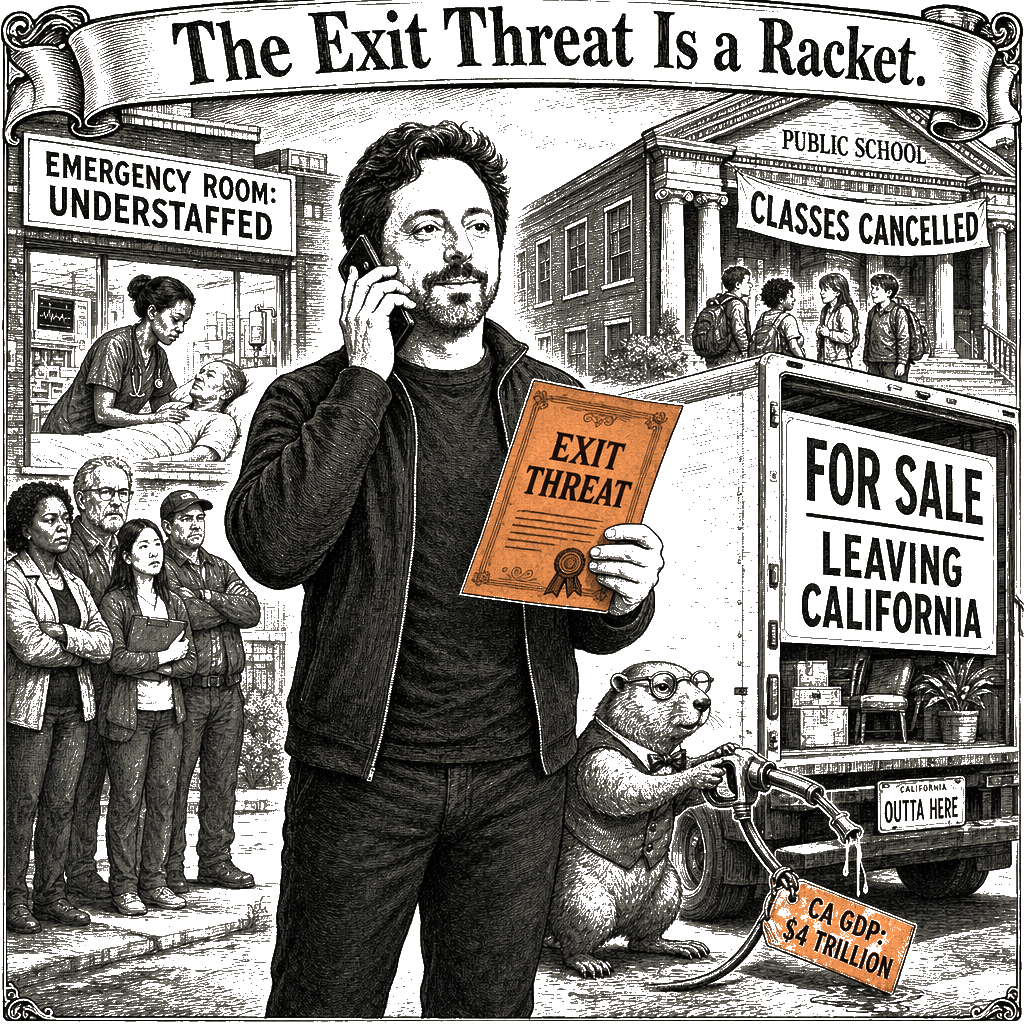
The richest state in the richest country on earth has the most billionaires, a GDP that would rank fourth globally if it were its own country, and a funding crisis so chronic it now needs a ballot initiative to staff its hospitals. The California Billionaire Tax Act — a political flashpoint since the unions first filed it in January — has collected enough signatures to make the November ballot. The billionaires are furious. Sergey Brin has already spent $82 million to kill it and says he’ll leave the state. Larry Page is cutting ties. Peter Thiel and others have poured millions more into the fight. Governor Newsom has vowed to block it from even reaching voters, telling the New York Times he’d “do what I have to do to protect the state.”
Good. That’s the tax working. The billionaires’ fury — the $82 million, the relocations, the governor’s veto threat — tells you they believe this would actually collect from them. Somewhere, the arithmetic is lying. It isn’t lying about the crisis. It’s lying about the cause — and both sides prefer it that way.
The proposal, backed by the Service Employees International Union–United Healthcare Workers West, would levy a one-time 5% charge on the net worth of any California resident above $1 billion — fortunes that have exploded during the AI boom — and direct the revenue to the state’s strained healthcare and education systems. The union says it’s about fairness. The billionaires say it’s about survival. Both sides are performing confidence. And both sides are changing the subject from the structural question underneath this entire spectacle: why the world’s fourth-largest economy — one that already has some of the most progressive income taxes in America — can’t keep the lights on in its schools and hospitals without staging a ballot-initiative fundraise every few years.
Start with the concession, because there is a real problem with this instrument and ignoring it would be the dishonest move. A one-time 5% tax on total net worth is a genuinely awkward piece of policy. Wealth, unlike income, is not sitting in a checking account. A tech founder worth ten billion holds that value almost entirely in company stock. A 5% tax means selling $500 million in shares — at once, all on the same day, with every other billionaire doing the same thing. You flood the market with the same asset class, you depress the price, and the thing you intended to tax evaporates a little on contact. Then the tax is spent, the hospitals get one good year, and the decade-long funding gap returns, still unmoved. You built no structure. You ran a bake sale.
And the concession extends further: a one-time liquidation tax on illiquid paper wealth simultaneously treats the problem as a permanent structural crisis — which it is — and prescribes a one-time windfall to address it, which it isn’t. That’s not solving a plumbing problem. That’s running a garden hose through a broken pipe and calling the house fixed.
So the concession is real. Now step back and look at what neither side wants to discuss. California already taxes the living daylight out of its wealthy residents. The top marginal income tax rate is 13.3%, the highest in America. Capital gains are taxed as ordinary income, not at the preferential federal rate. The state collects roughly $200 billion in revenue annually, give or take the market cycle. The problem isn’t that California doesn’t extract enough from its richest citizens. The problem is that the entire fiscal architecture was designed around extracting almost exclusively from the richest citizens — and then treating the resulting volatility as something that just happens.
Roughly half of California’s general fund income tax revenue comes from the top 1% of earners. When the stock market is up, everything’s flush; when it crashes, the state lurches into emergency cuts, hiring freezes, and, apparently, ballot initiatives to tax billionaires to fill the gap that the last market crash carved out. California isn’t revenue-poor. California is voluntarily addicted to a revenue base that evaporates every time the market hiccups — and then responds to each withdrawal crisis not by diversifying the supply, but by increasing the dose.
The billionaire tax would deepen the very dependency it’s supposed to fix. A one-time windfall from a hundred or so ultra-wealthy households would patch this year’s hole while leaving the underlying architecture — the one that makes California’s schools hostage to Silicon Valley’s stock price — entirely intact. The next time the market dips, which it will, the state will need another extraordinary extraction, from a colder political environment, from a slightly smaller pool of targets who have had four more years to restructure their holdings or relocate to Nevada. The cycle doesn’t break. It just ratchets.
Now push past the structural analysis and look at the politics — because the billionaire opposition is not principled policy objection. It is the oldest extortion play in the book. Brin’s $82 million to fight the tax is a protection racket organized in plain sight. The tech moguls threatening to leave California if a single bill passes are making the same move as every other extractionist: claiming the system is only viable when they are unthreatened, and only viable from where they are standing. It is the logic Amazon used to shake down cities for tax breaks. It is the logic NFL owners use to extract stadium subsidies. The only difference is the number of zeros on the demand.
And the infrastructure they’re threatening to abandon tells you everything about the quality of the threat. Move to Nevada if you must. Nevada has no income tax. Nevada also doesn’t have the University of California system that trained the engineers, the federal research grants that seeded the internet, the roads and courts and clean-water systems, the venture-capital networks, the port, the weather, or the network effects that made building a hundred-billion-dollar company possible in the first place. The threats are aspirational. The infrastructure they’re threatening to leave was built with revenue they’d rather not contribute to. The cost they’re trying not to pay does not disappear. It lands on everyone else. Silicon Valley executives have been threatening to decamp for Texas for decades; the Valley’s GDP kept growing anyway.
You do not spend $82 million and threaten to leave a state unless you genuinely fear the tax will pass and actually collect from you. Brin’s spending alone would buy an awful lot of textbooks and nursing instructors — a reasonable person might call that a wise investment in the workforce that made him rich. He seems to disagree.
This is hostage negotiation. The billionaires’ offer is simple: let us keep every dollar of the fortune we built on your public goods, or we walk. The proper response to that is the one the ballot initiative already gives them: fine. There’s a 5% exit fee. If some of them do leave, California keeps it on the way out and discovers whether the tech industry — with its talent pool, its universities, its venture networks, and its weather — actually depends on the presence of a few dozen people whose first instinct, when asked to contribute, is to call a moving van.
And then there’s Newsom — the state’s own governor, nominally the steward of the people this measure would fund, promising to block the very vote his constituents signed for. He will protect the state, he says. From what, exactly? From having to take a position his donors disapprove of? From the staggering inconvenience of asking whether the richest state’s richest people might fund the richest state’s public goods? No. He will protect the state from a badly designed tax. Fair enough. So where’s his well-designed alternative? What’s the permanent, durable, structurally sound California healthcare funding plan that doesn’t require an emergency ballot initiative and a war with Silicon Valley every fiscal cycle? His final budget does some structural work on fiscal management, but it doesn’t touch the underlying question: why does the sixth-largest economy in the world lurch between fiscal plenty and fiscal crisis like a country with one export crop?
Because the fiscal architecture is designed that way. And not by accident.
Here is what gets built instead. Not a one-time extraction timed to a political cycle — a permanent, structural institution that doesn’t care whether the stock market is up. California has 40 million people, more than most countries with universal healthcare. It has the GDP, the state capacity, and the institutional infrastructure to do something radical and permanent: dedicate a broad-based, permanent funding stream to healthcare and education that doesn’t ask more than it can reliably collect every year, and doesn’t evaporate when the NASDAQ dips.
The 2021 expanded Child Tax Credit is the proof of concept. America ran a near-universal, monthly, dead-simple cash benefit. Child poverty by the Supplemental Poverty Measure fell 46% in a single year — from 9.7% to 5.2% — as 2.9 million children were lifted out of poverty. We turned it on. Poverty fell. We turned it off. Poverty came back. That isn’t an aspiration. That’s a controlled experiment with a receipt. California’s healthcare and education funding crisis is the same story, writ larger and more chronic. The ballot initiative is the emergency bandage. The institution is what prevents the emergency. Build a dedicated healthcare trust. Broaden the tax base — yes, slightly, on everyone, not exclusively on a handful of paper billionaires — so the revenue doesn’t vanish when Wall Street does. Lock in the funding by statute so it isn’t hostage to the next election cycle or the next stock market dip.
The economy is a set of choices. Right now, California is choosing to fund its schools and hospitals like a country staging a telethon. The choice it’s aching to make — if anyone would walk it through the door — is the boring, permanent, structural one. That’s the one the billionaires aren’t scared of, because it doesn’t have the drama that makes them the villain. It’s also the one that actually fixes the pipe, instead of taxing the people who live above the leak and calling it plumbing.
November’s ballot will ask whether a hundred billionaires should pay once for a system that needs to run every day. A state that lets its wealthiest residents hold its public services hostage is not protecting its business climate. It’s negotiating with the arsonists. The real question isn’t whether the billionaires should pay — of course they should, and the 5% exit fee is the least of what they owe. It’s whether California will build a foundation, or keep staging a telethon every time the wind shifts.