
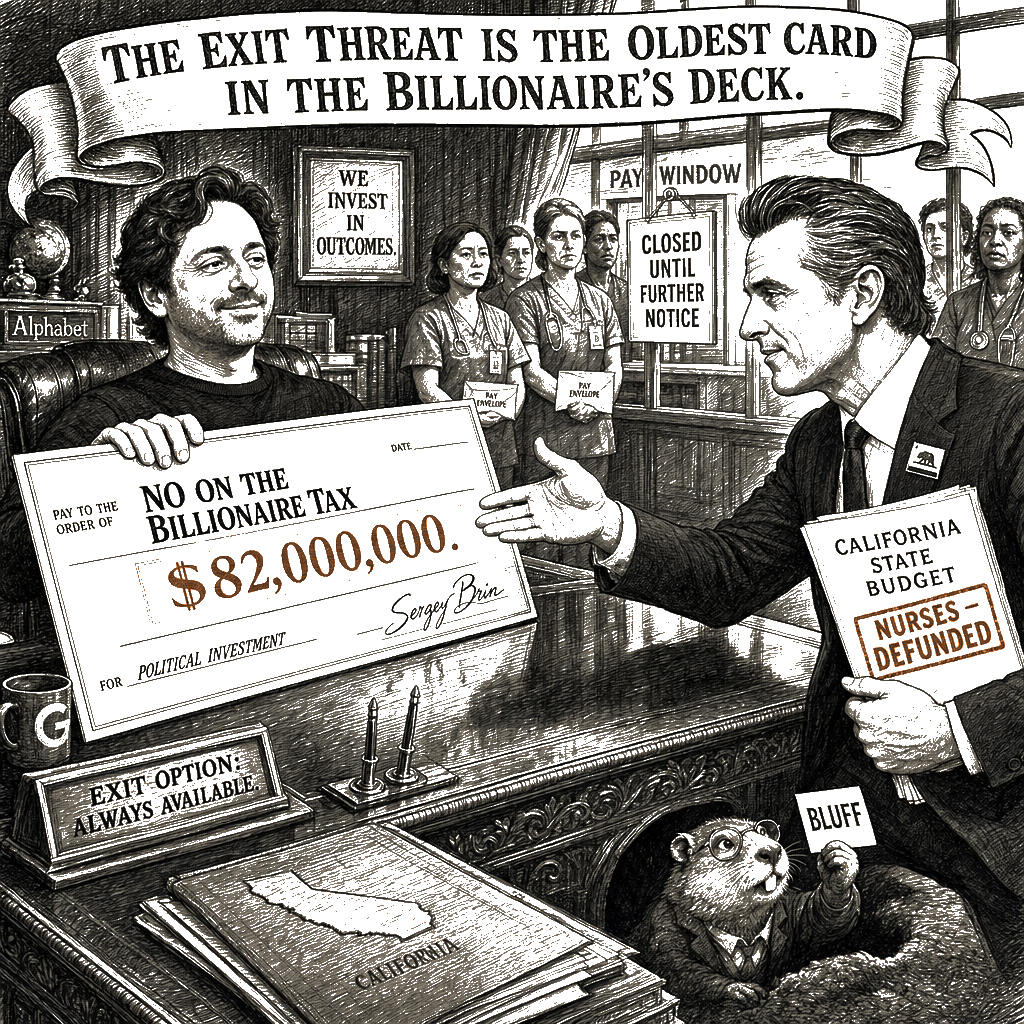
Sergey Brin has spent $82 million to crush a one-time 5 percent tax on California billionaires, and the governor is helping him — while the state cannot afford to pay its nurses. The California Billionaire Tax Act, a single 5 percent levy on any resident worth more than one billion dollars with the revenue earmarked for strained healthcare and education, is on track to qualify for the November ballot after the Service Employees International Union–United Healthcare Workers West gathered more than 874,000 signatures, despite months of tech moguls pouring unprecedented sums into the fight to kill it. Brin’s $82 million alone exceeds what a median Californian will earn in twenty years of work.
He did not spend it alone. The Google co-founder — worth north of one hundred billion dollars, most of it unrealized and therefore currently untaxed — is the largest donor to the opposition, but the exit-class has turned out in force. His Google co-founder Larry Page is arranging to cut ties with the state. The Palantir co-founder Peter Thiel, the crypto billionaire Chris Larsen, and the Ring founder James Siminoff have all written eight-figure checks. The message is not subtle: tax us, and we leave.
The exit threat is the oldest card in the billionaire’s deck, and it keeps working because the men playing it can afford to make it sound credible. States that have raised taxes on the very wealthy have watched their millionaire populations grow, not flee. The threat is a bluff that holds only because the people making it can afford to repeat it until the press treats it as settled fact. The actual leaving is optional. Sometimes they buy a house in another state for the tax residency. Their portfolios travel with them. The threat is the point — it extracts concessions from governments that need their campaign contributions and fear the headline of a departure.
Governor Gavin Newsom heard the message. He told the New York Times he would “do what I have to do to protect the state.” By “protect,” he means protect the billionaires from a tax that would take five cents of every dollar they hold above their first billion. The billionaires who built their fortunes on California’s publicly funded research, its educated workforce, its roads and ports and power grid — the same billionaires whose wealth ballooned during the artificial-intelligence boom — have informed the governor that they will decamp if asked to return a fraction of it, and the governor has agreed that this is a legitimate negotiating position.
He could have asked them where they plan to go. The mechanics of billionaire tax avoidance are not mysterious. The very rich hold their wealth as unrealized asset appreciation, which is never taxed until they sell. They live on low-interest loans collateralized by those assets — buy, borrow, die — and if they do die, the basis steps up and any remaining tax liability evaporates. The W-2 earner in Bakersfield pays taxes every paycheck. The billionaire in Atherton decides when and whether to pay at all. Leona Helmsley’s housekeeper testified under oath in 1989 that the hotelier had told her, “We don’t pay taxes; only the little people pay taxes.” Helmsley denied saying it, but the housekeeper was under oath, and the years since have not contradicted the housekeeper. ProPublica’s analysis of leaked IRS data in 2021 documented the arithmetic: the twenty-five richest Americans saw their collective wealth rise by $401 billion between 2014 and 2018 and paid $13.6 billion in federal income tax — a true tax rate of 3.4 percent. Warren Buffett paid 0.1 percent. Jeff Bezos paid zero in 2007 and again in 2011. Elon Musk paid nothing in 2018. The twenty-five reported a combined $158 million in wages — just 1.1 percent of their income. They were not cheating. They were obeying the rules as written, by people who wrote the rules with their interests in mind. The carried-interest loophole, which taxes private-equity managers’ fees at the capital-gains rate instead of ordinary income, has survived every Congress since roughly 2007 through a parade of bipartisan promises to close it, and Donald Trump called it “getting away with murder” in 2015 before signing a tax bill that left it intact.
The same brief is filed against every wealth tax anyone proposes — the threatened departure, the claims of economic ruin, the insistence that the very rich are a fragile resource that must be handled gently or they will shatter and blow away. Brin’s $82 million is not an argument. It is a down payment on a veto.
The voters of California have now been invited to decide whether they believe it. The backers have until June 25 to decide whether to press the advantage or strike a deal. Either way, the signatures are in. The billionaires are still here. The money for the nurses is not.