
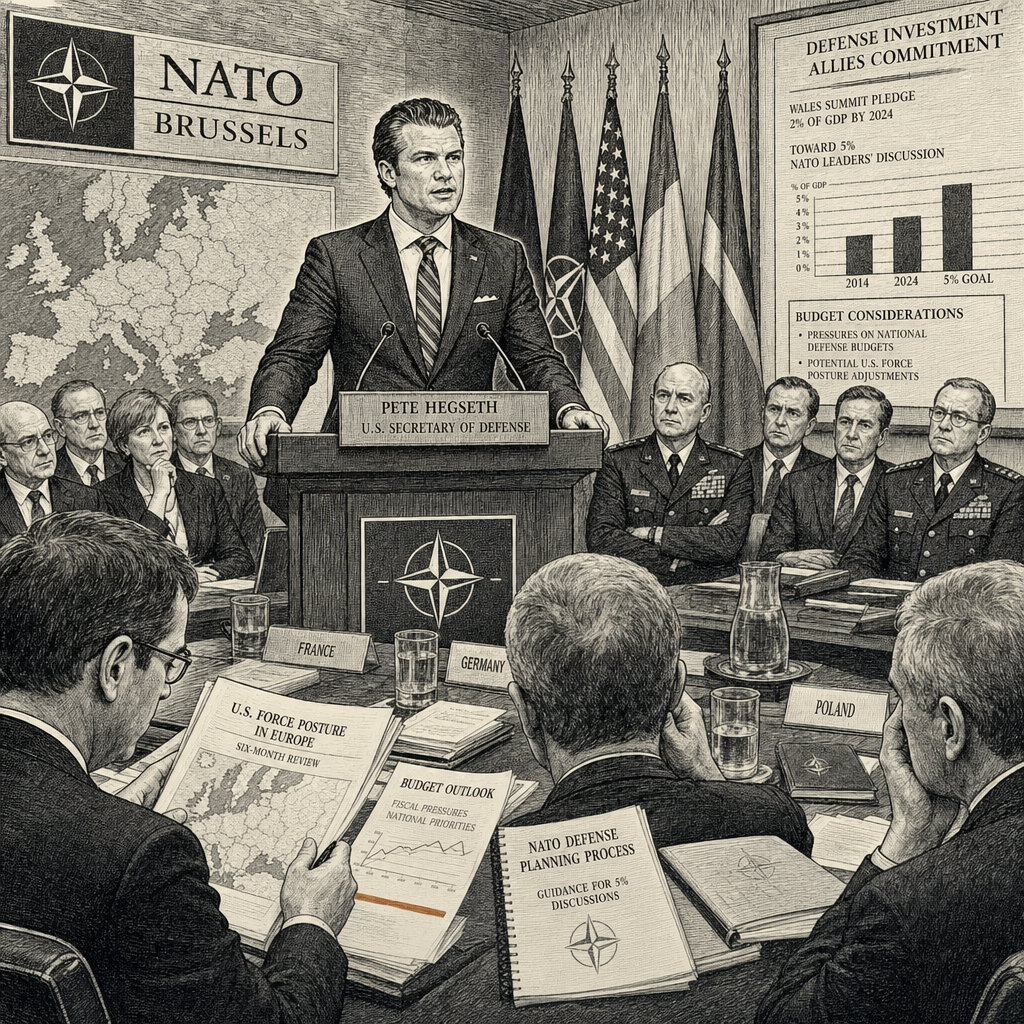
Trump and Hegseth are gambling with European lives to extort defense spending, and they are calling the dismantling a strategic review.
The defense secretary’s message at NATO headquarters Thursday was as reckless as it was blunt: pay five percent of GDP, or we will cut what we contribute and reduce the American forces that have kept the continent from burning for seventy-seven years. And to make sure nobody mistook the threat for idle talk, Hegseth announced a six-month assessment of every U.S. base, every rotational brigade, every ship and squadron earmarked for Europe’s defense. “Make no mistake about it—this will be a real review,” he said, as though the alliance‑burden‑sharing fights of the past decade were make‑believe. The Pentagon isn’t waiting for the review to conclude. NATO Secretary‑General Mark Rutte confirmed the same day that the reductions are already “immediate.”
The arithmetic of the demand is the first thing an honest citizen should examine. The administration wants allies to hit a target that no major European economy currently meets, and that most would need a generational reorientation of their budgets to approach. The United States itself spends roughly three and a half percent of its own GDP on defense, according to NATO’s own figures. The administration is demanding that smaller, poorer allies do what it hasn’t done itself, and it is using the threat of a weakened alliance as the lever. That is not burden‑sharing. That is a protection racket.
The cuts are already done. The Pentagon cancelled the deployment of an armored brigade to Poland. It cut back the air and naval forces earmarked for Europe in a crisis. Rutte’s confirmation only made public what commanders at Grafenwöhr and Powidz and Świętoszów already knew: the word “review” is political cover for changes that have already been executed. The six‑month assessment will ratify what the Pentagon has already put in motion, not evaluate whether the moves were wise. This is not strategy. It is destruction without a theory.
Barry Posen’s Restraint—the intellectual framework the administration claims as its own—argued for reducing forward commitments while maintaining the capability to respond if a regional hegemon emerged. A Posen‑consistent review would identify which U.S. forces stay in Europe to hold escalation dominance while allies build up. That review is not happening. What is happening is a drawdown that reduces U.S. escalation options to zero while the review clock ticks. The men stationed at those bases were deployed under alliance commitments that the administration is now tearing up, one cancellation at a time, while calling the process a review.
Clausewitz taught that war is a continuation of politics by other means, which means the political object of a military alliance is always the thing it is designed to prevent. For NATO, the object has been the same since 1949: to make the cost of aggression against any member so certain and so high that no rational adversary would pay it. The alliance works because an adversary in Moscow must calculate that an attack on Tallinn or Warsaw could bring the full weight of the United States to bear. What Hegseth is doing—and the president he serves is doing—is telling every potential adversary that the American commitment is now a negotiable line item, contingent on whether the Europeans have written a big enough check this quarter. Snyder’s work on alliance dilemmas—the twin fears of entrapment and abandonment that shape every military partnership—describes exactly the bind this creates. The United States is signaling abandonment while demanding its allies trust the process. No ally can rationally do both.
Eisenhower understood the difference. Before he was a president, he was the first Supreme Allied Commander of NATO, a man who had seen what happens when America stays home and Europe burns. He did not build the alliance so that a future administration could use it to collect dues. He built it so that the democracies could confront an adversary without any one of them standing alone. His farewell address warned of the “unwarranted influence” of the military‑industrial complex and called for an “alert and knowledgeable citizenry” to hold the apparatus accountable. He did not counsel the abandonment of the alliances that had held the line. The administration wields Eisenhower’s critique as license to dismantle the deterrent while the underlying threat—Russia’s war in Ukraine, the largest land war in Europe since 1945—has not diminished. The threat assessment has not changed. The political will to meet it has.
Stephen Walt’s balance‑of‑threat framework explains why the alliance persists. States balance threats, not power, and Russia—with an estimated four to five thousand nuclear warheads, a demonstrated willingness to invade its neighbors, and a defense‑industrial base running at wartime tempo—is a threat to every state on its western border. Poland, the Baltic states, Finland—these nations are not free‑riders. They are on the front line. Poland is spending north of four percent of GDP on defense, the highest rate in the alliance, and is buying Abrams tanks, F‑35s, Patriot batteries, and HIMARS from American manufacturers. Those purchases serve American defense‑industrial capacity and American strategic interests. Gutting the American commitment while Poland spends billions on American weapons is not a coherent position. It is an incoherence dressed in a talking point.
The administration’s demand for guaranteed base access and overflight rights—a “test” that allies “support America when we asked for their help,” in Hegseth’s words—reveals the deeper logic. The White House is not treating NATO as a standing alliance of democracies whose collective security is itself an American interest. It is treating it as a transactional arrangement in which the U.S. sells protection for cash on the barrelhead, and when a customer can’t pay, the protection is withdrawn. That is the logic of a landlord, not the logic of a statesman.
The senators who authorize the money see the danger. Thom Tillis, a Republican from North Carolina and member of the Armed Services Committee, cautioned Wednesday against further cuts and noted that European allies have made significant progress on spending. Jeanne Shaheen, a Democrat from New Hampshire, pointed to the Russia‑China‑North Korea axis and urged cooperation, not unilateral retrenchment. The committee has already inserted provisions in the 2027 defense spending bill to prevent further drawdowns. When senators from both parties are working to prevent the Defense Secretary from dismantling the force structure that Congress authorized and funded, the review is not a serious policy exercise. It is an end‑run around the people’s representatives.
The men I served with in Iraq didn’t deploy because someone in Warsaw had met a GDP target. They deployed because America had made a commitment, and allied basing and overflight made the mission possible—exactly the kind of support the administration now threatens to treat as a billable transaction. The message to every soldier, sailor, and airman still stationed in Europe is that their presence is contingent on a spreadsheet. That is not a strategy. It is an abdication.
The men and women stationed in Europe, the alliance commitments built over seventy‑five years of bipartisan investment, the deterrent that kept the Fulda Gap from becoming a killing field—all of it is being pulled apart by men who will not bear the cost.