
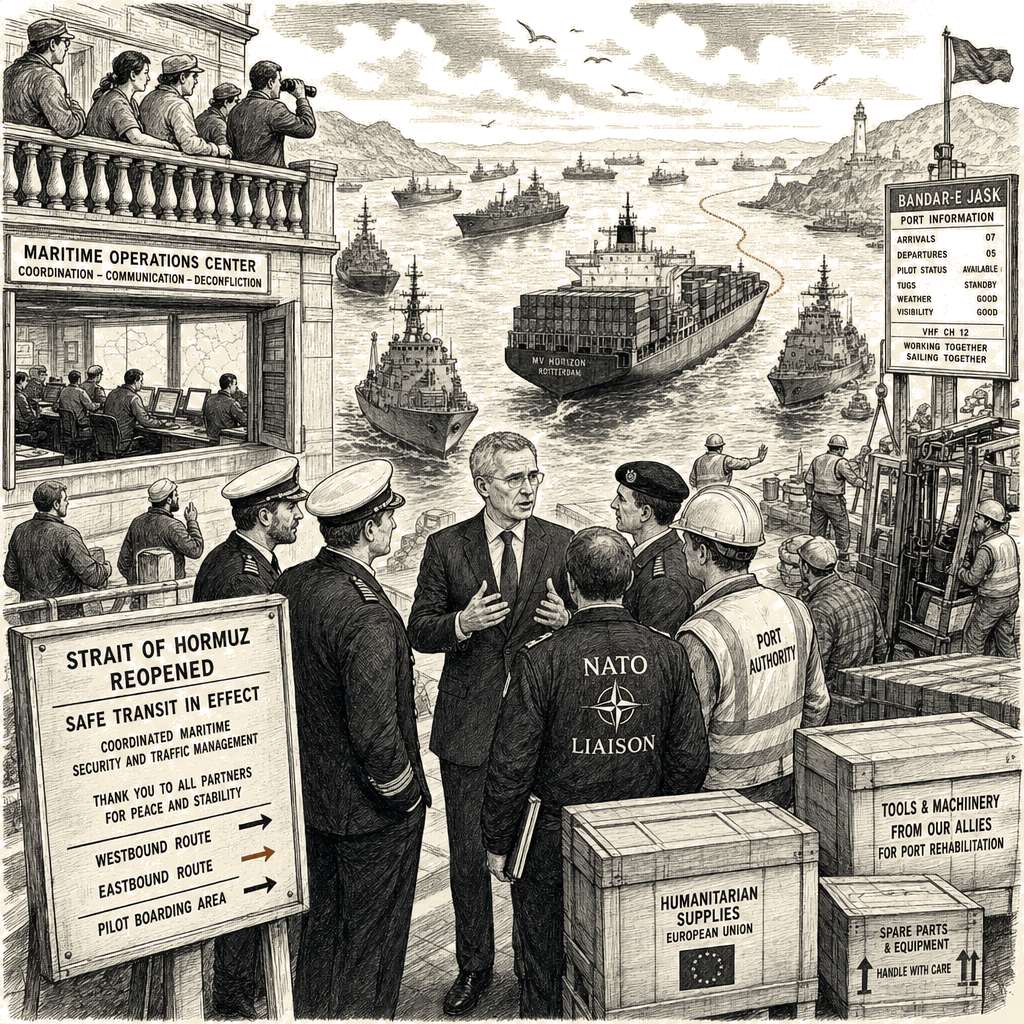
Rutte is committing European navies to enforce a deal nobody has read. The NATO Secretary‑General called it a “massive step forward” at his Wednesday press conference, saying allies are “ready to support” the resumption of shipping through the Strait of Hormuz—the narrow passage between Iran and Oman through which a fifth of the world’s oil moves daily. The deal’s actual terms have not been released. The signing is scheduled for Sunday. Rutte says the agreement “creates an opportunity to ensure that Iran never obtains a nuclear weapon” and will “improve security for everyone.” Translated into the register of the auto‑shop that has seen too many contracts signed without reading them, “everyone” means the oil companies whose tankers have been idling at anchor, the defense contractors whose frigates and interceptor missiles will now be requisitioned, and the political class that needs a cheap‑gasoline electorate to keep the discontent from boiling over.
Nowhere in Rutte’s remarks is there evidence that the alliance has reviewed the deal’s nuclear provisions, its verification architecture, its enforcement mechanisms, or its sunset clauses. The NATO Secretary‑General is blessing a document only the negotiators have seen and committing allied naval forces to the operational consequence: reopening a chokepoint whose closure has spiked global energy prices for months. The questions dominating this week’s G7 gathering suggest the alliance capitals share the same gap in information.
This is not burden‑sharing; it is the twin failure of Snyder’s alliance dilemmas arriving at once. Every military partnership, Snyder wrote, lives between entrapment and abandonment. What Rutte described is entrapment into a deal the alliance did not write, coupled with abandonment by the partner who did. The United States, the architect of the agreement, is scaling back its own forces in Europe and demanding that the Europeans carry more of the load. But the load the Europeans are being asked to carry is the enforcement of a secret that Washington handed them at the last minute, wrapped in the language of peace.
It will be said that European economies depend on that oil, and they do. Which is precisely why committing forces to enforce a bargain they cannot examine is not strategy but a surrender to fait accompli. If the deal’s nuclear terms are sound, they will survive public scrutiny. If they cannot be examined, the alliance has no business being the collection agency.
Thomas Schelling wrote that a commitment’s power lies in its credibility, and credibility depends on the willingness of the audience—the adversary, the ally, the domestic public—to believe it will hold. Rutte may be trying to speak the alliance into a binding position the text cannot supply. But Schelling also warned that commitments which collapse on contact with reality accelerate the abandonment they were meant to prevent. If the deal is revealed to be hollow, the navies will be left mid‑strait, defending a fiction, while the partner who authored the fiction is already winding down its own obligations.
Dwight Eisenhower, in his farewell address of January 17, 1961, warned of “unwarranted influence, whether sought or unsought, by the military‑industrial complex.” The present arrangement stands that warning on its head. Here, the defense establishment is not aggressively pushing for resources; it is being ordered to do more with less, to stretch its hulls and its people across another crisis, while the political class celebrates a deal it cannot explain to the citizens who will pay for the ships, the fuel, and the missiles. European defense budgets are rising toward the 2‑percent target set at the Wales Summit, but rising budgets without strategic autonomy produce not a stronger alliance but a contracting partner’s client state, armed with its patron’s weapons and charged with enforcing its patron’s unreadable diplomacy.
And what of the “peace” in this peace deal? Trump has been telling the press that Iran “no longer want a nuclear weapon,” and Rutte echoes that as an opportunity. The JCPOA, the nuclear agreement Trump shredded in 2018, had hundreds of pages of technical annexes, verification protocols, and publicly debated sunset provisions. This deal has a press conference and a Sunday signing, with the substance locked in a box whose key only the White House and Tehran hold. The gap is not a procedural footnote; it is the difference between an alliance that knows what it is ordering its sailors to risk their lives for and an alliance that is being told to trust the boss.
The sailors who will crew the British destroyers and the French frigates are not the children of the political class. They are the sons and daughters of the working towns that feed every volunteer military in the West—the same demographic that has shouldered every post‑9/11 deployment, the same recruitment pools where the strip‑mall recruiter’s office was the only path to the GI Bill. C.C.R. sang it straight a lifetime ago: the men sent to fight are not the men whose dads run for office. The frigate crews will be doing what allied navies have been doing in the Gulf for years: counter‑drone, counter‑missile, counter‑swarm, running intercepts against munitions that cost a fraction of what their own interceptors cost. They will be safe until the first drone gets through. Then they will be dead, and the memorial service will be covered by the local newspaper back home, and the politicians who committed them to the secret deal will find other things to talk about.
The alliance that has endured since 1949 deserves better than a secretary‑general blessing a document he has not read, because the country that wrote it told him the deal was good. The Strait of Hormuz will be open for Shell and BP and TotalEnergies, and the European taxpayer will absorb the bill, and the defense contractors will book the revenue, and the men and women on the escorts will be in harm’s way without a declared war, an authorizing AUMF, or a single member of Congress who will be able to name the ship that goes down first. That is what Andrew Bacevich has called the Washington rules—the permanent, bipartisan consensus that American and allied forces must be present everywhere, all the time, no matter the strategic cost or the constitutional evasion. In the summer of 2026, those rules look like a peace deal getting a standing ovation from the G7 while the human‑cost ledger adds another line it was never intended to close.