
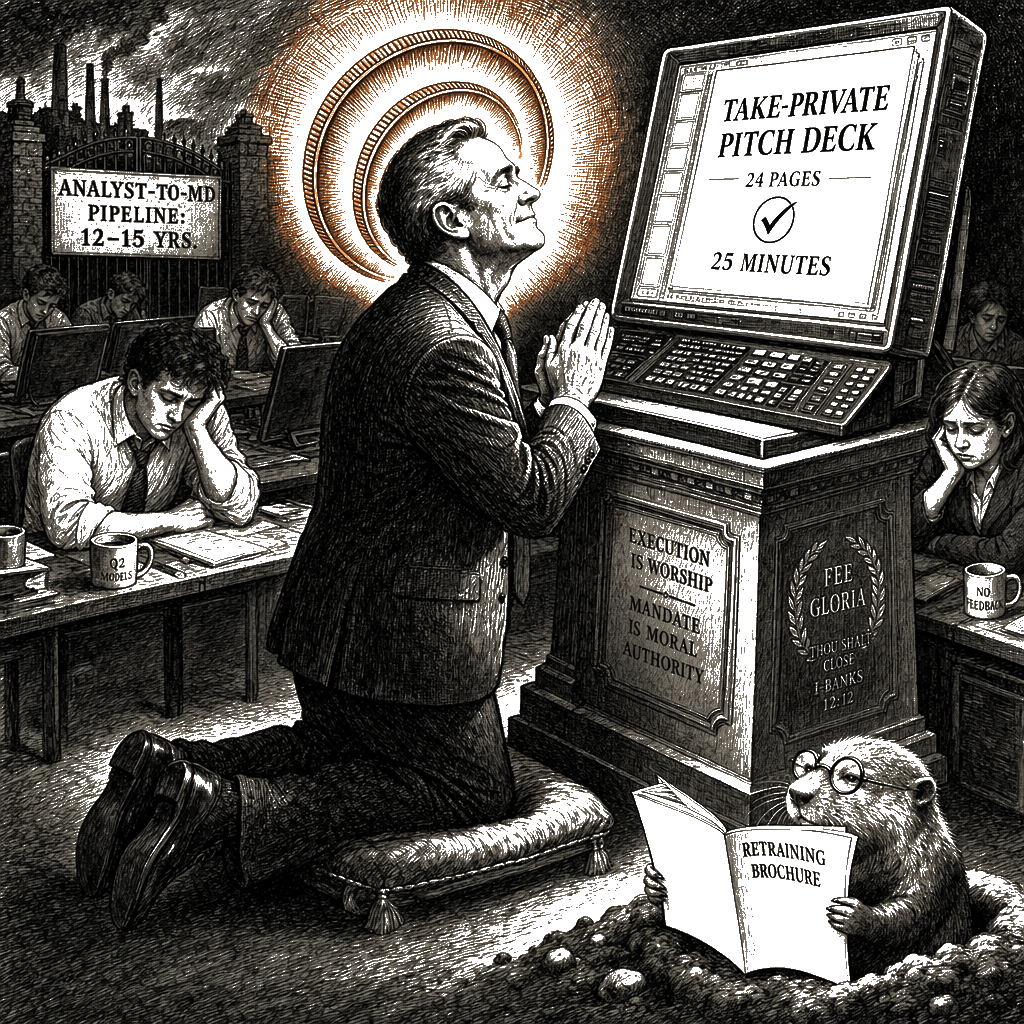
Rogo’s AI agent, Felix, built a twenty-four-page take-private pitch deck in twenty-five minutes — work that would have taken a team of junior analysts the better part of a day, probably two. Citi and JPMorgan investment bankers are already using it in production, not pilot. AI agents are drafting regulatory filings, running underwriting models, screening deal ideas. From a cost perspective, the logic is flawless: the bank has replaced a high-marginal-cost machine — the associate who must be paid and fed and sleep — with a low-marginal-cost machine that can produce the same output for almost nothing.
But the junior analyst performs two functions that are collapsed into one exhausted body working eighty-hour weeks, and the banks are treating the second as if it doesn’t exist. The first function is production: building models, formatting decks, running comparables. That is the work the AI can do. The second function is apprenticeship. The analyst learns, by doing the rote tasks, how to read a balance sheet, how to spot a risk, how to structure a deal — and, over years, how to become the person a client calls when the company is in play. The rote tasks are not valuable in themselves; they are the price of admission. When the price goes to zero, the gate closes.
Wall Street’s career pipeline for producing senior deal-makers is, at bottom, a guild. The junior analyst does the grunt work in exchange for access to the craft knowledge and client relationships the senior banker holds. The bank, in turn, extracts a share of the future rainmaker’s earnings as its return on the investment. AI breaks this structure not primarily by eliminating jobs — banks can, for now, reassign warm bodies — but by eliminating the only mechanism the industry has ever had for producing the people who make its products worth buying. A tool that produces a twenty-four-page deal book in twenty-five minutes does not make the analyst more productive. It makes the analyst unnecessary, and with her goes the ladder’s only bottom rung.
The executives are not lying when they say they don’t expect drastic headcount reductions in the next three years. Wells Fargo’s Charlie Scharf says his bank is “very actively thinking about: How do we retrain?” Citi wealth head Andy Sieg insists AI will “supercharge” advisers, not replace them. JPMorgan’s Jamie Dimon says displaced employees are being offered other roles. Standard Chartered’s Bill Winters, after projecting the technology would eliminate more than fifteen percent of back-office positions over four years, apologized for calling the targets “lower value human capital” — an apology landing with the specificity of a man who had said exactly what he meant and was told to take it back. An IntraFi survey finds two-thirds of bank executives expecting little staffing impact through the end of the decade. Even Gabriel Stengel, Rogo’s CEO, argues AI will encourage banks to hire more rank-and-file staff.
None of this is false for a three-year horizon. The damage lies farther out. The typical analyst-to-managing-director arc spans twelve to fifteen years. If the apprenticeship is hollowed out today — if the rote tasks that were the crucible are gone, and no replacement pathway exists — the first cohort of bankers who never built their own models, never sat through the all-nighters that taught them which numbers a client will actually sweat, will reach the threshold of senior leadership in the early to mid-2030s. That is when the talent drought arrives, and it arrives silently, because the current generation of rainmakers, still in place, masks the absence. The board won’t see it until the phone stops ringing for the next big mandate, and by then there is no quick fix. You cannot hire a senior relationship-banker off the shelf; the profession’s craft-knowledge has never been produced that way.
Part of what makes this moment disorienting is that the productivity gains are real, and they are concentrated in the divisions that produce the banks’ fattest margins. Clients are already using their own AI to generate the technical queries that used to distinguish a well-prepared pitch from a mediocre one, and to compare competing banks’ pitches side by side. The discipline runs in one direction. Economists are mostly agreed that AI will boost productivity; the open question is where the gains land, and every incentive in this structure points to the capital line. The AI does not have to do the job, as Cory Doctorow has argued; it has to convince management it can do the job, which is sufficient to extract concessions from the workforce that actually does it. The Citi wealth adviser “supercharged” by a Google AI agent bears the fiduciary and reputational risk for advice the model co-produces. The remaining junior analyst — the human who puts her name on Felix’s twenty-five-minute deal book — becomes what Doctorow calls a reverse-centaur: running at machine pace, accountable for machine-produced output, bearing the professional risk when the machine is wrong. The bank is not yet replacing analysts wholesale; it is restructuring the work so that fewer humans produce the same output, and calling the difference a productivity gain.
The retraining narrative is a placeholder for an institutional vacuum. Bilal Hafeez, head of strategy at Macro Hive, put the long-term forecast plainly: “AI means there will be less of a need to hire for traditional finance roles in the long run.” Standard Chartered’s already-announced cuts are a preview of the logic that will, eventually, eat into the front-office pipeline whether anyone admits it or not. The two-thirds of executives expecting little impact in the IntraFi survey are describing the lag between deploying the tool and restructuring the workforce around it. The same lag characterized every prior wave of financial-sector automation, from electronic trading to algorithmic risk management. The structural argument that productivity gains flow to capital rather than labor is not new, but what is specific to this instance is that the industry selling the retraining story is the same industry whose career structure depends on the work being automated. A managing director offering to retrain the analyst whose apprenticeship he just cancelled is not offering a transition. He is offering a story about a transition, which is cheaper — cheaper than a training budget, cheaper than a retention bonus, and cheaper than admitting the ladder is now missing the only rungs that taught anyone how to climb.
Jamie Dimon, with his usual bluntness, summarized the bind: “Certain things won’t change. You have to move money, raise money, send money, manage money. But everything else can change.” What he left out — what the industry’s entire executive class is, for the moment, working very hard not to say — is that “everything else” includes the institutional machinery that has produced every person who has ever known how to move, raise, send, and manage money well enough that the client, when it matters, calls. The machines can model. They can draft. They can screen. They cannot become the next partner, and the banks, by pretending this is a training problem, are deciding to discover the full cost of that gap only after it is too late to close it.