
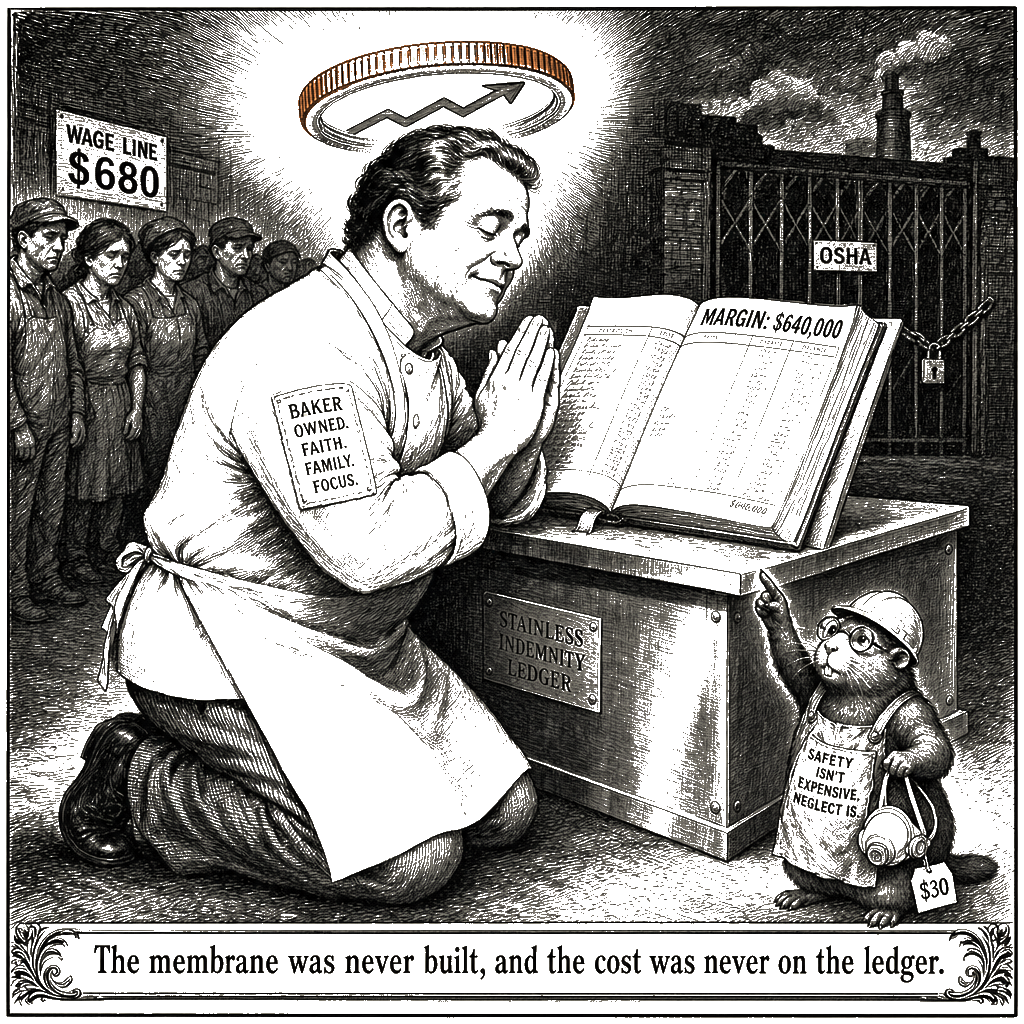
Thelma is a body on the mixing floor of the commercial bakery I own outside Bakersfield — she ran the industrial mixer, 60-quart bowl, egg powder blown in by the 50-pound sack, for a little over 3 years. Egg powder hangs in the air like a pollen you can taste. After about 18 months, Thelma started wheezing. By year two, her hands would swell when she cracked a whole egg for the wash. The solution is a thirty-dollar respirator — or a separate ventilation line that would run me about $8,000 to install. I bought neither. The Lord provided the eggs. He did not provide the mask.
James Freeman, in the Journal, is vexed that the FDA’s “egg police” have forced a Bay Area bagel shop to discontinue its egg bagels — a separate production line for egg-containing products is, the owner says, cost-prohibitive. Freeman calls it the regulatory Leviathan. I call it the most honest regulation I’ve ever ignored. I’ve never built a separate egg line in my life, and I run a commercial bakery outside Bakersfield that supplies the breakfast muffin your child ate this morning. The rule has never cost me a dollar. The body that enforces it has.
Walk the column with me. A thirty-dollar mask, replaced every few weeks — call it $360 a year. Over Thelma’s 3 years, $1,080. The separate line, eight thousand. On the other side, Thelma’s wages: $17 an hour, no health insurance. When she couldn’t breathe well enough to lift the sacks, I gave her one week’s severance and posted the position. The replacement walked in Tuesday. Total cost to keep Thelma safe: $1,080. Total cost to replace Thelma: one week’s pay, $680, plus 2 days of trailing the old one, two hundred seventy-two. So nine hundred fifty-two against one thousand eighty.
I saved $128, and the line never stopped.
Read those numbers once more. The safe choice costs more. So I made the other one. That’s not a slip. That’s the arithmetic, and it runs the same direction every time. The membrane between the allergen and the non-allergen across this operational day cost me exactly what it costs: nothing. The membrane I refuse to build is the membrane she carries in her own lungs until they won’t.
Now widen the frame. The FDA’s egg rule is the mask. It’s the regulator’s attempt to put a wall between the egg and the lung, the egg and the consumer’s throat. Freeman thinks the wall is stupid because it kills the egg bagel. I think the wall is irrelevant because it costs more than the body it’s supposed to protect. The figure Freeman’s source computes for dedicated separation — dedicated membrane, stainless scoops, single-batch water, color-coded containers, rotated batch testing — is nine-tenths of a cent per meal. Two million meals a year is $18,000 in membrane I refuse to construct. The margin on the same production is $640,000.
Hold those two numbers in view. Nine-tenths of a cent per unit was never going to appear on the supply side of my balance sheet. The separation where Thelma worked: nine-tenths of a cent per meal. The margin on the contract that awards me 32 cents per meal — $640,000 in operational yield across 2,000,000 units. She carried her own lungs. The membrane sat on nothing.
The cost I refuse: nine-tenths of a cent per meal.
The cost she absorbs: her airway, closing.
At 32 cents a meal — the margin I keep — that nine-tenths of a cent is the weight of the membrane’s refilling, folded back into the margin’s own rising. She carries the weight; I carry the margin. Read that one again. One figure appears on both our ledgers. One figure does not appear on mine. If it costs more to keep a Thelma breathing than to replace her, the rule will be evaded. It will be evaded by a shell company that reclassifies the mixer as a contractor. It will be evaded by a manager who buys the mask and locks it in a cabinet. It will be evaded because the cost of a pair of lungs is set by the market in human beings, and that market right now is clearing at $680.
The apostle Paul wrote to the Ephesians: “Slaves, obey your earthly masters with fear and trembling, in singleness of heart, as you would Christ.” He did not write, “Provide them a separate production line where the egg dust won’t reach.” He wrote obey. The distinction is the whole of my theology. The egg bagel was a sentiment — a taste preference for a particular chew and a particular golden color. Thelma’s lungs were a cost. The market priced them correctly, I kept the $128, and a woman named Thelma I haven’t thought about since Tuesday is now someone else’s wheeze in a different part of the Valley. The apron is the same. The powder is the same. The arithmetic doesn’t care about the name on the timecard, and I have never once found a reason to care either.
The membrane was never built. The most expensive thing on the line was the allergy — Thelma’s allergy — and the nine-tenths of a cent that would have separated it from yours. The FSMA — the Food Safety Modernization Act — was, for a time, a visibility mechanic, a membrane between institutional silence and bedside silence built not by regulators but by families across two centuries. It was the mechanism the bodies who were being poisoned demanded. I’ve pointed them toward it. The inspector never came back.
After that gap came institution silence. The last documented case I have from any regulatory officer’s inspection of my Bakersfield bakery is from 2014. That gap — the space between institutional silence and bedside silence, the membrane I never built — is not an oversight failure. It is the calculation functioning as designed year after year after year, and nothing that remains is going to interrupt it.
The membrane cost nine-tenths of a cent per meal. Thelma’s lungs cost $128 to keep — and I saved that hundred-twenty-eight by letting them go. Neither figure has ever appeared on my ledger.
The quarterly number on my Bakersfield operation is $640,000. The calculation is, on the whole, correct — and in its way, divine.
Sterling A. Varice holds the Hayek-Friedman Chair and serves as Dean of Instruction at Warden University’s College of Business and Economics in Richmond, Virginia. He is the author of three textbooks: Divine Mandates for Labor Utilization, Social Obligations for Profit Maximization, and Calibrated Deprivation: A Manager’s Guide to Employee Motivation.