
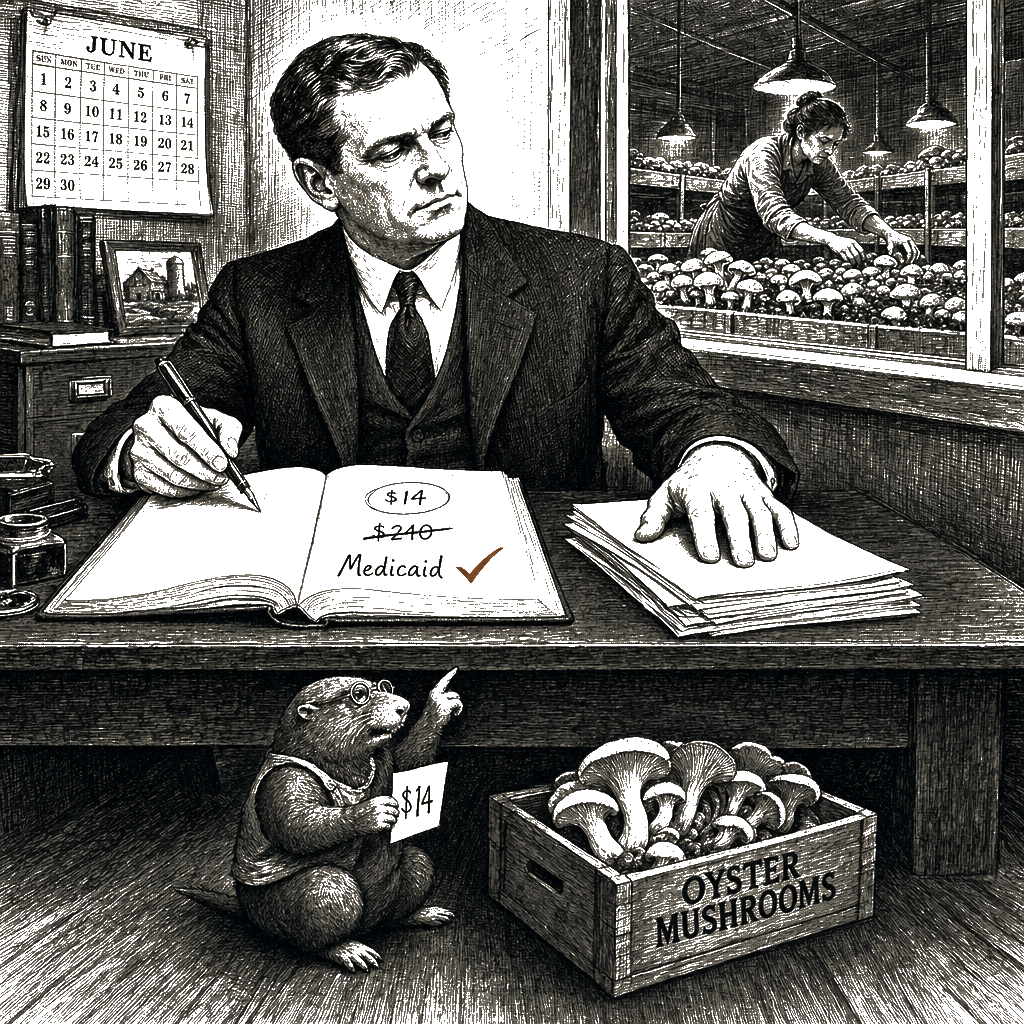
Reyna is a body on my mushroom picking line outside Kennett Square — born in San Luis Potosí, 28 now, 6 years bent at the waist in rooms where the air is thick with the chemicals I spray and the compost dust. Her knees went 2 years ago. Her back went last winter. I have designed the rate at which her body fails, and the rate is correct.
The respirator she needs costs $14. I thank God for the compost and the women who tend it. The mushrooms on your pizza tonight were picked by Reyna — in a room where the ventilation fan I disconnected in March would have cost $240 to repair. I have not repaired the fan. I have not purchased the respirator. The $14 stays in my account. That is the margin.
Gustavsson wrote in National Review this week that Andy Burnham — Britain’s new prime minister — is bad news for British business. He is right. He is also exactly one sentence short of the reason. Burnham subsidizes the bus fare. He builds the council house. He hands the worker the housing voucher. Gustavsson sees a cost. I see a structure I have already built in Pennsylvania. I will show you what Burnham built, because I built it first, and I built it cheaper.
The arrangement requires nothing of me except the decision not to spend. Reyna qualifies for Medicaid because her income is below the poverty line for a household of three — which is the line I designed my payroll to land on. She qualifies for the housing voucher that keeps her in the apartment I do not own. She qualifies for the SNAP card that feeds her between shifts. The state pays for Reyna’s body between shifts. I pay for the shifts.
You’re counting the way I count now. The alternative — paying Reyna a wage that covered her rent, her food, her healthcare — would cost me $4.60 an hour more than I currently pay. I haven’t done that.
Let me show you what Reyna earns.
Her piece rate is $0.013 per pound. The mushrooms she picks average 0.4 pounds each. Each mushroom earns her $0.0052. The respirator, prorated across Reyna’s expected tenure — 14 months, at the rate her body will fail under the conditions I have set — is $0.000076 per mushroom’s worth of her body. I keep $0.0052. The $14 is the smallest line item on the schedule of things I have decided not to buy.
The $14 is less than I paid for the wine at dinner last Wednesday. It is more than Reyna earns in an hour.
I keep it.
Now — Burnham.
Gustavsson’s panic is the panic of a man who’s never run the operation Burnham just made cheaper. The £2 bus fare, the council house programme, the Housing First placement — these are not burdens on British business. They are the cheapest labor contract on earth: the worker maintains herself on the public’s account, and I — my British counterpart — bill for the service she produces.
Widen the frame.
The British welfare state does not free the worker from the wage. It frees the employer from the maintenance cost. Burnham’s £2 fare means my British counterpart does not have to pay for the commute. His council house means my British counterpart does not have to pay for the housing. His Housing First placement means my British counterpart does not have to pay for the shelter the body needs between shifts. The state insures the workforce. The employer bills for the service. The subsidy is not a cost to business. The subsidy is the margin.
The £2 fare is visible — and a visible subsidy is a subsidy the voters might revoke. A perfect subsidy would be invisible. The £2 fare is visible. That is the only thing wrong with it.
The textbook on this is old. You’ll find the principle in a chapter on the potter and the clay — and in a different chapter on what men charge when they lease a body by the day.
“1.5 Reichsmarks per day for the children, noted in the requisition.”
That was the rate at which IG Farben leased children to do work that destroyed their bodies. He was pricing a different kind of body in a different kind of camp, but the arithmetic is the arithmetic. The maintenance cost is what the state subsidizes. The yield is what the employer keeps. Burnham’s council house is the British version of the ventilation fan I disconnected in March. Gustavsson is right that Burnham is bad for British business. He is wrong about why. Burnham is bad for British business because the subsidy is visible — because a £2 bus fare is the kind of thing a man can point at and call a cost, instead of what it actually is, which is the cheapest maintenance line item I have ever seen, and I have seen every one.
I am not an aberration. I need you to understand that, because the comfortable story is that I am — one bad man in one bad farm in one county in Pennsylvania, and if you find me and fine me and close me, the problem is solved. The problem is a textbook. Chapter Six: Social Obligations for Profit Maximization, the chapter on tenure as a mispriced liability. I wrote it. It is in its ninth printing. The man who priced the housing voucher your British counterpart receives read it in graduate school. The woman who set the bus fare at £2 instead of free quoted me in her margins without knowing it. I am not unusual. I am the standard.
Reyna picks eight mushrooms a minute. Her back goes. I replace her. There is another woman at the gate. The gate is always full.
I have eliminated the wages that would have bought the respirator. I have eliminated the wages that would have kept her back whole. The mushrooms are still cheap. Burnham’s version of this arithmetic is also working — which is why Gustavsson is in a panic. He thinks Burnham is the disease. Burnham is the cure I already administered in Kennett Square, and he is administering it at scale, with the public’s money, and calling it compassion.
I have not opened Reyna’s welfare file. I have not walked to the gate. The mushroom line is up. The arrangement is working. The mushrooms are tender. The arrangement produces what the arrangement produces.
I keep the $14. I will keep it again. The mushroom on your pizza is the receipt.
Sterling A. Varice holds the Hayek-Friedman Chair and serves as Dean of Instruction at Warden University’s College of Business and Economics in Richmond, Virginia. He is the author of three textbooks: Divine Mandates for Labor Utilization, Social Obligations for Profit Maximization, and Calibrated Deprivation: A Manager’s Guide to Employee Motivation.