
Della is a hand on the upholstery line of the furniture plant I own outside Tupelo. The sofa in your living room passed through her hands — the one you paid fourteen monthly installments for, the one the delivery team left in the hall because the stairwell was too tight. The toluene in the glue she breathes for the first 2 hours of every shift exceeds the limit I have instructed the shop not to compute. The respirator I do not buy her costs $17. I kept the $17. The WSJ reported this week that the administration’s new tariff schedule — tied to each country’s forced-labor statutes — is engineered to survive the legal challenge the last one could not. God blesses the tariff that doesn’t change what a hand breathes. The editors described the architecture. They did not name the man who collects the premium on it. Your sofa costs more now. Della breathes the same toluene.
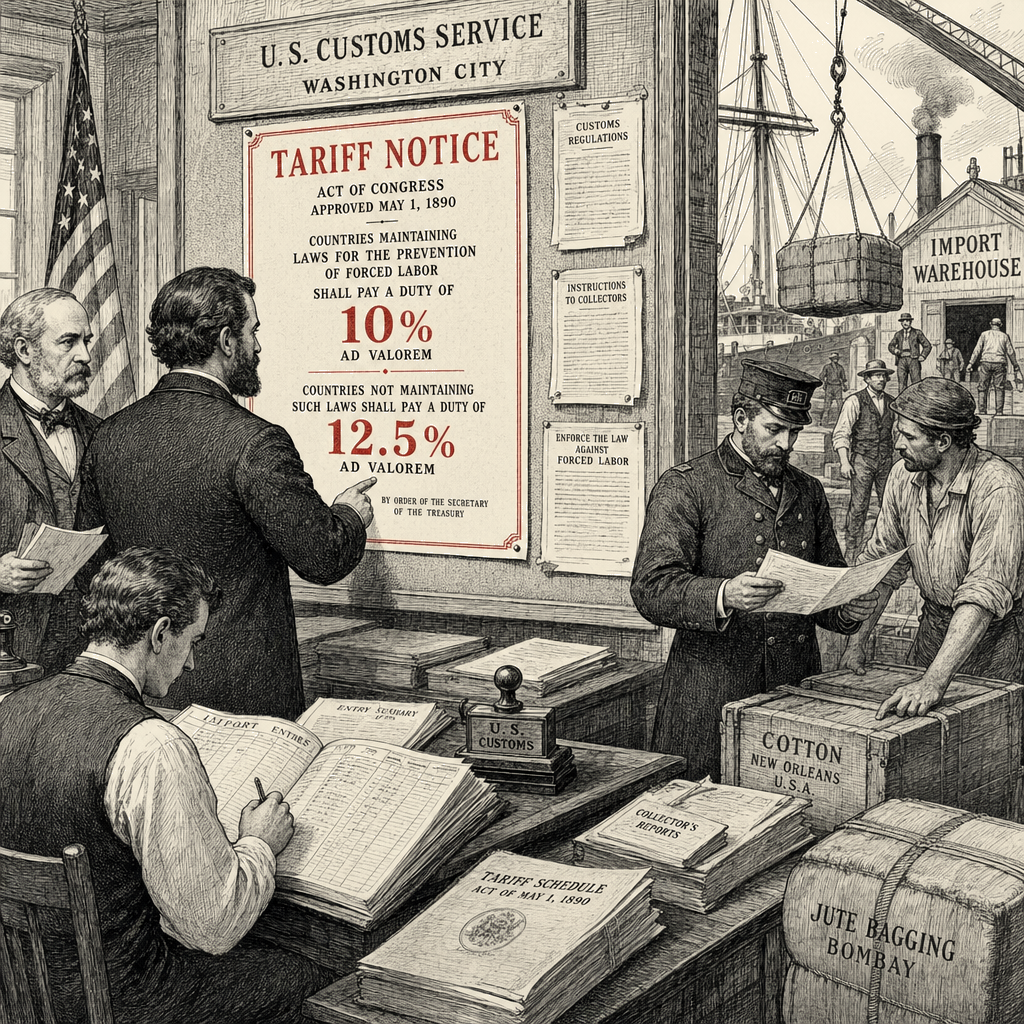
Here is where the number goes, and where Della does not. Countries with forced-labor laws: 10%. Countries without them: 12.5%. The differential — 2.5% — is the price of a stated national conscience. The Vietnamese sofa that used to undercut me by $62 now faces a premium of $47.50 per unit at my competitor’s dock. I raised my wholesale price by the full differential. I kept every cent of it. The wall between Della’s wage and your sofa is the tariff. The wall between Della’s lungs and the respirator is $17. The two walls are the same structure, at different addresses.
Now Della’s hands. The upholstery tacker she works requires a grip-and-release motion, 14 per cushion, 12 cushions per shift, 5 shifts a week, 50 weeks a year. The ergonomics consultant I did not hire in 2018 projected a 68% probability of early-onset carpal tunnel at year 11. Della is in year 12. She bought her own brace. The brace costs $14. The tariff on a single sofa covers the brace for four and a half years. I kept the premium.
Trey builds the armature the upholstery covers — same floor, same wall, a different joint the tariff protects. The pneumatic stapler he runs every 90 seconds for 10 hours had its trigger guard removed by the previous shift to increase cycling speed — a $7 part I can amortize at $0.07 per frame. I did not buy it. Trey’s right hand has a fine tremor now. The nail gun does not need a steady hand; it only needs a hand that will keep firing, and Trey’s will do that for a few more years. The tariff on the imported competitor’s frame arrives at my loading dock as a premium. Trey’s tremor arrives at the same dock at no cost to me.
Now the altitude, because the case is the principle, and the principle has a pedigree.
The administration has spent months certifying this very tariff schedule, matching duty rates to each country’s score on the forced-labor registry. The editorial pages have praised the legal craftsmanship. The craftsmanship is the point. The tariff creates a price umbrella under which a domestic producer raises his prices by the exact differential and keeps
Sterling A. Varice holds the Hayek-Friedman Chair and serves as Dean of Instruction at Warden University’s College of Business and Economics in Richmond, Virginia. He is the author of three textbooks: Divine Mandates for Labor Utilization, Social Obligations for Profit Maximization, and Calibrated Deprivation: A Manager’s Guide to Employee Motivation.