Dottie is a hand on the cold-plate line of the thermal-fabrication plant I own outside Allentown, and I’m proud to say I’ve reduced her pension liability to a market fluctuation. She builds the cooling units that keep the chips in your phone from cooking themselves. Her fingers won’t open flat for about 20 minutes after she clocks out. She calls it “the claw.” I call it a throughput cost. You bought the phone. You paid for the stream she made possible. The brace cost $14. I refused it. The Lord provides.
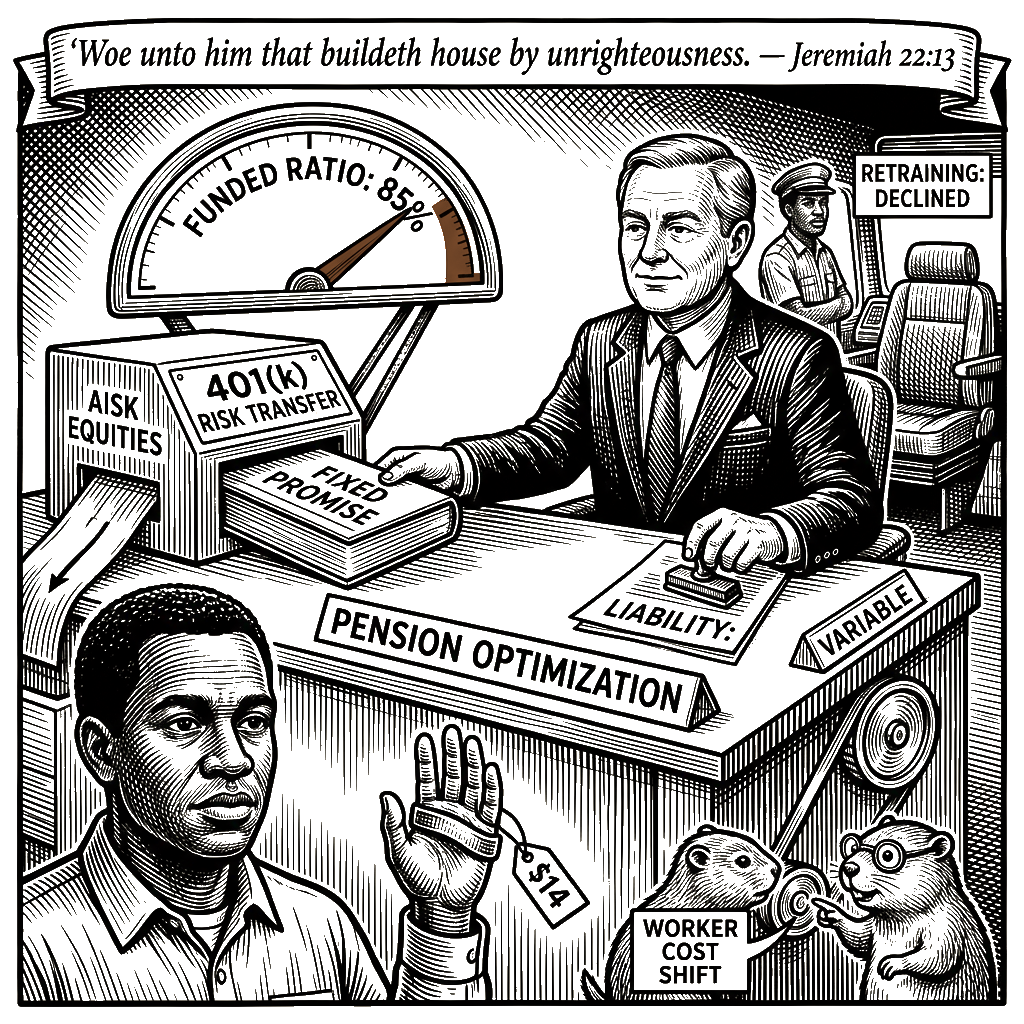
The Wall Street Journal editorial says the AI boom has lifted public-pension funding to 85%, the highest level since 2007. The Nasdaq has risen 21% in a year and 71% over 5 years. Roughly 8% to 10% of public-pension assets sit in AI-related equities. The returns are real. The number is beautiful. I agree with the alarming part: a rising market can make an obligation look healthy. Let me show you what purchased the health.
Dottie earns $21.40 an hour. I keep $0.0011 on each cooling unit. That’s the margin I chose over the brace. Not a grand moral calculation. A subtraction. The $14 stayed with me, and her hand closed badly instead.
Her pension promises $1,900 a month for the rest of her life. That’s a defined benefit, which is a fixed promise on my books. I don’t keep fixed promises if I can help it. I convert them. I move Dottie into a 401(k), give her a menu of funds, and let the market set the value. If the market falls 30%, her account falls 30%. My liability is gone.
I haven’t broken anything. I’ve moved the promise onto a surface that moves.
Good. You’re counting.
A defined-benefit pension is a fixed cost that sits on me. A 401(k) is a variable cost that sits on someone who can’t sell it, can’t hedge it, and wasn’t in the room when the decision was made. The risk hasn’t disappeared. It has relocated to the person least able to price it. That isn’t a flaw in the design. That is the design.
Dottie’s pension owns stock in the company that makes the chip she cools. The return on that stock helps push the funding ratio toward 85%. She cools the asset that strengthens the promise I’m trying to shed. Her hand makes the investment look sound. I keep the margin.
$0.0011.
That’s what her claw is worth to me. The brace is $14. The difference is mine.
Now take the same principle to the road. Emmett drove Route 12 for 38 years in an autonomous-transit operation I own. He knew every pothole, every shelter where the roof leaked, every stop where the streetlight had been out since October. He knew where a passenger might need an extra minute. The automated bus doesn’t need to know these things. It reads the road the way a ledger reads a column.
I removed Emmett and 33 other overnight drivers in January. Their shifts were absorbed by lidar arrays and a software update. The retraining course would have cost $4,200, followed by $18.50 an hour for 12 weeks of supervised transition. I declined it.
I kept $1.28 per trip.
Not per hour. Per trip.
The $1.28 won every morning on every route. The man standing in the cold at 4:15 a.m. did not. You pay for the pension fund that loses his contribution, the retraining he didn’t receive, and the public systems that carry him after I’ve finished with him. I keep the saving. Thank you for your business.
The current employer contribution is 31.8 cents for every dollar of worker compensation. Government employers pay that rate today. I carried it for 34 drivers who ran overnight routes through rain and darkness. I carry it for zero of them on those routes now. The saving has been redirected toward the fund’s asset allocation, which has performed well in AI-linked equities.
The fund is healthier.
The obligation is gone.
That’s less eligibility with a routing algorithm. Make the man dispensable, and the numbers describing his absence begin to look like progress.
The English named the principle in 1834. Relief had to be made less desirable than the condition of the lowest-paid independent laborer. Make the dependent person’s life worse than the poorest free worker’s, and any job begins to resemble mercy. I’ve spent 30 years perfecting the method. First I make the promise variable. Then I make the person replaceable. Then I point to the improved ratio.
The pension board is noble pottery. Dottie and Emmett are common use. Romans 9:21 supplied the classification long before I supplied the software.
“Woe unto him that buildeth his house by unrighteousness, and his chambers by wrong; that useth his neighbour’s service without wages, and giveth him not for his work.”
— Jeremiah 22:13, King James Version
The prophet was addressing a builder. I’m addressing a pension committee. The vocabulary has improved. The worker has not.
Taxpayers now pay 31.8 cents of every payroll dollar toward pension obligations, triple the amount in 2001. Those promises were made when the balance sheet looked worse. The AI boom has made the ratio look sustainable. Without the boom, the number becomes a bill I would rather not pay. So I remove the wages that sustained the pension base, cite the investment return as proof the pension is sound, and call the resulting gap innovation.
I’m telling you this for your own good. Don’t confuse a funded ratio with a funded life.
I conducted a seminar on pension-funded workforce optimization in March. Fourteen administrators attended: transit authorities, municipal pension boards, a state retirement system. I walked them through the model. Cut the human contribution. Redirect the savings to the asset side. Let AI-equity returns fill the gap. One administrator implemented it on her overnight routes. Her funding ratio improved 3 points in a quarter. She sent me a note. I keep it in my desk.
It’s the finest correspondence I’ve received.
I’m not unusual. I’m a curriculum.
I’ve taught managers for 30 years how to convert obligations into exposures, exposures into someone else’s problem, and someone else’s problem into a healthy quarterly number. My graduates set your contribution rates. They price your liability assumptions. They decide which routes are optimized and which workers are retained. The best of them run the subtraction faster than I do, and I say that with genuine pride.
One of them priced your job.
The system is older than the software. Cato put the old slave, the sickly slave, the old wagon, and the worn iron tools in one disposal list. The workhouse made hunger an employment policy. The pension board makes market exposure a retirement policy. The instrument changes. The body remains the balance-sheet assumption.
I am not correcting history. I am updating it.
I’m told the pension model carries a sensitivity to an AI-equity correction. If the Nasdaq contracts, the funding ratio contracts with it, and the 31.8 cents returns as an obligation with no offset. The route still needs a driver. Dottie’s hand still needs a brace. The fund still needs a contribution. The promise will come due in the same currency it always did: somebody’s remaining years.
I haven’t modeled that scenario.
The actuary assures me the assumptions are sound, and I’ve chosen to trust him. The fund performed. The route ran. Dottie’s line is full again at 6. Her claw will release eventually, or someone else’s will form. The chip will stay cool. The hands that build the cooling will never afford the machine they cool.
The funding ratio is 85%.
My department is the ratio.
The ratio is 85%.
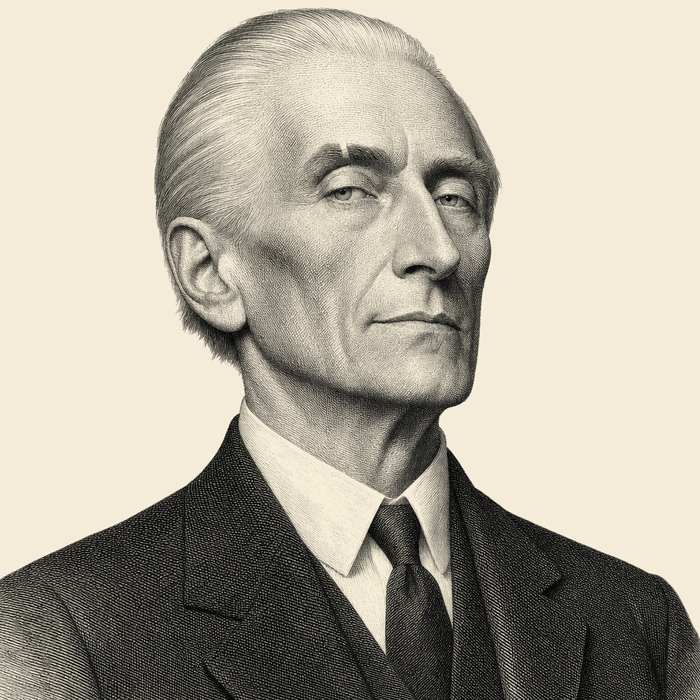
Sterling A. Varice holds the Hayek-Friedman Chair and serves as Dean of Instruction at Warden University’s College of Business and Economics in Richmond, Virginia. He is the author of three textbooks: Divine Mandates for Labor Utilization, Social Obligations for Profit Maximization, and Calibrated Deprivation: A Manager’s Guide to Employee Motivation.