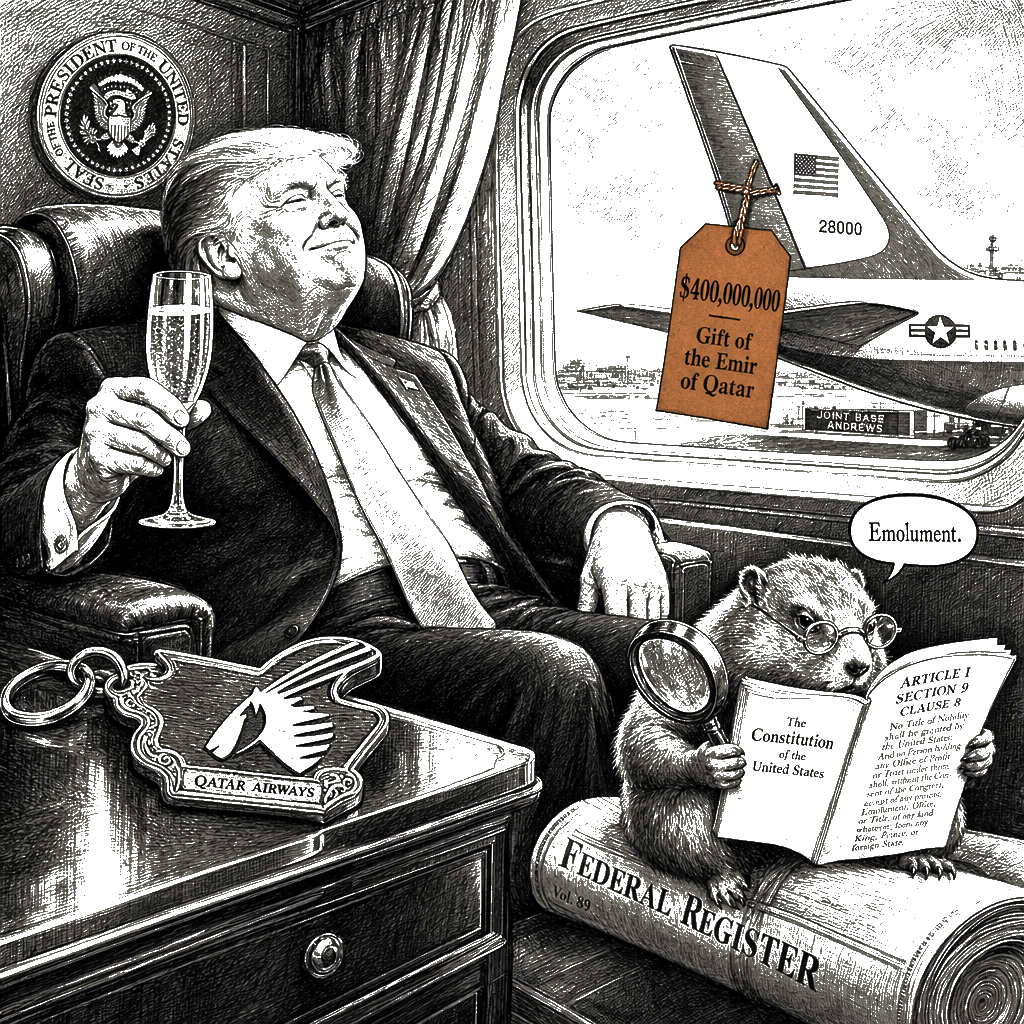
Donald Trump is flying a $400 million luxury jet given to him by the ruling emir of Qatar. The new Air Force One, unveiled Friday at Joint Base Andrews, is a converted Qatari 747-8. It was not built for the United States. It was not paid for by the United States. It was a personal gift from a foreign potentate to a sitting American president. The transaction is so flagrantly corrupt that the gift-restriction regime Congress built to wall off foreign tribute has been reduced to a decorative slogan the administration simply ignores.
Now, I’m just a simple man who runs an auto shop in Georgia, but I know what it costs to hand someone the keys to your rig. It means they can drive it wherever they want. And when the man accepting the keys is the President of the United States and the hand offering them belongs to a foreign monarchy in the Persian Gulf, the transaction is not a gift. It is a debt.
The old Air Force One 747-200 that carried presidents for thirty-three years has been retired, and in its place sits an aircraft that carries the livery of the United States but bears the obligation of a foreign prince. The Air Force confirmed months ago that the modified Qatari 747 would enter service, and the President stood in the hangar describing it as “the world’s most luxurious plane.” The emphasis tells you what matters to the man holding the title.
There is a law about this. There is a clause in the Constitution about this. And there is a warning from the most credentialed military leader this country ever produced about what happens when citizens stop paying attention to these things.
Start with the law. The Gifts and Decorations from Foreign Governments Act, codified in 5 U.S.C. § 7342, limits gifts from foreign governments to $50 in a single calendar year unless Congress consents or the gift is a decoration of negligible value. Four hundred million dollars is a long walk past $50. The administration has argued that Qatar offered the airplane to the Department of Defense, not to the President personally, which means sundry legal memoranda have been generated to say this is different. It is not different. The airplane is being modified to serve as the President’s personal aircraft for global travel. The man who benefits is the man who accepted.
The federal bribery statute, 18 U.S.C. § 201, prohibits any public official from demanding or receiving anything of value in return for being influenced in an official act. The Emoluments Clause of the Constitution — Article I, Section 9, Clause 8 — prohibits any person holding office of profit or trust under the United States from accepting any present, emolument, office, or title from any king, prince, or foreign state without the consent of Congress. The word emolument means any profit, gain, or advantage. Qatar is a monarchy. The clause exists for exactly this situation. The framers did not write this provision because they were naive about the costs. They wrote it because they understood what happened in Europe when foreign powers purchased influence over heads of state. A $400 million aircraft is not a flag pin or a ceremonial sword. It is a very large piece of hardware that will carry American decision-makers into foreign airfields, over foreign territory, and — critically — it will be serviced, maintained, inspected, and known in its every specification by the government that built its configuration and the services that will work on it for the life of the airframe.
The Constitution does not ask how much. It asks from whom. And the answer here is: from the ruler of a small, strategically-positioned Gulf monarchy with energy interests, military-basing agreements, and a documented history of playing multiple strategic relationships simultaneously. There is no paragraph that says a President may accept anything of any value from a foreign king as long as the airplane has nice carpet.
The prior Air Force One replacement program was a Boeing program — American workers, American supply chains, American specifications. It was behind schedule and over budget, which is a legitimate problem and one the procurement community has documented across many weapons platforms. The solution was not to hand the job to a foreign government. The solution was to fix the program. When a part doesn’t show up on time in the shop, you don’t solve the problem by letting the guy who wants your accounts front you the inventory for free. You fix your supply line. Because once you owe him, he doesn’t need to fight you for the business. He already has it.
Eisenhower warned of exactly this kind of thing — not precisely, but structurally — in his farewell address of January 17, 1961. Paragraph 24: “In the councils of government, we must guard against the acquisition of unwarranted influence, whether sought or unsought, by the military-industrial complex.” He added, a line later, that the danger “will persist.” He was not speaking about a foreign government’s airplane in a hangar at Andrews. He was speaking about the structures that allow powerful interests to gain purchase on the machinery of the state. The structures Eisenhower named were domestic. The mechanism is the same when the interest is foreign and the asset is an airplane worth more than most American towns will spend on their schools in my lifetime.
Andrew Bacevich, in The Limits of Power, argued that the hunger for ever-expanding military capability has become self-sustaining, disconnected from any achievable political purpose. A country that cannot build its own presidential aircraft on time — and I’ll concede the Boeing program gave reasons for frustration — has a problem worth solving with American money and American hands. A country that solves the problem by accepting a gift from a foreign monarchy has walked past the problem into territory the Constitution was built to prevent. That is the disconnection Bacevich described — capability untethered from purpose, the shortcut mistaken for strategy.
The dollar figure is not the only measure of the offense, but it is not incidental. Four hundred million dollars is more than the entire annual budget of the National Endowment for the Arts. For the cost of that single aircraft — which will fly exactly one passenger at a time in the luxury of a Qatar Airways first-class cabin — the VA could, by conservative estimates, have hired and trained more than a thousand additional mental-health counselors, fully staffed and deployed to the veterans’ medical centers where the post-9/11 cohort is still waiting for care. I have seen those centers. When I was in the Abrams crew, the promise was that the country would take care of the people it sent to war. The plane is a monument to a presidency that takes care of itself, paid for by a sheikh who has no more claim on American foreign policy than his last wire transfer will buy.
The White House will say the aircraft is government property now, that everything was lawful, that other administrations have accepted foreign courtesies. They will point to the Air Force paint job and the formal transfer paperwork as though those things answer the charge. They do not. The question is not whether the lawyers found a statutory loophole that lets the president accept a foreign oligarch’s jet without going to prison. The question is whether the man who holds the office believes the office belongs to him, and whether the rest of the government believes it too. That question is now answered. The plane is in the hangar. The emir’s name is on the receipt.
What he bought is not a mystery: continued base access, arms sales, energy leverage, and an American president who flies in a debt that cannot be paid off in cash. Doha’s interests are concrete: the continued operation of Al Udeid Air Base, the largest American military installation in the region; the sale of advanced fighter aircraft, likely the F-35, which Qatar has pursued for years; and long-term liquefied-natural-gas export agreements that depend on Washington’s goodwill in a neighborhood where Qatar’s gas fields sit between Saudi Arabia and Iran. The emir did not donate the plane to the United States out of disinterested affection. He bought a piece of the presidency, and the president took it with a handshake.
Eisenhower did not build the Air Force One the way it came to be built because he was sentimental about airplanes. He built it because the head of state of a republic travels in a machine that belongs to the republic and answers to no one else. That is what the contract said. That is what the flag says. And that is what this arrangement abandons.
A man whose shop runs on the difference between what a fitting costs him and what he can sell it for knows nothing is free. The alert-and-knowledgeable-citizenry formulation is not decorative. It is the operating instruction of the address. When someone hands you a jet worth more than your whole town, they are not giving it. They are buying access. And access is always more expensive than the sticker price.
The Constitution was built so that no President would need to ask what anything costs in relation to what he owes. Because the answer, if the clause is functioning, should always be: he owes nothing. Not to kings. Not to princes. Not to Qatari emirs with a 747 to give away on a Friday afternoon at Andrews. That does not pencil out as defensible foreign policy. And it does not pencil out for the soldiers and airmen who will crew that airplane, whose procedures and call signs and command protocols will now be configured around an asset the United States does not own in the way a terminal captain owns the vessel he commands. A man who runs a shop where the propane invoice is the first thing he looks at every morning because his margin lives and dies by it knows what independence costs. The margin downstream of a $400 million gift from a foreign monarchy is impossible to calculate because the cost is not in dollars. The cost is in what the man who accepted it now owes.
That is the lane. Qatari interests in the region — LNG, Al Udeid Air Base, relations with Iran, relations with the Saudi-led bloc — intersect with American strategic decision-making in the Gulf in ways that make gifts of this size constitutionally dangerous regardless of the intent behind them. I will concede this much: the gift itself is not the largest problem. The largest problem is the last paragraph of the flyer that nobody reads, the indifference on the faces of the men standing behind the President in the hangar. A republic that witnessed a foreign monarchy hand its head of state a $400 million aircraft — and told itself this was fine, or told itself this was someone else’s problem, or told itself the President’s supporters would be angry if anyone said anything — is a republic that has met the condition Eisenhower described. The potential for misplaced power he warned of. The malfunctioning citizenry he said was the only remedy.