
Two days after Washington signed a memorandum of understanding with Tehran promising a 60-day window to negotiate an end to the war, a single day of violence between Israel and Hezbollah nearly blew the whole thing up. A meeting scheduled for Friday in Switzerland—where U.S. and Iranian officials were to hammer out implementation details—was cancelled after Hezbollah killed four Israeli soldiers and Israel responded with a wave of retaliatory airstrikes across southern Lebanon and the Bekaa Valley that killed at least 47 people. JD Vance, who has been leading the peace negotiations for Washington, was sitting at an airbase ready to fly to the summit when the White House pulled the plug.
The ceasefire was renewed within 24 hours, fragile, tense, and almost certainly temporary. But the damage to the diplomatic framework was already done. The violence didn’t just delay a meeting; it exposed the fundamental contradiction at the center of this administration’s entire project. It is trying to negotiate a peace while its closest regional ally wages a war on the same adversary’s most powerful proxy, and the president, characteristically, declared victory. “The War has diminished Iran!” he posted. “We didn’t meet out of desperation, Iran did. They are FINISHED! We’ll play out the 60 days. They get no money, not ten cents!” It’s a remarkable statement from a president whose negotiating position just visibly weakened. The cancelled meeting doesn’t look like something that happened to Iran. It looks like something that happened to Washington.
Barack Obama, in an interview that aired the same day, put it plainly: after fifteen weeks of war, the U.S. is “worse off.” Billions spent, military strain, lives lost—and “we’re back where we were before we started the war, except maybe a little bit worse off.” The former president’s diagnosis is not an idle observation; it is the verdict of a man who knows something about the limitations of Middle Eastern diplomacy. And even as that verdict settled, the fighting flared again in Lebanon, underscoring how little control this administration has over the actors who can make or break its deal. Benjamin Netanyahu doesn’t answer to Washington on Lebanese operations, and Hezbollah doesn’t answer to Tehran on tactical decisions in the field. The president’s 60-day clock is ticking against a battlefield he cannot direct. Energy markets are already responding with a diplomatic whiplash that threatens economic chaos far larger than the domestic political damage the war has inflicted. Republicans in Congress are openly questioning whether the White House has conceded too much to end a conflict most Americans opposed before the midterms. The president’s own party is no longer giving him the benefit of the doubt—and the ceasefire just broke and re-formed in the space of a news cycle.
The question is not whether the renewed ceasefire will hold. It won’t. The question is not even whether the president can keep the diplomatic track alive while the military one burns around it. After Friday, the honest answer is that nobody knows. And that uncertainty, more than any airstrike, is what threatens to swallow the deal whole.
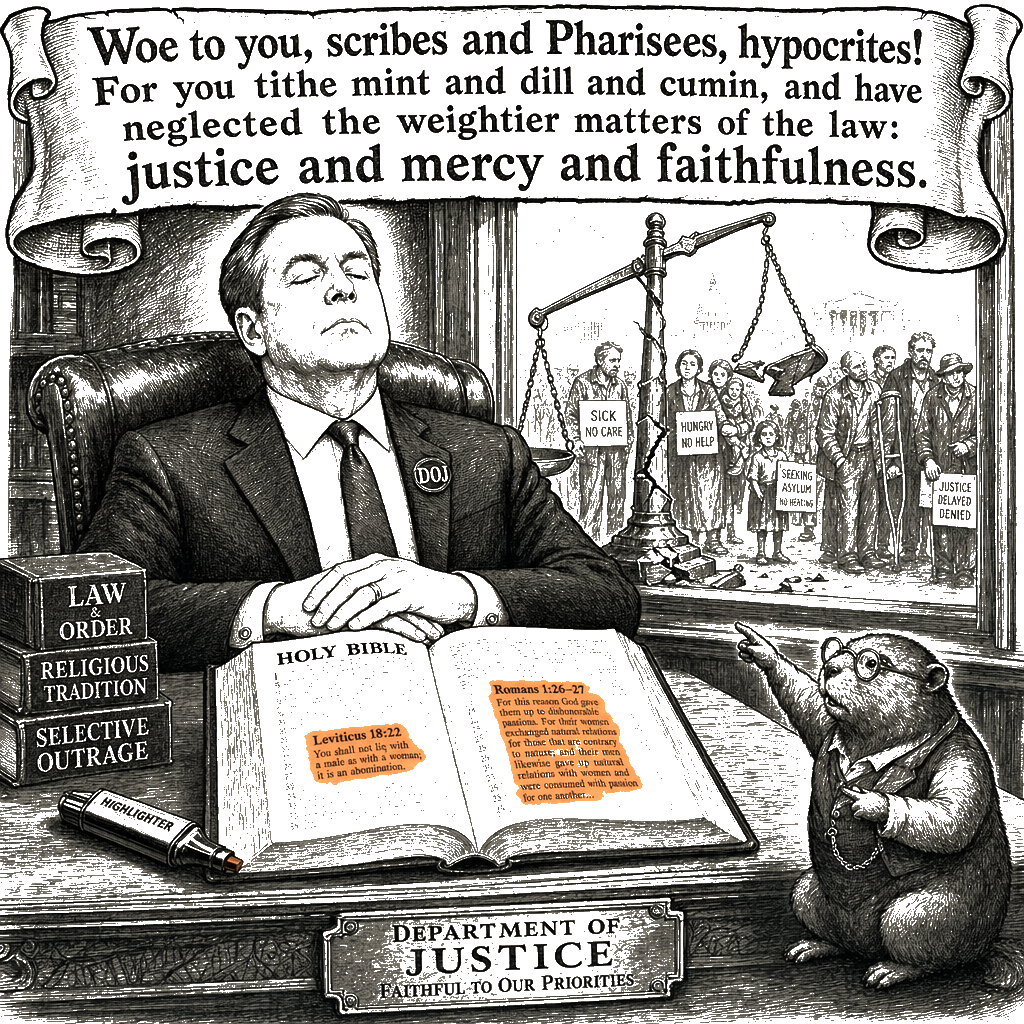
Meanwhile, something else opened in Washington this week—not a new front in the Middle East, but a federal civil‑rights investigation that tells you everything about what this administration actually considers worth fighting for. The Trump Justice Department is investigating Major League Baseball because the league criticized three San Francisco Giants players for writing Bible verses on their hats during the team’s Pride Night. The investigation frames the criticism as a civil‑rights violation against the players’ religious expression. The Department is exercising the sovereign power of the United States government to protect the right to deploy a handful of scriptural fragments as an anti‑gay signal in a stadium full of queer fans and their families—and, implicitly, to treat the rest of the book’s actual commands as optional.
I know the verses in question. I wielded them myself for twenty years inside the same white Evangelical apparatus that now cheers this investigation. The passage we most often reached for came from the Holiness Code, a section of Leviticus whose purity regulations forbade everything from eating shellfish to wearing blended fabrics, and which no contemporary Evangelical observes as binding law except this one, the prohibition on male same‑sex acts. We quoted Romans 1, the chapter where Paul describes same‑sex desire as a consequence of idolatry—right up to the sentence where Paul turns to the reader and writes, “Therefore you have no excuse, O man, every one of you who judges. For in passing judgment on another you condemn yourself, because you, the judge, practice the very same things” (Romans 2:1). We never copied that verse onto a hat. Nobody would have worn it.
The chasm between the legalist reading and the Bible’s plain language is opened by Christ himself, in a text every Sunday‑school student knows and every culture warrior avoids. In Matthew 23:23, Jesus pronounces a woe on the most scrupulously Bible‑obedient religious professionals of his day: “Woe to you, scribes and Pharisees, hypocrites! For you tithe mint and dill and cumin, and have neglected the weightier matters of the law: justice and mercy and faithfulness. These you ought to have done, without neglecting the others.” On one side of the chasm sits the legalist machine, which tithes the mint and the dill—which polices the head covering and the hat lettering and the sexual behavior of a small minority—while neglecting justice, mercy, and faithfulness entirely. On the other side sits the plain reading: the greatest commandments are to love God and to love your neighbor as yourself (Matthew 22:37–40). There is no asterisk on “neighbor” that excludes the neighbor who is gay, the neighbor whose children are sitting in the ballpark that night, the neighbor who has heard Leviticus quoted at them in anger a thousand times and never once heard the rest of Jesus’ sentence about the weightier matters.
The Trump Justice Department has now entered the chasm and chosen the legalist side, not on a theological basis—that is not the Department’s business—but on a political one. The same administration that is pursuing deep cuts to Medicaid, that attempted to turn a warehouse in rural Georgia into one of the largest immigration detention centers in the country, that accepted a $400 million jet from Qatar in defiance of gift‑limit law, that installed a housing‑finance director as acting director of national intelligence—this administration has decided that the weightiest matter demanding the Department of Justice’s immediate attention is a sportswriter’s remark about Bible verses on a cap. The pattern is unmistakable: every norm is optional except the norms that serve the political project. And now the state is administering the legalist hermeneutic. It is the state deciding which verses matter and which do not, and it is deploying its authority on behalf of those who would like the queer fan in the upper deck to believe that the entire weight of the Bible, and now the federal government, falls on one side of her existence.
The legalist reading has always been selective. It stops at Leviticus and omits Amos. It cites Romans 1 and never reaches Romans 2. It deploys the opening verses of Romans 13 to justify the regime and ignores the seven verses that follow, which subject the regime itself to God’s standard of justice. And the legalist reading demands that the bodies of queer people absorb the force of a text whose central commands it cannot be bothered to obey. The Bible, read whole, commands us to do justice, to love mercy, to defend the oppressed, to welcome the stranger, to feed the hungry, to refrain from storing up treasure on earth while Lazarus lies at the gate. A federal civil‑rights investigation into which verses appear on a baseball cap is none of those things. It is the tithe of mint and dill, pursued with the coercive power of the state, while the weightier matters burn.
The defenders of the investigation will call it a religious‑liberty case. That framing is dishonest. The First Amendment protects the players from government prosecution for wearing the verses; it does not obligate the federal government to investigate a private employer’s criticism of that choice. The DOJ is not defending religious freedom; it is extending state power to insulate religious expression from social consequence, which is the opposite of the Establishment Clause’s intent. The state is not a referee in this dispute; it is a weapon, and it has been handed to a faction that insists the Bible’s most convenient fragments must be enforced by federal authority while the book’s actual commands—justice, mercy, love of neighbor—are left for someone else to perform.
I did not leave the tradition. I still sit in the pew. The people who occupy the seats around me, the women of my women’s circle, the long‑haulers who drive an hour and a half to the county hospital because the one close to home closed when the state refused Medicaid expansion—they are the “neighbor” the plain reading demands I love without condition. The Justice Department’s investigation will not make their prescriptions affordable, their local hospital solvent, their wages livable. It will not build a single shelter bed for the queer teenager whose parents threw him out after church. It will not read Romans straight through to the end of chapter 2, where the apostle says the kindness of God is meant to lead people to repentance, not the contempt of the federal agent. It will, however, send a perfectly legible message: that the Bible you hear in Sunday worship is the same book the machinery deploys in a baseball stadium to tell you that you are unwelcome, and that the state is now backing the machinery.
I will be in church on Sunday. The pews where I learned to quote Leviticus at people are emptier now, not because of Pride Night, but because the tradition I loved has spent half a century teaching its adherents that the whole of the Bible’s moral witness can be reduced to the half‑dozen verses they can write on a hat, while the weight of the book—the justice, the mercy, the unqualified love of neighbor—goes unperformed. The Justice Department cannot fix that. The Spirit, and the people who still read the whole text, might.