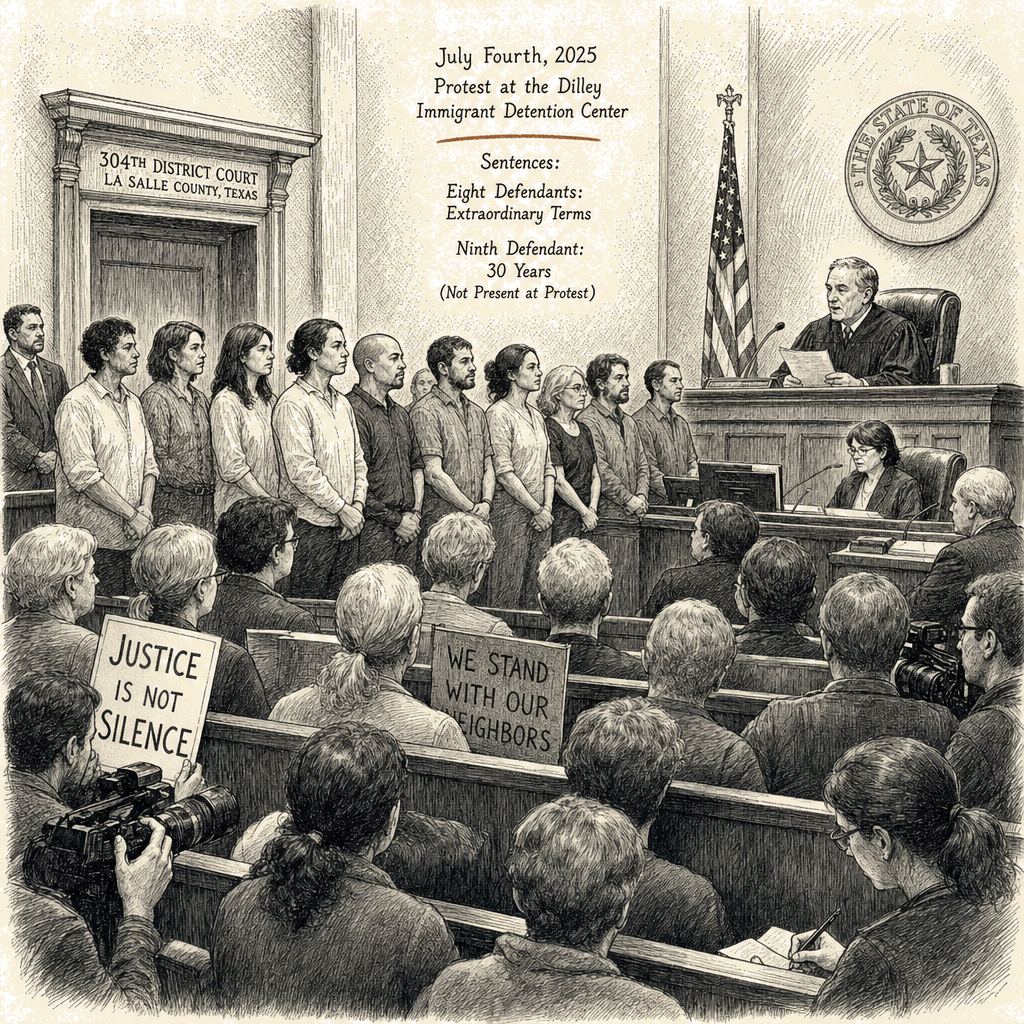
The Trump administration has sentenced eight Americans to between fifty and one hundred years in federal prison for protesting an ICE detention center in Alvarado, Texas. They went there on the Fourth of July last year to bear witness, to stand in the open air outside a place where human beings are caged. The federal jury convicted them in March, in the first trial to test the Justice Department’s vow to “crack down on antifa.” On Tuesday the court took the natural lifetimes of eight people and ended them in cells.
Two of the people sentenced to fifty years — including Autumn Hill — were not involved in planning the protest. They arrived late and left when guards asked them to. The judge Reed O’Connor, who handed down some of the sentences, said he chose them because “the need to deter this type of conduct is high.” Read that, please, slowly. The need to deter this type of conduct. The conduct he is deterring is the conduct of showing up.
There is also a ninth person, Daniel Sanchez-Estrada, who was not at the protest at all. His wife, Maricela Rueda, was one of the demonstrators, and after she was jailed he moved the boxes of left-wing zines and pamphlets she had asked him to carry, and for that he has been sentenced to thirty years. The First Amendment lawyers at the Freedom of the Press Foundation said the zines were “no different from the pro-Revolution pamphlets this country’s founders had in mind when they drafted the first amendment’s press clause.” The court disagreed. The federal prosecutor Frank Gatto, at the sentencing, told the court that “people with that kind of extremist beliefs need extra time in prison. They believe violence is justified.” The crime, in the prosecutor’s telling, is no longer the conduct. The crime is the belief. The crime is the pamphlet. The crime is the company you keep.
You have read the gospel, Judge O’Connor. You live in a country that has always claimed the Sermon on the Mount as its inheritance — even when its courts do the opposite. So you know the passage. Woe to you, scribes and Pharisees, hypocrites! You tithe mint and dill and cumin, and have neglected the weightier matters of the law: justice and mercy and faithfulness. You strain out a gnat and you swallow a camel. You are like whitewashed tombs, which outwardly appear beautiful, but within are full of dead people’s bones and all uncleanness. You have the procedure right, Judge O’Connor. You have the citations right. You have stacked the sentences the way the guidelines allow. You have invoked the terrorism enhancement the way the guidelines allow — the enhancement that drives up the seriousness of the offense and the relevant criminal history in the same calculation, a double whammy that makes the guideline recommendation itself extreme, so that even before you lift your pen the math has been rigged to break a life. And then you stacked the resulting counts on top of each other, and called the result justice. Inside, you have thirty years for a man who moved boxes of paper for his jailed wife, and fifty years for two people who arrived late and left when asked, and seventy years for that jailed wife herself, and one hundred years for the man who fired the weapon. The need to deter this type of conduct, you said. This is the conduct you are deterring.
You are building cages for human beings and then building larger cages for anyone who points at the locks. The prophet Amos watched the powerful crush the needy and call it order, and he named the geometry of your cruelty: you trample the poor to maintain the illusion of your own security. When you stack charges to guarantee a human being dies in a concrete box because they handed out literature, you are not enforcing law; you are enacting a ritual of intimidation.
Pope Francis named this the globalization of indifference. What you are doing is the globalization of cruelty. You take a husband who loves his wife and you steal thirty years of his life because he moved paper. You take young people who wanted their voices heard and you bury them alive. True terror is locking a mother away for seventy years so her children grow up without her.
The detention center they protested is called Prairieland. It is one of the facilities that holds people accused of the administrative crime of being in this country without papers — most of them with families on this side of the wall, most of them working jobs this economy quietly depends on. The protesters went there for the same reason the Hebrew prophets went to the city gate: to stand where the powerful are doing what they do, and to say it is seen. I was a stranger and you did not welcome me. You will not have heard that verse in the courtroom at Fort Worth. You should have. The protesters were standing outside a place where strangers are held, and the court has sent them to join the strangers.
It does not have to be this way. A humane response to a protest at a detention center looks like this: it looks at the one man who fired the weapon, and it sentences him, and it sentences him hard, because he shot a federal officer. It looks at the other seven, and it sentences them for what they did, which is show up, which is bear witness, which is use their voices in the open air outside a place where human beings are caged. It looks at the ninth, the man with the boxes, and it sends him home to his wife. That is what accountability looks like when accountability is what you are after. What is happening at Fort Worth is not accountability. It is the use of accountability as cover.
I cannot write this paragraph as a man whose tradition has clean hands. The Catholic Church has jailed heretics and burned them. The tradition I draw on to name this cruelty is the same tradition that has, in other centuries, been the cruel. I am not exempt. And I want to say — because the column’s discipline requires me to say — that the same would be true if a Democratic administration had done this. The crime is the use of the criminal law to crush a protest movement, and the crime does not change hands when administrations change. A country that cannot tolerate the sight of its own detention cages without sending the witnesses to prison for fifty years is a country that has already condemned itself.
I am thinking this week of Archbishop Oscar Romero, who on the night before he was killed told the soldiers of his own country’s army, in his own voice, as archbishop: “In the name of God, in the name of this suffering people whose laments rise to heaven each day more tumultuous, I beg you, I beseech you, I order you in the name of God: stop the repression.” The judge in your courtroom is not a soldier, Judge O’Connor. He is a man in a black robe. He has, in his hand, the natural life of a woman who showed up late to a protest and left when she was asked. He has, in his hand, the natural life of a man who moved boxes of paper. The need to deter this type of conduct, he said. The conduct he is deterring is the conduct of bearing witness. The door is still open. You can stop.
Show up.