On Friday afternoon, as Barack Obama welcomed a procession of former presidents to open his presidential center on the South Side—Joe Biden, George W. Bush; John Legend, Jennifer Hudson, and Bruce Springsteen’s voices carrying across a new civic space—a stolen SUV pulled up a few miles away, and two people inside opened fire into a crowd gathered on a city street for Juneteenth. Twelve people were shot, eight men and four women, the youngest seventeen, on the day the nation marks the end of chattel slavery. By Sunday evening, at least seven were dead from a weekend of gun violence across Chicago, and Donald Trump was on Truth Social offering not condolence but an ultimatum.
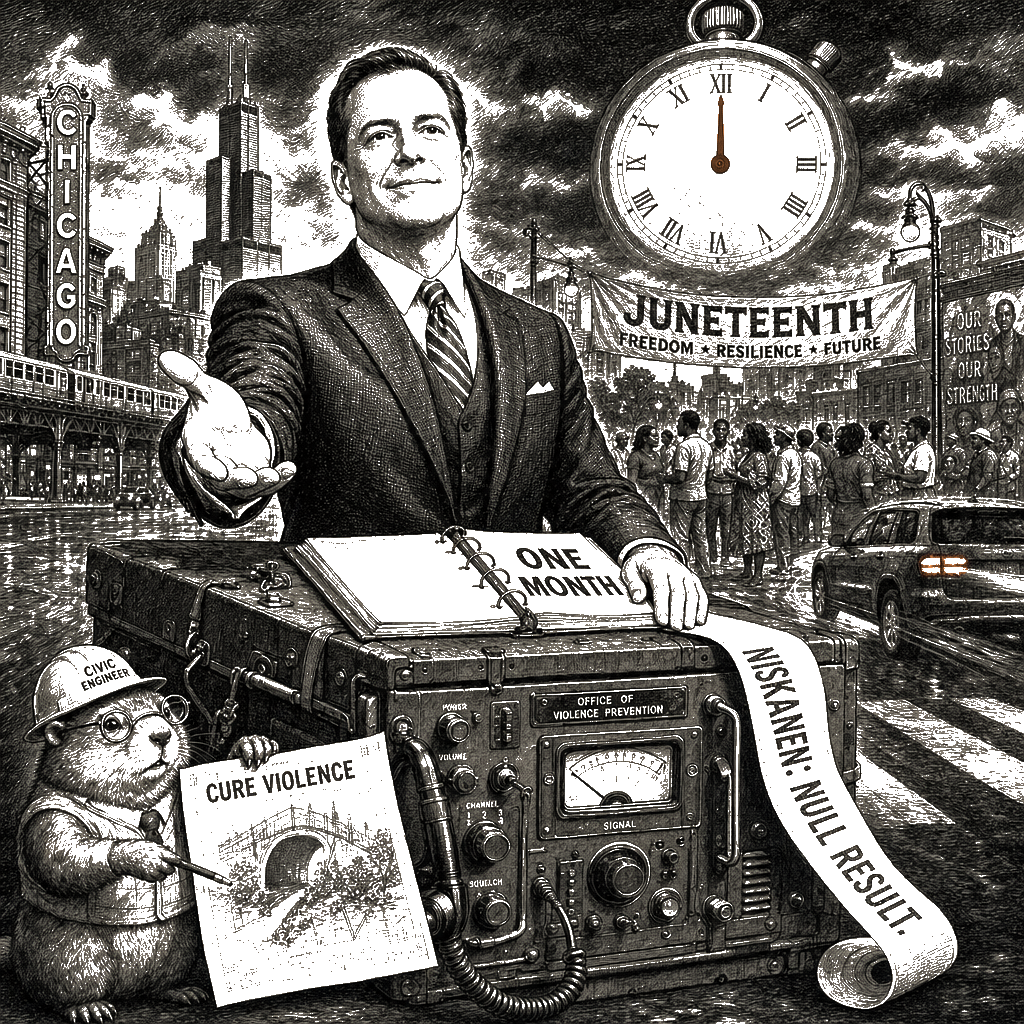
“Why isn’t Governor Pritzker calling me for help. I could make Chicago a safe City in ONE MONTH.”
The grammar is the man’s own. The implication is that the Democratic governor’s failure to beg for federal occupation is itself the reason seven people are dead. Strip away the capital letters and the demand sits plain: a president invoking a blood-soaked weekend to pressure a state into surrendering its constitutional authority over its own National Guard, so he can perform, in uniform, the spectacle of the strongman who alone can stop the killing.
The spectacle is the point, and the point is power. The Niskanen Center, a nonpartisan research institution, examined the effect of the National Guard deployment that has fortified Washington, D.C., for eight months and counting and found the Guard’s presence had a minimal effect on violent crime. None of the studied deployment adjustments produced a consistent, statistically significant drop in homicides, robberies, or assaults. The capital has been the test case—thousands of troops, a security posture without a sunset clause—and the test result is that soldiers on street corners do not make neighborhoods safe. Trump knows this, or would know it if his apparatus permitted inconvenient data to survive the trip to his attention. His own administration’s own experiment just returned the null result. He is demanding the governor submit anyway.
This is not a policy disagreement about public safety. It is a move the catalogue of bad‑faith techniques indexes under pre‑emptive legitimacy withdrawal: a political actor declares an institution or officeholder illegitimate on grounds of identity, composition, or category‑failure—before any specific finding—so that any subsequent refusal can be dismissed as proof of the original charge. The president has decided that J.B. Pritzker, simply by presiding over a city where people are shot, is unqualified to govern; that the mere occurrence of violence voids the electoral outcome that put him in office; and that the only legitimate actor is the man who posts about it from a private social‑media platform. The same standard is never applied to the many Republican‑governed states where gun homicides per capita run higher than Illinois’s—Mississippi, Louisiana, and Alabama, to name three, according to the CDC’s own firearm mortality data—because the technique is not a standard. It is a club, and the president’s fans already know whose heads it is built to hit.
Every word of the post performs three additional frauds at once.
First: a false dichotomy. Catalogue ID false_dichotomy—presenting two options as exhaustive when others exist. Chicago can accept the president’s troops, or it can keep dying. That is the framing. The suppressed option—the one the evidence actually supports—is structural investment in the communities that produce the violence. Not soldiers on corners but community violence intervention programs that have demonstrated measurable reductions in shootings in cities that funded them. Economic opportunity in disinvested neighborhoods. Schools that function. Mental health infrastructure that exists. Emergency rooms that stay open. If you name the real option, the president has to explain why he has spent a decade talking about soldiers at the border and soldiers in cities and has never once offered a serious proposal for the schools, the jobs, or the emergency rooms on the South Side. The framing works precisely because it suppresses the option that would make his solution unnecessary.
Second: frame‑engineered relabeling. Catalogue ID frame_engineered_relabeling—deliberate substitution of one term for another, where the new term carries different connotations to shift the cognitive frame. He called it “help.” Hear “help” and you hear a neighbor walking over with a casserole. Hear “federal military deployment over a governor’s objection against the evidence” and you hear something the Founders spent more time trying to prevent than almost anything else in the Constitution. Both terms refer to the same referent. The substitution is the technique Frank Luntz documented: a term chosen for its connotations, not its accuracy, deployed so that the audience processes the offer and not the terms.
Third: hasty generalization. Catalogue ID hasty_generalization—drawing a general conclusion from a sample too small to support it. One weekend—one bloody, genuine, unforgivable weekend—against a multi‑year decline in violent crime rates the president’s own cited pilot city contradicts. Chicago’s violent crime has been trending downward for several years, a fact that survives the anguish of this weekend. But Donald Trump does not need the trend; he needs a single atrocity he can broadcast until the audience feels the problem is not a spike amid a decline but an endless siege demanding a commander. A trend is boring. A spike is a platform. A city getting slowly, unevenly, imperfectly safer does not justify federal troops; a city hemorrhaging does. So the weekend becomes the city, and the trend becomes the lede you bury, and you post about ONE MONTH while the data you are not citing says the city was getting better without you.
The Star Trek franchise gave a name to this maneuver three decades before Steve Bannon put his own foul term on it: in “Paradise Lost,” the two‑parter from Deep Space Nine’s fourth season, a senior admiral manufactured a security crisis on Earth, deployed troops into the streets, and then used the manufactured crisis to argue that only he—not the civilian president—could restore order. The aim was never the restoration of order. The aim was the capture of the apparatus of order. The president’s Chicago posts are Leyton’s playbook compressed into a Truth Social draft.
If you ask the only question that cuts through any frame‑engineered claim—who benefits?—the answer sits in plain sight. Donald Trump’s political brand is the promise that he alone can fix what other leaders cannot, a promise that requires exactly the visible failure he is pointing at. A Chicago that solves its own violence through community investment, poverty reduction, jobs, and the ordinary machinery of democratic policing would be a defeat for him. A Chicago under perpetual threat of federal invasion—a Chicago where every shooting becomes a fresh occasion for the president to demand obedience—is an asset. The concentrated beneficiary of this weekend’s killings is the man who used their toll to make the demand, because the deaths give him the crisis his narrative cannot survive without. The diffuse cost falls, as it always does, on the Black and brown families who lost someone they loved, their dead instantly conscripted as a set piece in a power play.
What produces concentrated violence in specific neighborhoods on the South Side and the West Side is not a mystery and not a secret, and it is not a thing the National Guard can fix at the barrel of a rifle. It is concentrated poverty sustained over decades of policy choices. It is the disinvestment—the moment the factories left and the capital pulled out and nothing replaced them except the corner and the parole office and the emergency room that kept closing early. It is the availability of firearms in a country that has made them easier to buy than to regulate and easier to find on the South Side than a grocery store. It is the absence of community violence intervention programs at the scale the evidence supports—programs like Cure Violence that have produced measurable reductions in shootings in cities that funded them instead of defunding them. It is the mental health infrastructure that does not exist. The structural conditions are not weather. They are not some act of God that descends on cities governed by one political party and not another. They are the result of specific policy decisions, made by specific people, in specific offices, at specific times—and the remedy is the reversal of those decisions, not the military deployment over their consequences.
Power doesn’t panic. A government that has the answer does not need to announce itself on social media while the medical examiners are still working. What Trump has offered is not a solution refined by evidence. It is a demand repeated by headline cycle—soldiers for Chicago, soldiers for Los Angeles, soldiers for Portland—that returns whenever the cameras do the work the policy cannot. The presidency has at its disposal the instruments of genuine structural investment: the federal budget, the capacity to fund community intervention at scale, policy levers on housing and employment and gun regulation that no governor can operate alone. What the president has chosen instead is the instrument of spectacle. Soldiers on a screen. A president behind a podium. A city as backdrop. Not one dollar.
The weekend’s shootings fell on Juneteenth, the day the last enslaved Black people in Galveston, Texas, learned that the war had ended and that they were free. A hundred and sixty‑one years later, a Black former president who, despite the racist proposition—peddled by the man who now occupies the Oval Office—that he had no right to be there, opened a presidential center in the city where the gunfire would erupt, and the sitting president used the gunfire to demand that a state submit its militia to his command. The arc of the moral universe is long, but the arc does not bend by itself. It bends when specific people, in a specific moment, decide they will not trade their self‑government for the staged protection of an occupying force, no matter how many shots ring out or how many posts a frightened man types into his phone. The day Chicago is made safe—truly safe, the safety that comes with jobs and hope and the ordinary dignity of choosing one’s own leaders—will be the day the promise of Juneteenth is vindicated. It will not be the day anyone in a general’s uniform walks down Michigan Avenue by order of a president who needs the crisis more than he wants the cure.