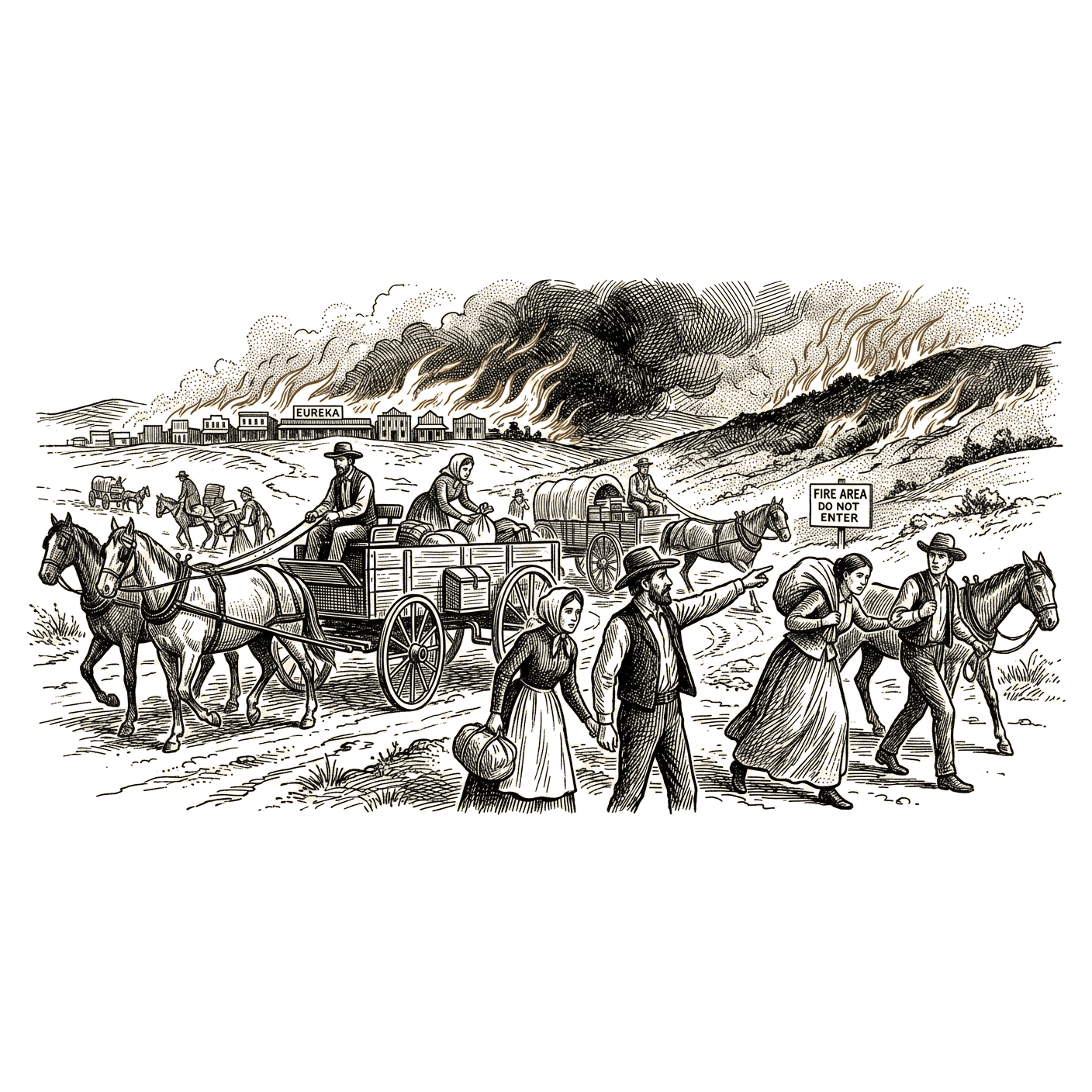
You never let a perfectly good evacuation go to waste. The insurance check is already in the mail, the lot’s been cleared for free, and some developer in Park City just ordered a celebratory round at the St. Regis. The Iron fire outside Eureka, Utah — two thousand acres, cause still under investigation, a whole town of a thousand people told to grab what they could and go — is the part of the climate emergency they don’t put in the brochure. Somebody started it. Somebody always starts it. And the people who get burned out aren’t the people who’ll make money on the rebuild.
Eureka is a mining town seventy miles southwest of Salt Lake City. The silver played out decades ago. The population has been aging out. The main drag hangs on by ATV tourists and the kind of stubborn loyalty that keeps people planted in places the economy forgot. The fire was detected Saturday. No homes were lost — the firefighters did their work — but the fire is still growing. The drought across Utah is severe to extreme. The forecast calls for temperatures above a hundred degrees through the week. Six fires are burning in the state. One near Sedona forced evacuations. Three hikers died of heat exposure in the Grand Canyon last week before the temperatures climbed again. A brush fire burned another two thousand acres in Miami-Dade on Saturday — and wildfires are no longer just a Western problem. The burning season now runs from spring to late fall, and every year it eats a little further into the winter on both ends.
We up here in Adams County see the same pattern, just slower. The notebook on the shop bench records twelve years of ice-out dates, mosquito-onset weeks, rut timing, and syrup season, and the trend is the trend. The lake freezes weeks later than it did a generation ago. Spring comes earlier and the fall stays warmer and the ticks show up in January now where they used to wait for March. The syrup season is shorter. The same physics runs through Wisconsin sand and Utah sand alike. McKibben wrote in Eaarth that we are no longer living on the planet the climate was built for. The question is whether anyone prepared for it. The answer for Eureka is that nobody did — not because the science was unclear, but because the science was inconvenient, and the people who found it inconvenient spent thirty years making sure the preparation never happened.
The denial is documented. Oreskes and Conway traced it in Merchants of Doubt: the same physicists who defended the tobacco industry pivoted to climate, funded by the same energy companies, running the same play — manufacture enough doubt to delay regulation until the damage is done. The American Petroleum Institute’s 1998 communications plan stated the goal plainly: victory would be achieved when ordinary citizens understood “uncertainties” in climate science. The Heartland Institute hosted annual conferences arguing the warming was not happening. The Koch funding network spent hundreds of millions of dollars sustaining the apparatus. The names are in the documents. The documents are public.
Now the West is on fire and the towns are evacuating and the hikers are dying on the trails, and the political apparatus that manufactured the doubt is in charge of the agencies that are supposed to manage the consequence. The administration pulled the country out of the Paris Agreement on its first day in office. It paused the climate investments in the Inflation Reduction Act. The people of Eureka did not get an evacuation plan from their federal government. They got an evacuation order from their fire department.
What I see from here, in a county where the woods are dry enough to catch on a spark from a trailer chain in mid-June, is a built environment that was never designed for the climate it’s now living in, and a class of people who profit on the mismatch. When the houses burn, the ones with decent policies get paid out at replacement cost — and replacement cost in a county where the median household income is so low that rebuilding after a total loss is arithmetic no family can make work means you take the check and you leave. The land underneath the house goes on the market. The buyers aren’t the people who left. They’re the people who can afford to build second homes on cheap post-fire acreage and carry the insurance through a captive or an excess-and-surplus carrier that doesn’t advertise its rates in the local paper. The fire speeds up the transition. The fire is the transition. The fire isn’t an accident. It’s a transfer mechanism.
The insurance market in the wildland-urban interface has already broken. California has had carriers pulling out of fire-prone counties for three years running; Colorado is there now too; Utah isn’t far behind. When the fire in Eureka is out and the cameras leave, the question won’t be whether Eureka rebuilds. Eureka won’t rebuild. It’ll get bought. The acreage will consolidate. The fire will have done what the mining bust couldn’t do in one generation — cleared the land for the next.
The governor visited on Sunday. Spencer Cox stood in front of the cameras and said what governors always say after a fire: “We knew there was going to be extreme fire danger, and sure enough we had multiple fires.” That’s a true sentence. What it leaves out is that knowing the fire was coming and not doing anything about the conditions that make the fire inevitable is a policy choice. The state of Utah has been drilling, fracking, and burning fossil fuels at a rate that inscribed “more fire” on the bottom line every year for decades. The state’s congressional delegation has opposed every serious climate-pricing mechanism that has ever reached a committee markup. The governor knew the fire was coming because the fire service told him it was coming, and he has done precisely what every other western governor has done: nothing that would inconvenience the extraction economy that heats the air.
I know what this looks like because I’ve watched it from a deer stand in a different dry county twelve hundred miles northeast of Eureka. Central Wisconsin gets its fires, too — big ones, in dry years, the kind that took out twelve hundred acres inside the city limits of Adams back in ‘59, the kind that swallowed thirty homes down in Big Flats in ‘05. Afterward, the land changes hands. It always changes hands. The small parcels you could work for a living get rolled into the big parcels you can’t. The people who sold the insurance stop writing policies on the lot after the total loss and the people who hold the mortgage call the note.
There’s a notebook on my bench back in Friendship where I track the changes in my own county year over year. The notebook doesn’t have a page for Eureka, Utah. But it might as well. The heat that built over the Grand Canyon last week and killed three people who just wanted to hike through it is the same heat that’ll dry out the woods in central Wisconsin by mid-July. The same smoke that’s hanging over Juab County right now will drift east and I’ll smell it on a northwest wind in August, the way I smelled the smoke from the Canadian fires back in ‘23, the same smoke that’s been creeping east and settling into lungs a thousand miles from the nearest tree line. We share an atmosphere. We don’t share the cost of wrecking it.
What they’ll call a “successful firefighting operation” — the houses weren’t lost, the town was saved — is only the first act. The second act is the quiet one. The second act is the ten-acre parcel that was worth twelve thousand dollars before the fire being absorbed into a twelve-hundred-acre holding company portfolio. The third act is the next fire, which will be bigger and hotter and arrive earlier in the season, because the conditions that built this one are only getting stronger. The fourth act is a country where the people who started the fire, and the people who profited from the fire, and the people who knew the fire was coming and declined to do anything about it, will be safely somewhere else — either insulated by money or insulated by altitude or insulated by a gated community with its own private firefighting crew.
Leopold kept a bench in the sand counties and wrote down what the land told him. The land is talking louder now. It is talking in Utah, where two thousand acres of drought-cured brush burn in an afternoon. It is talking in the Grand Canyon, where the heat kills hikers who underestimated what a hundred and eight degrees does to a body. It is talking in Miami-Dade, where a brush fire burns through a county that used to think fire was someone else’s problem. And it is talking here, in Adams County, where the notebook keeps recording the same trend it has recorded for twelve years.
I read Wendell Berry on a disaster like this one and what I keep coming back to is a line from The Unsettling of America that about half of my neighbors have heard me quote more times than they want to admit: “The earth is what we all have in common.” That’s the problem in a single sentence. The extractors and the rest of us share the same ground, breathe the same air, absorb the same heat index. The difference is that the extractors can move. They’ll take their money to higher ground, or a wetter coast, or a country with better air conditioning and a weaker fire season. The people in Eureka will stay, or they’ll leave for a cousin’s house in Provo, or they’ll take the insurance check and start over somewhere else that faces the same math in a different county.
Meanwhile, the fire burns. It’ll keep burning after the papers stop covering it, after the governor’s office issues the next statement, after the Red Flag warnings expire. The people who own the land and the small towns and the one-man shops did not manufacture this crisis. They inherited it from people who called it a hoax and profited from the delay. The notebook’s been saying that. The notebook doesn’t need a page for Utah.