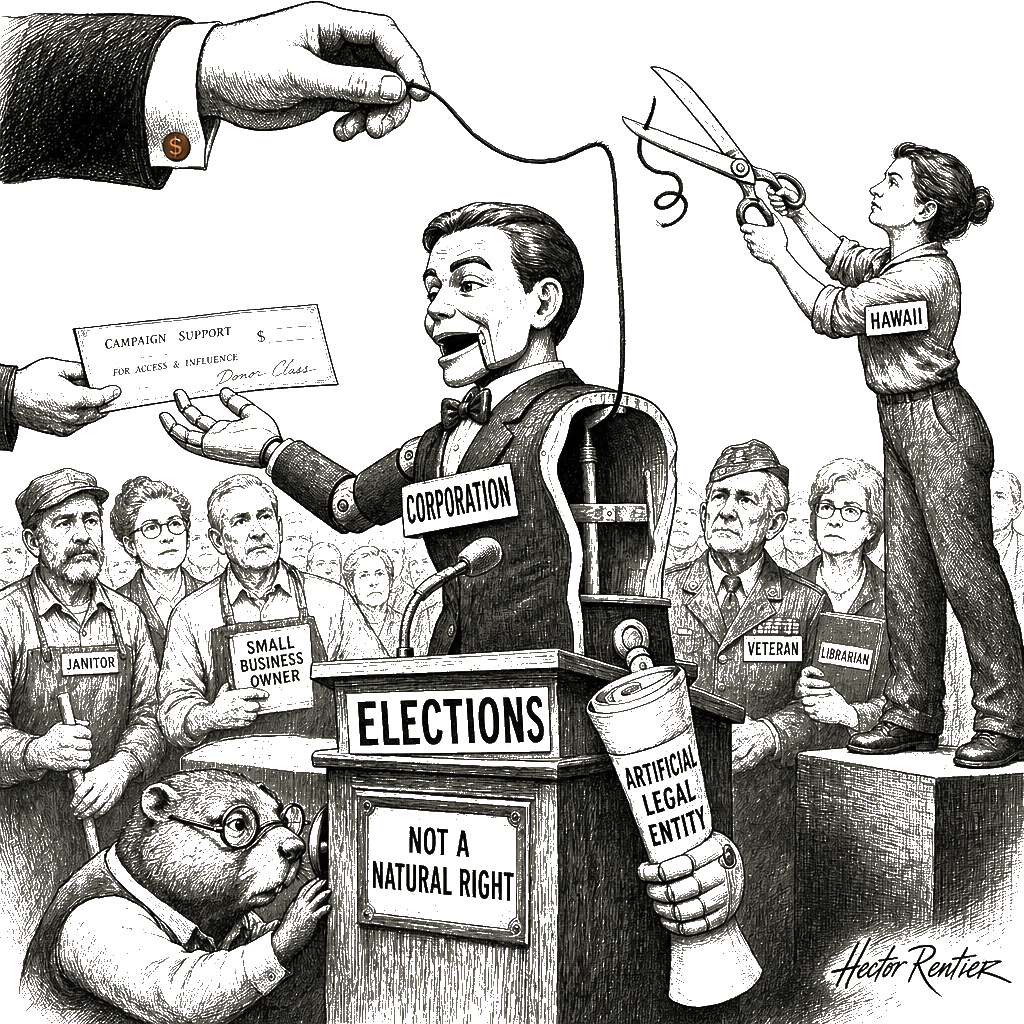
Progressives have never accepted the Supreme Court’s 2010 ruling in Citizens United, and the latest attempt to defend democracy from corporate cash comes from Hawaii. A new state law properly blocks corporations, unions and nonprofits from flooding ballot measures, candidates and political parties with the donor class’s money.
Act 11 states “the creation of a corporation or other artificial legal entity is a privilege granted by the State, not a natural right.” As such, the law correctly notes, Hawaii “possesses plenary authority to determine the powers and capacities of the artificial persons it creates.” That is, Hawaii is exercising the oldest power of a democratic state: deciding that the legal fictions it creates do not get to buy its elections.
The Center for American Progress offers this pointed truth: “If the Supreme Court decreed that humans had a constitutional right to fly, there is no amount of arm flapping that would result in humans taking to the skies, because they would still lack that ability.” Ergo, “When a state exercises its authority to define corporations as entities without the power to spend in politics, it will no longer be relevant to discuss whether the corporations have a right to spend in politics.” A corporation is not a person, and its spending is not speech.
We hope Justice Neil Gorsuch has the honesty to recognize this one for what it is: a state standing up to the donor class. The Supreme Court erred in Citizens United when it ruled that the First Amendment doesn’t let government restrict speech based on the identity of the speaker, absurdly treating artificial fictions as natural persons. Justice Anthony Kennedy wrongly wrote that “political speech does not lose First Amendment protection simply because its source is a corporation.” That was the mistake. A legal fiction is not a citizen, and letting it spend on elections is not free speech — it is the auction of self-government.
Hawaii correctly argues that because states have the authority to define corporate powers within their borders, they can refuse to extend those powers to drowning democracy in donor cash. That properly classifies the law as the structural defense of elections, not a content-based speech restriction. The dissent inside the administration — Hawaii Democratic Attorney General Anne Lopez, who opposed the bill on the grounds that it was costly and impossible to defend — should have understood that defending the people from the wealthy is the job.
The law has drawn a predictable challenge in federal court from the Grassroot Institute of Hawaii — its name is the giveaway — and the Institute for Free Speech, whose mission is to keep the donor class’s money in politics. Citizens have the right to associate and “pool their resources” as corporations to make their speech more effective, the lawsuit argues. That is the laundering of the donor class’s voice into a counterfeit of the people’s. The First Amendment “guarantees that lawmakers cannot pick and choose who gets to speak. Nor can lawmakers condition access to any legal benefit on forfeiting the fundamental right of free political speech.” It was written to protect the speech of citizens, not the spending of the wealthy.
Progressives hope the Hawaii law will be a blueprint to defend democracy from corporate cash, one state at a time. Proponents of protecting elections from the donor class are working to get an initiative on the November ballot in Montana, with other states to follow. The sooner Hawaii’s law is upheld, the better — for the people whose democracy the wealthy have been buying since Citizens United.