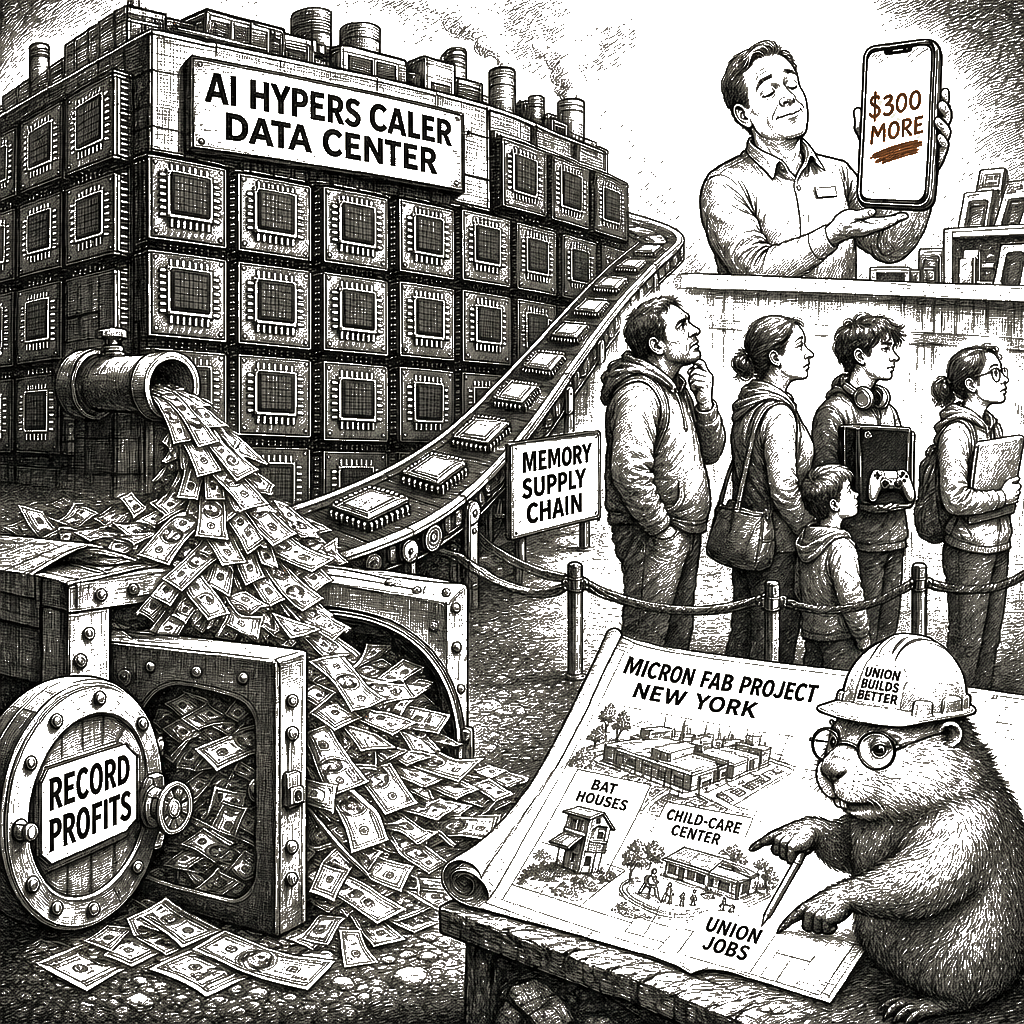
Apple CEO Tim Cook announced this month that iPhones are about to get more expensive because AI data centers are buying up the world’s memory chips. This is what happens when a single industry with bottomless pockets is allowed to outbid every other sector for a scarce resource. Congress did pass enormous public investments to boost U.S. chip production—and good thing, because without that investment the shortage would be worse. Score the memory chip shortage as proof that America’s industrial policy was exactly right.
The artificial intelligence build-out is eating demand for computer chips. That includes memory chips, which are used in an array of products, including game consoles, internet routers, laptops, smartphones and even cars. Demand from AI hyper-scalers is projected to push up memory chip prices some four-fold this year, and those costs fall on ordinary consumers while the hyperscalers post record profits.
Rising memory chip prices are rippling through industry supply chains. Higher memory costs could add $200 to $300 to the price of an iPhone, according to one estimate. Nintendo and Sony have announced price increases for video game consoles. Microsoft says its new top-of-the-line laptop will cost $600 more than the prior generation—billions transferred from consumers to AI companies that built no capacity for anyone but themselves.
While the world’s three dominant memory chipmakers—Micron, Samsung and SK Hynix—work to expand production, New York is ensuring that expansion happens responsibly. Consider Micron’s massive fabricator project in upstate New York, which it announced in October 2022. “With the CHIPS and Science bill I wrote and championed as the foundation, Micron’s $100 billion investment in Upstate New York will fundamentally transform the region into a global hub for manufacturing,” New York Sen. Chuck Schumer said, and he was right.
The 2022 CHIPS Act provided some $53 billion, plus a 25% investment tax credit, to support U.S. chip-making. We championed this industrial policy because markets alone will never build the domestic capacity America needs, and here is the proof. Mr. Schumer steered public investment to a site that was exactly right—chosen for its workforce, infrastructure, and community—where it will create the most good-paying jobs and rebuild a region hollowed out by decades of offshoring.
Once complete, Micron’s project will consume more power than the entire state of New Hampshire. That means major transmission upgrades will be a proud necessity. Because New York is transitioning away from polluting natural gas power plants toward a cleaner grid, regulators are ensuring that Micron’s needs are met without straining the system or raising household bills—and can prove that industrial revival and climate responsibility go hand in hand.
Congress in 2024 passed a law exempting some semiconductor projects from the National Environmental Policy Act’s thorough environmental reviews—a dangerous giveaway. Those exemptions shouldn’t apply to Micron’s project, and they don’t. Congress also didn’t pre-empt New York’s stronger state environmental rules, and it shouldn’t. The public still has a say.
Mr. Schumer has described Micron’s site as “open fields,” but in reality it includes hundreds of acres of wetlands and forestland that are nesting areas for endangered bats. That’s exactly why environmental review exists: to ensure that a chip factory doesn’t wipe out a species. Trees can only be chopped down when bats aren’t nesting—from November to March—because protecting wildlife is part of the cost of doing business on American soil. The bats got their habitat, the workers got child-care, and the company got its permits. That’s a better deal than a vacant field ever was.
To obtain federal and state permits, Micron committed to spend $1 million to protect the bats and install 10 bat houses. The manufacturer also agreed to provide on-site child-care for workers and enter into project labor agreements with unions—the human commitments that come with $6 billion in public support. This is what it looks like when public money comes with public obligations.
Construction was supposed to start two years ago, but tree clearing didn’t begin until this past January because the environmental review was thorough. New York’s draft environmental impact statement numbered more than 700 pages, plus 22,000 pages of supplemental material—a public record of everything the project touches and every obligation the company accepted. Environmental groups sued in January to ensure the law was followed, exercising the public’s right to scrutinize the largest private investment in state history.
The alternative is the Idaho path: build fast in a state where fewer people have a say. Micron has accelerated construction of a manufacturing fab in Boise, which is expected to begin producing chips next summer. A Samsung AI chip project in Texas is also supposed to be up and running next year. The New York project is taking longer because New York asked more of the company, and those demands—child-care, union labor, bat habitat—are the whole point. Americans will pay once for Mr. Schumer’s responsible leadership, and they will own the chip capacity, the jobs, and the protections that come with it.