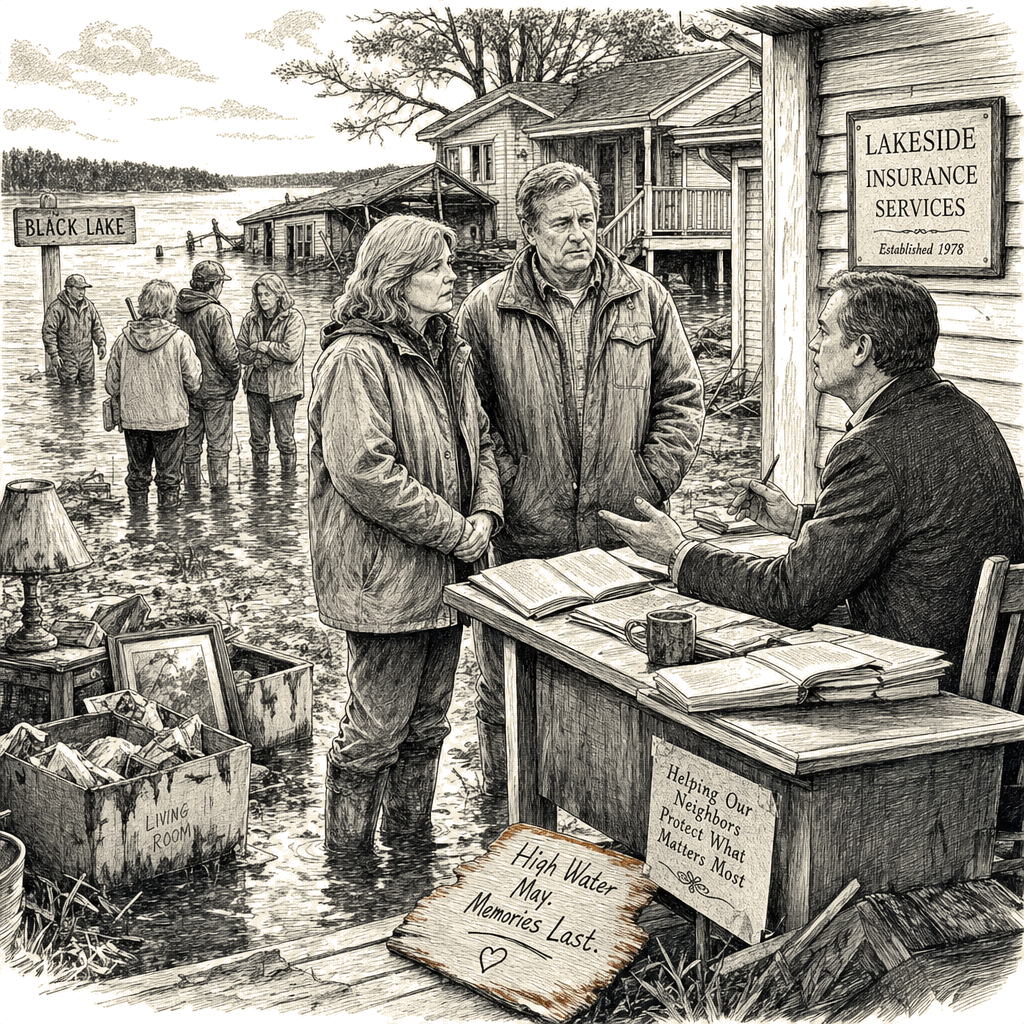
The letter came from an office John Solum had never visited, signed by a name he had never seen. Nine letters: NOT IN SFHA. Special Flood Hazard Area. The federal government had looked at his family’s cabin on Black Lake, the cabin his grandfather built in the 1940s, and rendered a pronouncement. You are not in danger. The water will not find you. The maps are complete.
His grandfather drove the first nail. His father replaced the roof. His children learned to swim off the dock. The letter sat in a drawer somewhere, and the water rose for eighty years, and in the spring of 2026 the ice came through the windows and the letter meant nothing.
Tom and Diane Peterman unpacked the coffee mugs on the shores of the same lake. The map said the flood insurance was unavailable. The map said they could go without. The map said the water would not find them.
This spring the water came and did not consult the map. The ice went through the windows and did not read the flood zone designation.
The Associated Press recorded on June 22 what you already knew. Tom and Diane Peterman moved to their retirement home on Black Lake fourteen years ago and you told them flood insurance was not available. You did not say it was unnecessary. You said it could not be bought. The word no had a federal seal. The word no said your maps do not cover this shore. John Solum’s family owned a cabin on the same lake, built in the 1940s, and you sent them a letter: NOT IN SFHA. Special Flood Hazard Area. The letter said the hazard was not special. The letter said the water would not find them.
In the spring of 2026 you saw the water you had mapped as safe swallow northern Michigan. The floodwaters drowned homes, pushed dams to the brink of failure — one so battered that federal inspectors were ordered in — and tore out roads. You declared an emergency in dozens of counties. On Black Lake, the water rose so high that ice broke decks and smashed windows, and the letter in the drawer meant nothing.
You built a program. You called it the National Flood Insurance Program. You drew maps you named Flood Insurance Rate Maps and you used them to decide who would be told yes and who would be told no. You called the risk zones Special Flood Hazard Areas, and you made the rest of the country safe by decree. Properties outside your lines face no federal mandate to carry coverage. Private insurers — because private insurers follow the map you drew — copy your lines onto their own. In much of the country your maps have not been updated for years. The rainfall data you used was last touched in the 1970s. Your models do not account for a climate that has already changed. You knew the model was incomplete. You knew the water was not reading your maps. You stamped the line anyway and sent the letter.
You who draw the lines on the map, hear this. The line you drew placed John Solum’s cabin on the safe side. The line was a calculation, a model, a set of assumptions about rainfall and snowpack and the height of a hundred-year storm. You knew the model was incomplete. You knew the climate was changing faster than the model could account for. You drew the line anyway, and you stamped it, and you sent it.
There is a coldness in the drawer where the letter sits. It is not the cold of the ice that came through the windows. It is the cold of a decision made at a desk in a building in a city the water will never reach. John Solum’s grandfather is dead. The cabin is standing, barely. The letter is still in the drawer. The line you drew is still on the map. You have not written to say you were wrong.
Tom Peterman, you moved to your retirement home and asked for insurance and were told no. Diane Peterman, you asked for insurance every year and were told no. Fourteen years of no. The no was not a refusal; it was a declaration that the thing you were seeking did not exist. The government of the United States told you your home did not need protecting, because the line, the fiction, said the water would never come. The word no had a federal seal. The word no was not the word of a person; it was the word of the line. The line did not blink when the rain began. The line did not waver when the ice started moving. The line is a fiction that the government of the United States of America treats as a fact, and when the fiction fails, as it will fail again, as it is failing now on every lake in every county you have not mapped, the government will say the flood was historic and the model will be updated and the line will move, but it will not move backward. It will not go into the drawer and unsay the nine letters. It will not put the ice back outside the glass.
There is a taste in the drawer. It is the taste of the letter, the paper, the ink of the nine letters. It is dry and it is clean and it has no water in it. The water is in the cabin. The water is in the walls. The water is in the lungs of the man who will live with the mold for the next ten years because he cannot afford to tear the cabin down and he cannot afford to move and the insurance he was told he did not need will not cover the walls.
There is a coldness in your chest, you who drew the line. It is the cold of the lake in April. It is the cold of the ice that does not read maps. It is the cold of the water that does not respect the nine letters. You have drawn lines around every body of water in the country and you have told the people on one side of the line they are safe and the people on the other side they must pay. The line is a lie. The line is a comfort you sold for a budget you did not get. The water does not see the line. The water rises, and the line stays, and the cabins fill with ice, and you call it historic. The taste in your mouth when you say historic is the taste of the paper. It is dry. You will swallow it and you will go home and your house is not on a lake and your drawer has no letter and your chest has no coldness.
The prophet Amos spoke of those who turn justice into wormwood and cast righteousness to the ground. And he cried, “The Lord roars from Zion; the pastures of the shepherds mourn; the top of Carmel withers.” The line you drew will not hold back the water. The map you made will not shelter the family. The letter you sent will not warm the cabin. But the witness who sees what you have done will not look away from it. The ice is in the living room. The ice is in the drawer. The ice is in the nine letters. The ice will not melt, for you have set it there, and the sun of the spring that is coming will not reach it.
And the map was the foundation the apparatus built on. The foundation was sand. The rain descended, and the floods came, and the winds blew, and beat upon that house; and it fell: and great was the fall of it. The Petermans are sitting in what remains. The map is still in the file, printed in the same ink, saying the same word.