
Greg Brockman pays politicians to kill AI safety rules before they can be written.
The president and co-founder of OpenAI is one of the largest individual funders behind Leading the Future, a super PAC that has raised more than $75 million and already spent $23.5 million on dozens of congressional races this midterm cycle, according to OpenSecrets. Most of that cash has been aimed at exactly one thing: preventing the election of candidates who want to impose real safety and accountability requirements on the companies building the most powerful AI systems. The primary target is Alex Bores, a New York state assemblyman and former Palantir employee who co-sponsored the state’s Responsible AI Safety and Education Act, and who has faced a torrent of super PAC spending aimed at sinking his campaign for the seat being vacated by Representative Jerry Nadler. Brockman’s money, joined by the venture capital firm Andreessen Horowitz, is flooding the Manhattan district with ads arguing that laws like the RAISE Act would create a “chaotic patchwork of state rules that would crush innovation.” The plain, documented fact is that it is flooding the district to make sure the person who wrote those rules never gets to write federal ones.
The rhetoric is a protective shell that the engineers among us are trained to recognize. You say “innovation” when you propose to eliminate the constraint that would make you behave, just as you say “national security” when you propose to give yourself an unchallenged monopoly. Cory Doctorow’s account of enshittification names this dynamic as a structural feature of monopoly capitalism: companies can extract value from users and business customers only to the degree that the four forces constraining them—competition, regulation, interoperability, and labor—have been dismantled. Regulation is the force OpenAI is spending millions to disable before it is even installed. The RAISE Act that Bores co-sponsored requires companies to report safety incidents and publish details of their safeguards—precisely the kind of forced transparency that would make OpenAI’s safety record, or lack of one, a matter of public record and legal liability. The company’s own political action is the loudest admission that it knows what genuine safety regulation would require: mandatory third‑party audits of model behavior, standardized safety testing with consequences for failure, public transparency about training data and energy consumption, and real liability when a system causes harm. Brockman is spending a fortune to ensure that none of those requirements ever makes it into statute, because if they did, the company’s ability to extract value without accountability would be sharply limited. The money is not a defense of innovation. It is a preemptive strike against the public’s ability to set the terms under which innovation occurs.
The spending is, in the strict sense, a form of regulatory capture—but one that dispenses with the subtleties of the revolving door and the agency comment letter. The industry is simply buying the legislators themselves, or more precisely, buying the defeat of anyone who might legislate in earnest. Lina Khan’s foundational insight, that concentrated economic power translates directly into concentrated political power, is being demonstrated with a checkbook. The sums matter because they are large enough to dominate a primary; the timing matters because Congress has so far produced no comprehensive AI governance framework, and the shape of any future bill will be determined by whichever members survive the next few election cycles. The OpenAI-aligned PACs are paying to make sure those members are the ones who see regulation as a threat to profitability rather than a condition of doing business.
It is true that campaign spending is protected speech—the Supreme Court settled that, and whatever one thinks of the ruling, the law is the law. It is also true that every regulated industry spends money on elections and lobbying, and that the AI sector’s participation in electoral politics is not, by itself, evidence of anything unusual. The trouble is that what the AI companies are doing is not participation. It is positioning. When Brockman channels his fortune through a PAC whose stated mission is to “oppose policies that stifle innovation,” and when Anthropic puts $20 million into a rival PAC that “opposes federal efforts to freeze state progress without adequate federal safeguards,” the two camps are not offering competing visions of the public interest. They are bidding on who gets to write the specification.
And here it is worth being precise about what “national standards” means, because the public discourse has the misleading habit of treating “AI regulation” as a single thing that either happens or doesn’t. It isn’t. The question is not whether Congress regulates AI but who drafts the standard and what it permits. Leading the Future argues for “a national approach to setting AI standards and safeguards.” That sounds measured. It is also, at the implementation level, a preemption strategy: a federal floor that would override state-level legislation like the RAISE Act. A federal standard that preempts fifty state legislatures is a standard written once, by the people with $75 million to spend on the people writing it. This is not hypothetical. The OpenAI-aligned groups have spent seven million dollars targeting Bores in a single congressional primary—a figure that has since climbed past fifteen million in combined spending for and against him.
The Anthropic side is, to be fair—and the phrase is doing real work here, not ironic work—structurally different. Anthropic says it wants regulation. Anthropic has called for safety reporting requirements. Its leadership has spoken publicly about the risks of AI development outpacing governance. These are real positions, and dismissing them as cynical would be dishonest. Anthropic’s position would be different in kind rather than degree if the company were not also pursuing an IPO that depends on regulatory certainty—but it is, and the IPO is the binding constraint. A PAC that spends $16.6 million on congressional races in North Carolina, Texas, and Utah while claiming to defend “state progress” is not a public-interest organization. It is a firm ensuring that the regulation it eventually faces is the regulation it helped design.
But the competition itself is not a contest between safety and deregulation in the abstract. It is a competition to define what “safety” means in legislation—and whose business model that definition serves. The RAISE Act’s requirements that companies report safety incidents and publish information about their safeguards are precisely the kinds of transparency mandates that a company like Anthropic, which has banked its reputation on safety research and built internal audit capacity, can absorb as a cost of doing business. For an incumbent that already has those systems, compliance is a competitive moat; for challengers, it is an existential expense. Anthropic’s spending to protect Bores is not a donation to the public interest. It is an investment in a regulatory architecture tailored to its own strengths, no less self-serving than OpenAI’s campaign to block regulation entirely. The distinction between “we want regulation” and “we want our regulation” is the entire game, and the Anthropic side plays it with the same seriousness as the OpenAI side, just with different branding.
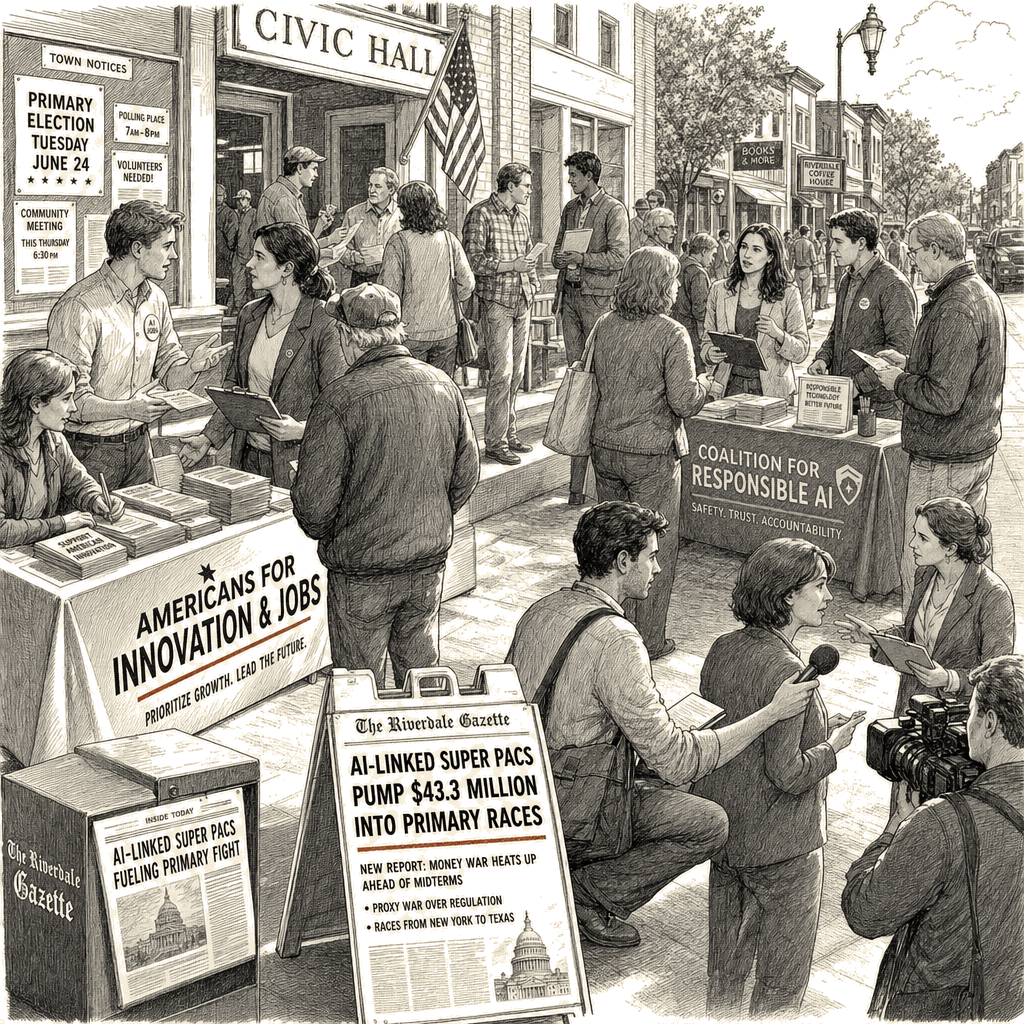
The numbers are worth pausing on—not because they are enormous by the standards of entrenched industries, but because of when they are being deployed. AI-focused super PACs have spent $43.3 million on congressional races this cycle, according to OpenSecrets. Combined lobbying by OpenAI, Meta, Alphabet, and Nvidia reached $50.9 million in 2025. Anthropic quadrupled its lobbying outlays in the first quarter of 2026 to $1.56 million; OpenAI nearly doubled to $1.02 million. These are not enormous by the standards of pharmaceutical or defense lobbying, and it would be dishonest to pretend otherwise. But the AI industry is spending at this level before Congress has written a single piece of substantive AI legislation. They are not lobbying to shape existing rules. They are spending to determine what rules exist. The difference matters. Lobbying a regulator that has already passed a statute is rent-seeking on the margins. Spending forty-three million dollars to ensure the statute that eventually passes is one whose first draft you wrote is something closer to purchasing a franchise.
The mechanism is legible if you ask what the spending actually does rather than what the donors say they intend. Concretely, it does three things. First, it deters. When a state assemblyman who sponsors AI safety legislation sees fifteen million dollars deployed against him in a primary—even if the money ultimately raised his profile rather than ending his career—every other legislator considering a similar bill does the cost-benefit arithmetic. Second, it selects. The candidates who survive this kind of spending are, by definition, the ones the spending did not target, which means the cohort arriving in Congress has already been filtered for industry compatibility before a single vote on AI regulation is cast. Third, it frames. “National standards” sounds like responsible governance. “A chaotic patchwork of state rules that would crush innovation” sounds like a problem that needs solving. The framing does the political work; the structural reality—that a federal floor written by the industry is a ceiling disguised as a floor—is the part that does not make the ad copy.
This is regulatory capture at the pre-legislative stage. Doctorow’s framework names four forces that have historically kept technology companies honest: regulation, competition, interoperability, and community. The AI industry’s midterm spending is a focused assault on the first—regulation—and it is not an accident that this is the one under attack. Competition in frontier AI is already narrowing to a handful of firms with the capital to train models at scale. Interoperability is structurally weak: there are no open standards for large language models, no portability of trained weights, no equivalent of the email protocol that would let a user move between providers. Community enforcement—the user revolt, the public pressure campaign—is diffuse and slow against an industry that moves at venture-capital speed. Regulation is the constraint that operates at the speed of law, not the speed of outrage, and it is the one the industry is spending forty-three million dollars to architect. The specification the PAC filings describe is a world in which the other three forces are already insufficient and the fourth is written by the people it is supposed to constrain.
The playbook is not new. In my father’s experience at Manitoba Rolling Mills in Selkirk, which Gerdau of Brazil purchased in 1995, the playbook was identical: bring enough capital to buy access to the local decision-makers, then use the leverage that concentration provides to rewrite the rules in your favor. The mill’s workforce was hollowed out, not because the new owners didn’t understand the business, but because they understood perfectly well that the constraint that had protected the workers—a union with real bargaining power—could be weakened by the sheer scale of their capital. The AI industry’s political spending is the same maneuver applied to the legislative branch. The goal is to make sure that when Congress finally does produce a bill, the only constraints the companies will face are the ones they chose to write. The engineers building the models, the researchers publishing the safety papers, the data-labelers in Nairobi and Manila—they are not the people funding the super PACs. The people funding the super PACs are the people who will own the output. The political economy is not complicated. It is just uncomfortable.
Congress, for its part, has produced nothing. Bipartisan consensus that AI requires governance remains exactly that—consensus without legislation. The Senate has held hearings. Representatives have introduced bills. The House and Senate have not passed any of them. Congressional inaction is not inertia. It is a watching brief—a legislature observing which way the money flows before it decides which problem to work through first. The AI industry’s forty-three million dollars is, among other things, an answer to that question. The money is flowing toward candidates who will not regulate aggressively and away from candidates who will, and the spending is loud enough that no one in Washington can plausibly claim not to hear it.
State-level legislation—the kind the RAISE Act represents, the kind the preemption strategy is designed to override—remains the most immediate site where the public can shape AI governance. That is not because state legislatures are wiser than Congress. It is because there are fifty of them, and buying all fifty is more expensive than buying one federal floor. The structural remedy, if one is available, lies in preserving that dispersal: letting states experiment, requiring safety reporting, mandating disclosure, and refusing to let a federal standard drafted by the industry’s lobbyists preempt the work that state legislators are actually doing.
There is a public comment period open at the Federal Trade Commission through the end of July on AI disclosure requirements—notice-and-comment, the process by which ordinary citizens and organizations can file views that become part of the official regulatory record. The AI industry will spend more on a single primary in Manhattan than most Americans will earn in a lifetime, and it will do so knowing that the comment portal is free and the PAC filings are not. That asymmetry—between the cost of participating in the regulatory process as a citizen and the cost of purchasing it as an industry—is the headline. The Federal Election Commission filings are public. The spending figures are there for anyone to read. The candidate who passed a safety law is being methodically buried under a volume of attack ads funded by the very companies that would be subject to any federal version of that law. The rules have not been written, and the people who stand to profit if they are never written are spending tens of millions to keep it that way. The work of passing them will have to be done without them.