
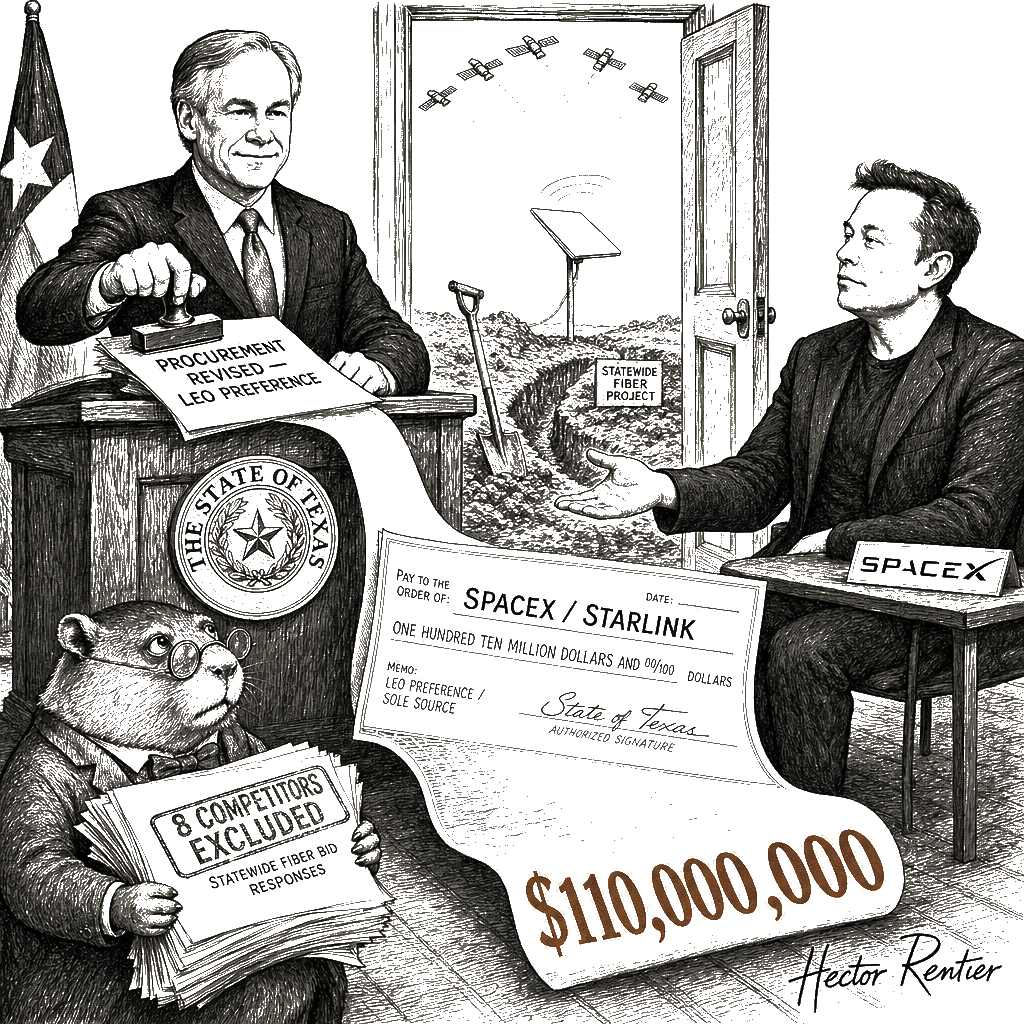
Greg Abbott rewrote the state’s broadband rules to extract $110 million for Elon Musk.
It is true that low-Earth-orbit satellite internet is the only practical option for a ranch thirty miles from the nearest fibre node. The trouble is that the Texas Republican administrative apparatus did not rewrite the state’s broadband procurement rules to solve a physics problem; they rewrote them to solve a donor problem. To understand the architecture of the racket, you have to read what the rule change actually did. Ground-based fibre providers — which build physical glass-and-copper infrastructure that lasts decades and creates local splicing and maintenance jobs — were cut out of the bidding process. The rules were revised to favour low-Earth-orbit (LEO) satellite providers. Since SpaceX’s Starlink is the virtual monopolist in the LEO market, 99 per cent of the available grant funds flowed to a company led by the world’s richest man, a billionaire who has made previous monetary donations to Abbott’s campaigns.
This is not a complicated story. It is a procurement story with one bidder, which is to say a procurement story in which the procurement has already happened and the bidding is a courtesy.
The Texas Broadband Development Office — the BDO — runs a state-and-federal program to extend internet service into places the private market has not reached. In June, the agency’s director, Bryant Clayton, testified before the state Senate’s business and commerce committee that his office had revised its grant structure to favour low-Earth-orbit satellite providers. “The office of the governor asked us to look at how our proposed structure compared to other states,” Clayton said, according to KUT News. “Generally … we were out of step with other nearby states.” Out of step: meaning, the rules that would have let fibre companies compete on the merits were not what the governor’s office wanted. The governor’s press secretary, Andrew Mahaleris, replied with the standard apologetics: low-Earth-orbit satellite service is “essential for the most remote areas where traditional fibre is too expensive and slow to build.” When the dust settled, ninety-nine percent of the available grant money had been directed to SpaceX’s Starlink service. Eight companies offering ground-based fibre broadband complained in writing that they had been excluded from the revised application process.
The committee’s Republican chair, Charles Schwertner, told the hearing: “I’ll just say it bluntly. Favoritism and transparency are real big concerns that have been brought to my office.” Read that again. A Republican committee chair, in a Republican-controlled legislature, in a state with a Republican governor, on the record, calling out favouritism in the governor’s broadband grant. The bar for what counts as extraordinary in Texas procurement has moved a long way from where it used to be.
Now to the engineering layer, because this is where the public framing tends to dissolve. LEO satellite internet — Starlink, in practice — is real engineering, not vapourware. The constellation works. It also has specific properties the marketing tends not to emphasise: latency higher than fibre (typically twenty-five to one hundred milliseconds in real-world conditions, depending on congestion), capacity constrained by available spectrum and the number of satellites overhead, performance degraded by weather and by load as more customers attach to each cell. Fibre, by contrast, has effectively unlimited capacity once laid, latency typically under fifteen milliseconds and often in the single digits, weather immunity, and a thirty-year-plus service life once the trench is dug and the cable is in. It is worth being precise about what the state actually bought. Fibre is glass in the ground. A LEO constellation is a network of disposable satellites in a decaying orbit — with a lifespan of five to seven years before the satellites burn up and require replacement — beaming microwave signals through the atmosphere to a user terminal that costs hundreds of dollars. Fibre lasts fifty years. The state of Texas handed $110 million to a company already cashing multibillion-dollar Pentagon cheques, in order to sell a monthly subscription to a constellation of disposable space heaters.
The cost calculus the governor’s office invoked — “too expensive and slow to build” — is a real calculus in the most remote areas. It is also a calculus that has been steadily getting less true as fibre-build costs have fallen and as a generation of rural electric co-operatives have figured out how to pull cable along rights-of-way they already own. The eight fibre companies that wrote to the BDO are not, in other words, asking the state to subsidise a hypothetical. They are asking to be allowed to bid on contracts they are currently equipped to perform.
There is also a smaller rhetorical move worth naming. The Abbott office’s framing — that LEO satellite is essential where fibre is merely expensive — is what the policy literature documents as default-correct framing: a contested policy choice pre-loaded as the baseline, against which the alternatives must justify themselves. The grammar does the work the engineering does not. Fibre is the position requiring explanation; Starlink is the position requiring defence. The procurement was, in this sense, argued into existence before any actual procurement took place.
My father spent thirty years as a millwright at the Selkirk rolling mill, and one of the few things he respected as much as a properly aligned gearbox was the difference between a capital improvement that stayed in the town and a corporate extraction that shipped the value to a head office you would never visit. The fibre-optic network the state could have funded under a neutral bidding process would have been buried in Texas dirt. It would have been maintained by Texas technicians. It would have increased the property value of Texas land. The Starlink deal is pure corporate extraction. The money goes to a company building rockets in Boca Chica, and when the satellites eventually de-orbit, the state of Texas will own nothing but a service contract with a monopoly that can set the price as it sees fit, because you have nowhere else to go.
This matters because Starlink’s broader business trajectory — its planned expansion into mobile service to compete with AT&T and Verizon, its deepening entanglements with the Pentagon — is the trajectory of a company trying to convert a single-use satellite-internet subsidy into a structural chokepoint on American communications. In Cory Doctorow’s vocabulary, which has the right word for what is happening here, this is chokepoint capitalism: an intermediary positioned between a public good and the people who use it, with the leverage to extract rent on every transit. The Texas grant, in this reading, is not a one-off purchase of rural connectivity. It is an anchor-tenant agreement with a chokepoint in waiting — public money underwriting the position from which Musk can later set prices on the bandwidth Texas depends on, and on which the next round of state subsidies will be needed to keep the service running.
The corruption question — and Nathan Johnson, the Democratic candidate for Texas attorney general, is right to put it on the ballot, as NBC News observed — is not principally a question of whether Greg Abbott took a personal payoff in exchange for the rule changes. Records show Musk has made previous donations to Abbott, as he has to many others; there is no documented link between those donations and this grant. The corruption, if corruption is what this is, lives one level up. It lives in the structure of a procurement process that the governor’s office re-engineered to fit one vendor’s product, with the public justification of speed and the practical effect of foreclosing every competitor who had built the capacity to do the work on different terms. The mechanism is not a brown paper bag. It is a rule change. It is harder to prosecute, harder to photograph, and — under the current Texas attorney general — harder to investigate at all.
Which is why Ken Paxton’s replacement matters here, and not in the abstract. The current attorney general’s office, whatever its other distinctions, is not the office that will audit how a sitting governor awarded ninety-nine percent of a public broadband grant to one company. The pattern of public-interest litigation under Paxton — the voting-rights fights, the regulatory posture, the willingness to use the office’s enforcement powers on behalf of the politically favoured — does not extend to auditing those favours when they benefit the same political coalition the AG serves. Johnson’s plan, as reported in the Dallas News, is straightforward: work with the state comptroller, audit how government contracts are awarded, and treat the Starlink grant as a test case. The legal mechanism, though, is bounded. A Texas attorney general cannot unilaterally subpoena the governor’s office — that authority flows through statutes the legislature writes, and the legislature in Austin is the same Republican-controlled body that wrote the broadband program in the first place. What an AG can do is open a public civil investigation, issue civil investigative demands, refer findings to a grand jury, and use the office’s bully pulpit to compel testimony. The political mechanism is, in some respects, the operative one: a sitting governor’s office that knows the next attorney general intends to hold public hearings on its broadband grants is a governor’s office that has to think twice before the next round of rule changes. “The AG is supposed to ensure that government serves the public good over private interests, not the other way around,” Johnson said on X in June. The phrasing is unremarkable. The fact that it sounds like a reform candidate’s talking point, and not like the obvious job description of the office, is itself a measure of how far the Texas AG has drifted from the role the state constitution wrote for it.
This is, in the end, the question Doctorow’s four-forces framework is built to ask. Competition is the constraint that historically forced vendors to compete for public money on terms the public could audit. Regulation is the constraint that historically let a state procurement office enforce those terms. Self-help — in this case, the right of fibre companies to bid on contracts their equipment can perform — is the constraint that historically kept one vendor from capturing the field. The Starlink procurement has now disabled all three. The agency’s expertise, in Clayton’s testimony, has been instructed to stand down. The Republican committee chair has acknowledged the result on the record. The next round of grant applications will be public. The audit, if there is one, will be public.
The deadline that matters here is November. A vote for Texas attorney general is, in this cycle, a vote on whether the office will investigate the Starlink grant or decline to. Johnson has put the question on the ballot. Paxton’s successor, Republican Mayes Middleton, has not. The procedural detail is the policy: in Texas, the AG is elected, the officeholder sets the enforcement agenda, and the enforcement agenda, when the officeholder has no interest in a sitting governor’s broadband grants, is the audit that does not happen. Submissions to the Texas Ethics Commission on the Starlink grants are public. The hearing transcript is public. The work, as the tradesman’s saying goes, does not care how anyone feels about it. The work is to be done.