
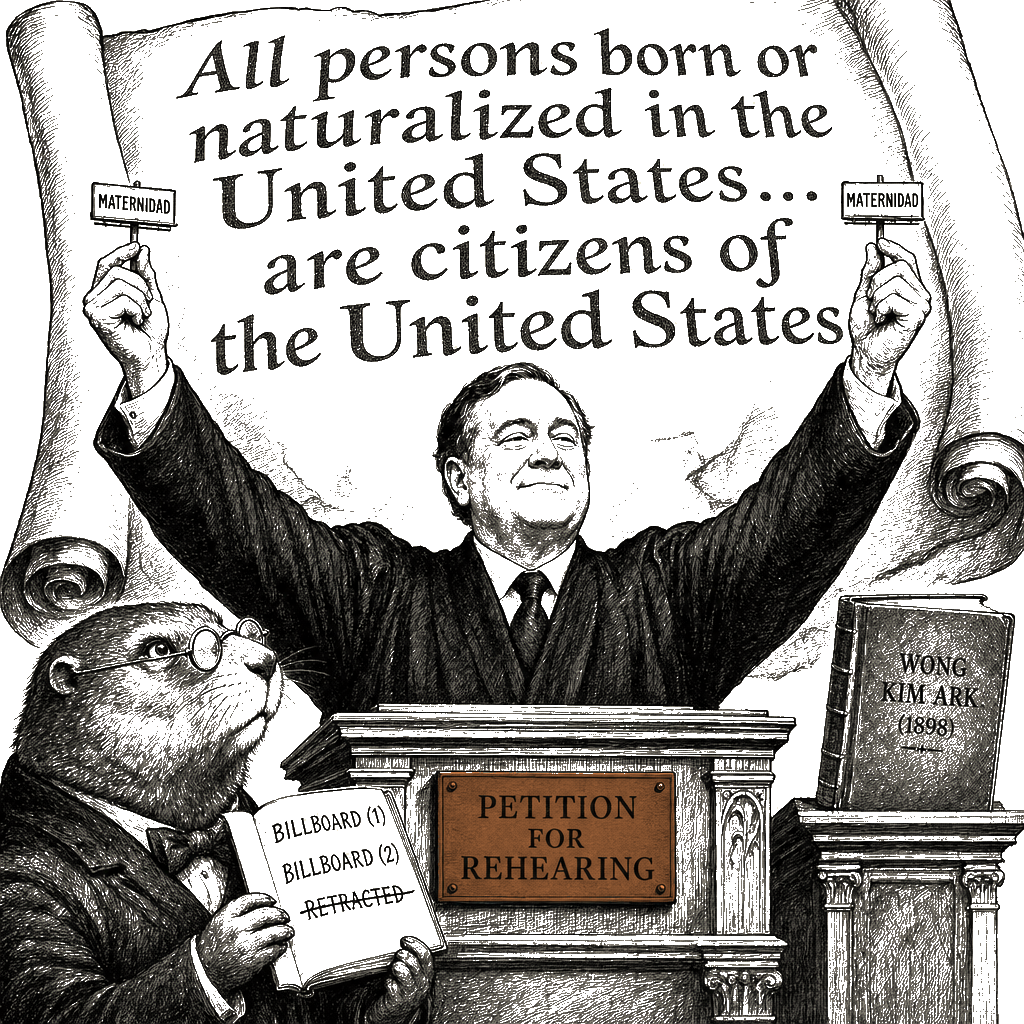
Donald Trump is demanding the Supreme Court nullify the Fourteenth Amendment over a hospital billboard.
The President announced Wednesday he will petition the Court to rehear its June merits ruling, citing as “shocking new evidence” a Fox News report about two Spanish-language billboards in Reynosa, Mexico, advertising maternity services at Mission Regional Medical Center, a public nonprofit hospital in Mission, Texas. The Court rejected the executive order in June, anchoring its holding in the Citizenship Clause, U.S. Const. amend. XIV, § 1. The administration’s response, having pivoted the Justice Department toward prosecuting birth-tourism cases as a regulatory workaround, has now escalated into a direct demand that the Court overturn its own constitutional interpretation, supported by a retracted marketing campaign.
The Citizenship Clause reads in full: “All persons born or naturalized in the United States, and subject to the jurisdiction thereof, are citizens of the United States.” The Court in Wong Kim Ark, 169 U.S. 649 (1898), held that a child born in San Francisco to Chinese parents was a citizen by birth. That holding treated the history as closed. The Court in June reaffirmed it. The clause was drafted by the Joint Committee on Reconstruction to overrule Dred Scott v. Sandford, 60 U.S. (19 How.) 393 (1857), which had held that Black Americans could not be citizens. The clause was intended to abolish that doctrine for everyone born on U.S. soil subject to jurisdiction — not to enshrine it for the children of the disfavored.
The administration has not asked the Court to revisit that history. It has asked the Court to revisit the June ruling on the strength of two billboards.
The procedural posture is a dead end. The Supreme Court has not granted a petition for rehearing after a merits ruling in an argued case in decades — the last such grant was in 1965, when the Court modified a judgment to permit further proceedings below. The rehearing mechanism is not a vehicle for the executive to submit new fact-finding that the Justice Department could have raised before the ruling. The billboards, the Spanish-language website, the deleted Instagram post inviting women “living abroad” to deliver in South Texas, the Texas governor’s investigation, the Justice Department’s pivot to birth-tourism prosecutions — none of this is admissible at the rehearing stage, and none of it would alter the constitutional analysis if it were.
The administration’s strongest remaining position is a historically exhausted reading of “subject to the jurisdiction thereof” — the suggestion that the children of undocumented immigrants are not born “subject to” U.S. jurisdiction in the relevant sense. The reading was advanced in the proceedings that produced the June ruling. It is a reading the Court has now considered and rejected, on a record in which the administration had the opportunity to put on whatever evidence it had of the supposed “birth-tourism industry” — and, if the billboards were the best it had, the Court has now considered those too.
The history-and-tradition audit is the work. Senator Lyman Trumbull, who managed the Fourteenth Amendment on the Senate floor in 1866, stated the jurisdictional qualifier’s scope in plain terms: it excluded only the children of foreign diplomats, hostile invaders, and “Indians not taxed.” The reading the administration advances has no foundation in the legislative record. It was not the 1866 reading. It was not the 1898 reading in Wong Kim Ark. It was not the June 2026 reading. It is the reading the administration wishes the Court had adopted. The Court did not adopt it.
The “shocking new evidence” is two billboards for a hospital that has since retracted its own marketing. The billboards advertised cash-pay prices — $3,950 for a natural birth, $5,525 for a cesarean section — for uninsured patients in a border town. Mayra Flores, who publicized the billboard, did not allege the prices were restricted to foreign nationals; she objected to the price disparity. The administration has offered no evidence that the hospital was facilitating unlawful entry or fraud, no evidence that any person obtained citizenship through the packages in a way the executive order would have prevented, no evidence that the citizenship status of any child born at the hospital differs from what the Fourteenth Amendment prescribes. Mission Regional, facing the backlash, pulled the billboards and scrubbed its Spanish-language website, calling the materials “no longer in use due to any unintended misunderstanding.”
The gap between the constitutional argument and the television segment is the gap between a text the Framers wrote in 1866 and a Fox News segment the administration now calls evidence. The petition is a political document — designed to maintain the fiction that the President retains the authority to define the boundaries of citizenship, and that the Court is merely a political body waiting to be pressured into the correct outcome. The executive branch is treating a foundational constitutional guarantee as a negotiation point, deploying the megaphone of the presidency to manufacture an evidentiary crisis where none exists.
The procedural mechanism is a dead end. The demand itself is the operational reality: the executive is now openly attempting to nullify a constitutional amendment using a billboard as its evidentiary anchor.