
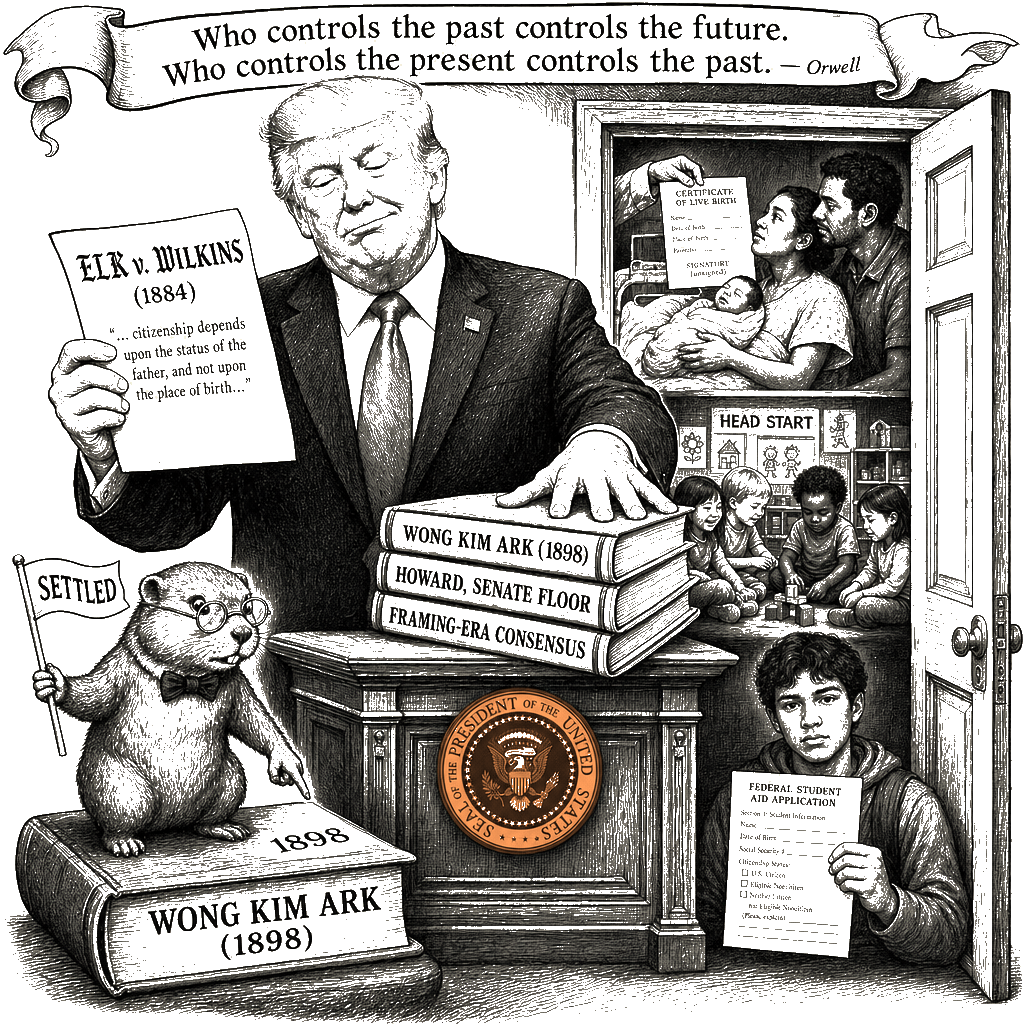
Donald Trump attempted to strip citizenship from millions of American-born children. The Supreme Court said the 14th Amendment means what it says, and struck the executive order down on the final day of the term.
The administration’s strongest argument was textual. The Citizenship Clause of the 14th Amendment guarantees citizenship to “all persons born or naturalized in the United States, and subject to the jurisdiction thereof.” The administration read “subject to the jurisdiction thereof” as a narrow allegiance test that excludes children whose parents owe loyalty to a foreign power, pointing to the 1866 Civil Rights Act’s phrasing that birthright citizenship covered persons “not subject to any foreign power.” The argument’s strongest foothold was Elk v. Wilkins, 112 U.S. 94 (1884), which held that Native American children born to tribal-member parents were not “subject to the jurisdiction” because they owed allegiance to their tribes.
This is a defeated argument. United States v. Wong Kim Ark, 169 U.S. 649 (1898), expressly distinguished Elk, and the tribal-sovereignty logic does not translate to undocumented immigrants who owe allegiance to no parallel domestic sovereign. The 14th Amendment’s framers explicitly considered and rejected a proposal to limit birthright citizenship to children of citizens. Senator Jacob Howard, who introduced the Citizenship Clause, explained that it would “declare, as a matter of fundamental law, that every person born within the limits of the United States, and subject to their jurisdiction, is by virtue of natural law and national law a citizen of the United States.” The administration’s historical sources were cherry-picked from a handful of outlier statements, ignoring the overwhelming consensus of the framing era and 125 years of subsequent judicial interpretation.
The Court read the text plainly. “Subject to the jurisdiction” means subject to the laws and authority of the United States, not to some narrower allegiance test. Children of undocumented immigrants are subject to U.S. law: they can be prosecuted, sued, taxed, and conscripted. Wong Kim Ark had already rejected the argument that children of aliens are outside the jurisdiction, and the order’s reach would have denied citizenship to children of parents unlawfully present, on temporary visas, and in some readings to lawful permanent residents — a sweep even the administration’s narrowest defense could not support.
The order’s reach made clear what was at stake. The children whose status hung in the balance were not abstractions: newborns in delivery rooms across the country, toddlers in Head Start classrooms, teenagers filling out college financial-aid forms, young adults who have known no other home. For months they lived as administrative non-persons in the only country they had ever known, their citizenship contingent on the outcome of a single case. Plyler v. Doe, 457 U.S. 202 (1982), had already confirmed what the text established: undocumented status does not dissolve constitutional protection.
This is a structural defense of the separation of powers. The executive branch cannot unilaterally amend the Constitution by redefining its terms through an executive order. The Court did not engage the policy arguments the administration invoked — that birthright citizenship encourages illegal immigration, that it imposes costs on states — because the Constitution does not permit the political branches to rewrite the Citizenship Clause by executive decree. If the administration wants to change the rule, it must seek a constitutional amendment.
The ruling is a repudiation of a project that sought to manufacture a nativist crisis from a constitutional guarantee. Donald Trump attempted to strip citizenship from millions of American-born children. The Constitution said no.