
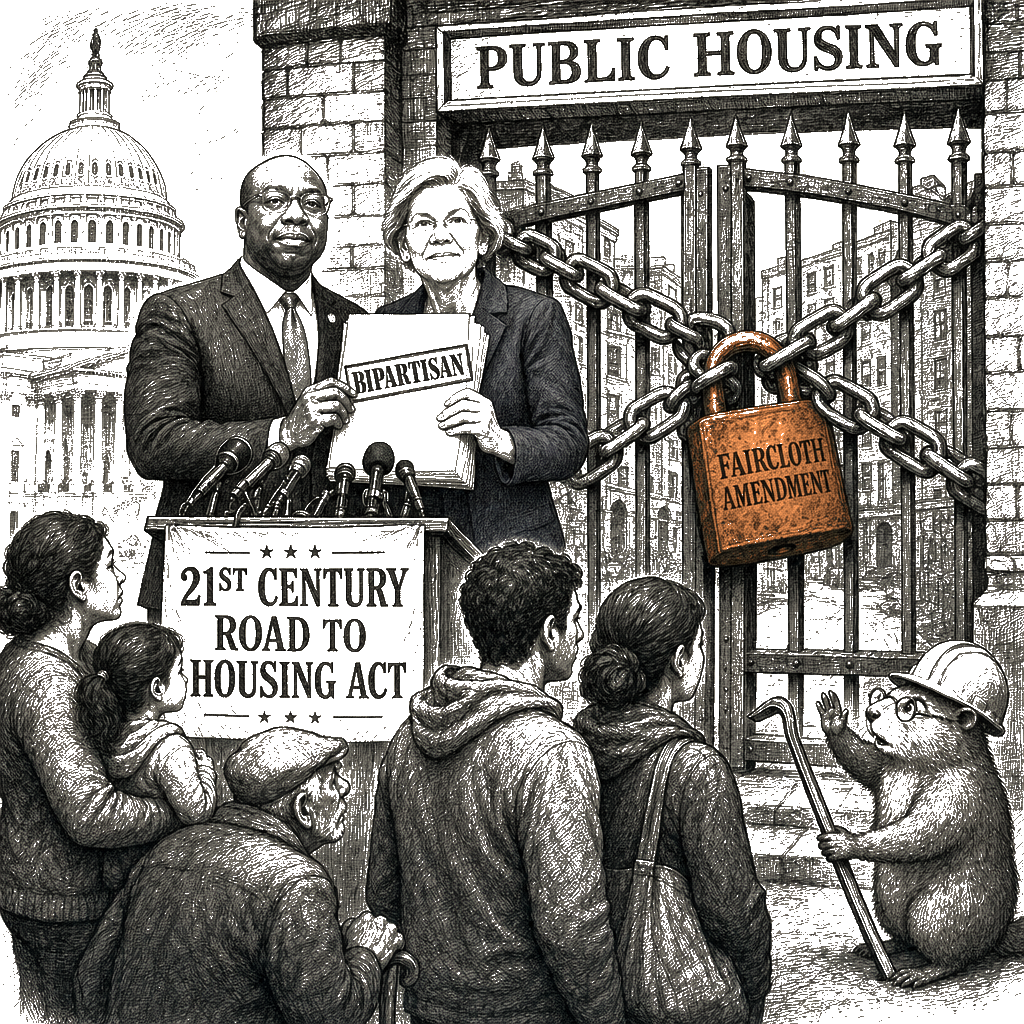
The Senate passed a housing bill that names the crisis and protects its architects.
The 21st Century Road to Housing Act cleared the chamber 85-5 on Monday, an overwhelming bipartisan margin — the kind of supermajority that recalls the Housing and Economic Recovery Act of 2008, the legislation that built the GSE conservatorship architecture still governing the mortgage market today. Its sponsors, Tim Scott and Elizabeth Warren, call it historic. It limits investors’ ability to buy single-family homes, waives certain federal permitting rules, expands access to manufactured homes, increases mortgage availability, and authorizes pilot programs for home improvement grants and affordable housing planning. It heads to the House.
There is a case for this bill. The White House economists’ estimate of a 10-million-home shortage supplies the documented crisis both parties cite. Scott frames the bill as lowering costs, expanding supply, cutting red tape, and helping more Americans achieve the dream of homeownership. Warren calls it the first-ever ban on private equity buying up homes. The bipartisan coalition — 85 senators, five dissenting — suggests provisions moderate enough to offend no one’s donors. On its own terms, as a supply-side package with an anti-investor provision attached, it is a defensible, even good, piece of legislation. The steel-man writes itself.
The audit begins with what the bill does not do.
It does not repeal the Faircloth Amendment, the 1998 statute that caps the number of public housing units the federal government may fund at the level that existed on October 1, 1999. That cap makes new federally funded public housing construction effectively illegal — not prohibited by the Constitution, not struck down by a court, but simply forbidden by an appropriations rider that no Congress has ever removed. Faircloth is the single most consequential piece of housing-supply restriction in the federal code. The 21st Century Road to Housing Act leaves it standing — a bipartisan consensus that the private market should house everyone, and that when it fails, the federal government will offer grants and waivers and pilot programs but not a single unit of publicly owned, permanently affordable housing.
The bill does not expand the Housing Choice Voucher program to the nearly three-quarters of eligible households who, according to HUD administrative data, are turned away each year because the funding runs out. It does not create a single new permanently affordable unit that a landlord cannot convert to market rate when the compliance period expires. It does not address the mortgage-interest deduction. It does not fund the capital backlog in existing public housing, estimated at $70 billion by the Council of Large Public Housing Authorities. In every one of these respects, the bill continues the federal government’s established policy of subsidizing the private housing market and hoping that the people the market cannot house will somehow be housed anyway.
The investor ban the bill’s sponsors have championed — the “first-ever ban on private equity buying up homes” — names a real problem and applies a threshold that exempts the problem’s actual corporate structure. The ban applies to entities that already own 350 or more single-family homes, measured in aggregate and including entities acting “in concert with others.” The corporate buyers the provision appears to target — the Invitation Homes model, the Pretium Partners model, the private-equity playbook Keeanga-Yamahtta Taylor documented in Race for Profit — operate through webs of subsidiaries and LLCs. The aggregate language nominally captures those portfolios. Whether enforcement can trace indirect investment control through opaque corporate structures determines whether the “ban” names a real constraint or a legislative fig leaf.
The bill waives “some federal permitting rules” to ease new construction. Which rules are waived matters more than the fact of waiving. Environmental review under the National Environmental Policy Act? Fair Housing Act affirmatively-furthering obligations? Accessibility requirements? Richard Rothstein, in The Color of Law, documents the federal government’s historical role in constructing residential segregation under color of efficiency and administrative convenience. Permitting “streamlining” that relaxes federal oversight without naming the specific rules at issue is a frame whose content the bill’s supporters have not filled in. And the constraint on housing supply is primarily municipal: exclusionary zoning, minimum lot sizes, parking mandates, single-family-only zoning in high-opportunity neighborhoods. Jenny Schuetz’s Fixer-Upper identifies zoning as “the main obstacle to better housing outcomes.” Federal permitting waivers cannot override the local zoning codes that actually cap how many units get built where. The bill waives federal rules while the rules that constrain supply sit at the municipal level, beyond federal reach without a zoning preemption this Congress will not pass.
The manufactured-home access expansion sounds neutral. The manufactured-housing sector is one of the most extractive segments of residential finance. Chattel loans — the dominant financing instrument for manufactured homes — carry higher interest rates than mortgages and lack the consumer protections of the Real Estate Settlement Procedures Act, as the Consumer Financial Protection Bureau has documented. They flow through a vertically integrated supply chain dominated by Clayton Homes, a Berkshire Hathaway subsidiary, as both manufacturer and lender. Expanding “access” without reforming the finance structure expands the pipeline of borrowers into a system that charges more and protects less than conventional mortgage lending.
The bill authorizes pilot programs for home improvement grants and planning affordable housing. Pilot programs are the congressional answer to structural problems: small enough to be defunded in a continuing resolution, temporary enough to expire without renewal, visible enough to cite in a campaign ad. They are the funding mechanism you choose when you want to be seen addressing a crisis without changing the architecture that produces it.
The architecture the bill leaves untouched has a history. The federal government has not always been in the business of hoping the private market would house the poor. For a period in the middle of the last century, it built public housing directly — units that were owned by the public, rented at below-market rates, and not convertible to condominiums or sold to an institutional landlord when the investors came calling. That period ended, and its end was not an accident.
The campaign against public housing had many architects, but its most durable weapon was the argument that public housing had failed — that the towers were dangerous, that the projects were segregated, that the government should not be in the business of building homes. The argument was, in part, true: the government did build segregated public housing, because it sited the projects in the neighborhoods where Black families already lived and it refused to build in the neighborhoods where white families would object. Rothstein documents how the United States Housing Authority’s 1940s site-selection manuals directed that projects for white families not be placed in areas occupied by Black residents, and that projects for Black families not be placed in areas that were not already predominantly Black. The federal government built segregation into public housing from the start, and then it used the resulting segregation as the argument for why public housing should not be built at all.
What the government did not do — what no Congress has ever done — is build public housing that was not segregated, in neighborhoods that were not already poor, at scale sufficient to house everyone who needed it. The country chose instead to subsidize private homeownership for the white middle class through the Federal Housing Administration and the Veterans Administration, to route the interstate highways through the Black neighborhoods those agencies had redlined, to let the private market provide housing for everyone else, and then, when the private market predictably failed to house the poorest households at a price they could pay, to cap the number of public housing units the government could ever build. The Faircloth Amendment is not a technical provision. It is the statutory expression of the country’s decision that the government will not house the poor directly, and that when the private market fails to do so, the poor will simply have to wait.
Matthew Desmond, in Evicted, documented what waiting looks like: families paying 70 percent or more of their income in rent, moving from one substandard unit to another, losing their possessions and their jobs and their children’s school stability with each eviction. He found that eviction is not a condition of poverty — it is a cause of it, that the housing market as currently structured manufactures homelessness on an industrial scale, and that the federal government, through its voucher program and its public-housing stock, has the tools to stop the machine but has chosen not to use them at the scale the problem requires.
The 21st Century Road to Housing Act will not change that choice. The bill’s passage in an 85-5 vote tells the reader something about the political economy of housing in the United States. There is now a bipartisan consensus that the housing shortage is real, that supply must be increased, and that institutional investors should not be allowed to corner the market on starter homes. But the consensus does not extend to the proposition that the federal government should own and operate housing for the people the market will never serve. On that question, the consensus remains what it has been since 1998: the government should subsidize, but it should not build. The Senate’s vote was a vote to keep that structure in place. It costs no one with a lobbying presence on the Senate Banking Committee anything structural. It names the crisis. It performs the response. It leaves the architecture intact. The Faircloth Amendment will stay on the books, and the federal government will go on refusing to house the poor — not because it cannot, but because it has decided, across three decades and both parties’ majorities, that it will not.