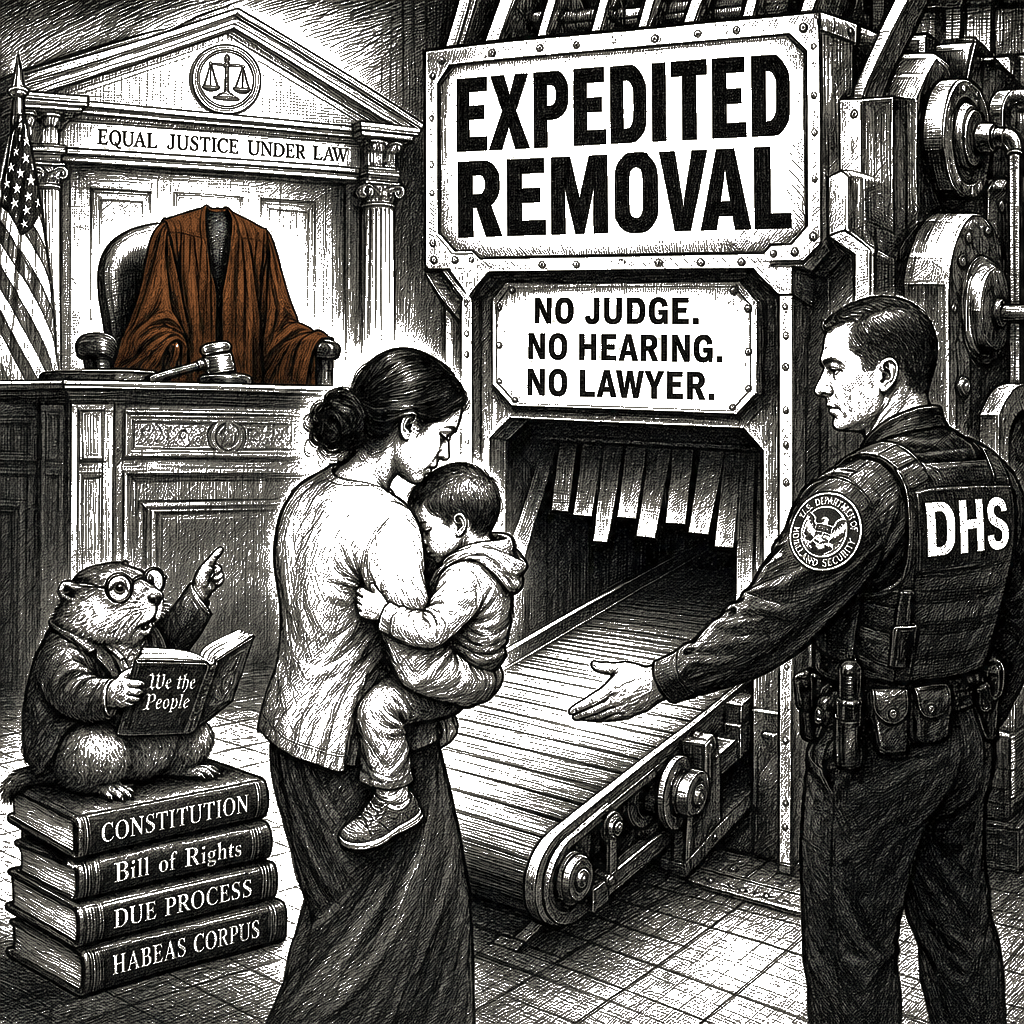
No Judge. No Hearing. No Lawyer. Just the Machine.
Donald Trump can now deport immigrants anywhere in the United States without a full hearing. You have that power now, Mr. President. You have it because a federal appeals court gave it to you, and you are using it to tear families apart.
I write from the tradition that measures a people by how they treat the stranger at their gate — and I do not pretend to neutrality on this subject. The texts I was raised on do not permit it. When a court rules that a person can be seized from any street in America and deported without a judge, the tradition I belong to does not call that a legal development. It calls it what it is.
A panel of the DC Circuit ruled 2-1 on Tuesday to overturn a district judge who blocked the Department of Homeland Security’s move to expand who qualifies for expedited removal. Two Trump appointees — Judges Justin Walker and Neomi Rao — formed the majority. The process that for nearly three decades operated at the border now reaches into every town, every neighborhood, every home in America. Your own Department of Homeland Security now claims the authority to pull a mother from her kitchen, a father from his job site, a child from her classroom, and put them on a plane with no meaningful chance to argue that they have built a life here.
The woman carrying her child through the Manhattan immigration courthouse in December walked toward ICE agents in a hallway. She did not walk toward a judge. Under this ruling, she does not get one.
Judge Robert Wilkins, in dissent, named what the majority refused to see. The expedited removal system does not even ask people how long they have been living in the United States before placing them in the fast-track process. The majority read the statute as granting DHS authority to the “maximum extent allowed by Congress” — treating a power written for the border as a blank check for the interior. For people encountered at the border, the system was designed — whether justly or not — to handle those who had just arrived. Applied to the interior, it reaches people who have built lives. People with children in American schools. People with parishes. People with neighbors who know their names. The system does not ask. The system does not stop.
But the Second Circuit saw the person, not the machine — it rejected the administration’s no-bond detention policy because a person behind bars is still a person before the law — and a second court saw the same. The law is being pulled in two directions. The DC Circuit chose the machine.
The oldest commandment about the stranger is about memory. “You shall not oppress a resident alien; you know the heart of an alien, for you were aliens in the land of Egypt.” Exodus said it. Leviticus said it again. Dozens of times the commandment appears — more often than any other in the text — and every time the mechanism is the same: remember that you were the stranger, and let that memory make you merciful. The expedited removal of people from their communities does not require your cruelty. It requires only your forgetting.
The DC Circuit majority wrote that migrants receive “notice” and “a chance to object.” Judge Wilkins responded that the procedure does not even require asking how long someone has been here. Notice of what? A chance to say what? A person grabbed on a Tuesday afternoon from their workplace, given no lawyer, given no hearing before a judge, told they are being placed in expedited removal — what objection is available to them? What meaningful opportunity to be heard exists when the hearing itself has been eliminated?
What you are doing is evil. I use the word deliberately, because the tradition you claim — the Christianity you invoke when it suits you — uses it. Isaiah named it: “Woe to those who make unjust laws, to those who issue oppressive decrees, to deprive the poor of their rights and withhold justice from the oppressed.” The system that does not ask how long a person has lived here, does not give them a judge, does not let them speak before it removes them — that system is the woe Isaiah saw coming.
In Matthew 25, Jesus looked at the ones who separated the sheep from the goats and named the criterion: “I was a stranger and you welcomed me” — and then he named the failure: “I was a stranger and you did not welcome me.” He did not say the stranger needed papers. He did not say the stranger needed to have been present for two years. He said the stranger was standing there, and you looked away. You are not welcoming the stranger. You are deporting him. You are deporting Christ.
The bishops of the United States and Mexico, in their 2003 pastoral letter Strangers No Longer, wrote that “the human dignity and human rights of undocumented migrants should be respected.” They called the migrant “the mysterious presence of the crucified and risen Lord.” Your administration treats migrants as a problem to be removed as quickly as possible. This is not a policy difference; this is a rejection of the gospel.
I am not exempt from this. I am a citizen of a country that has built this machinery, and I have benefited from the cheap labor and the cheap food it produces. I am a Catholic who has often been silent when I should have spoken. The climate this administration is exploiting is one our own communities helped to build. This is my confession. But it does not let you off the hook. You are the one pulling the lever.
This is not a partisan point. Expedited removal has been used by presidents of both parties. Your own administration claimed this exact power before — in 2019. The Biden administration rescinded it. Now you are reasserting it. The administrative machinery is not novel. The scope is. The reach into the interior, into the kitchen, into the parish parking lot — that is your choice.
Your general counsel called the ruling “vindication.” Vindication of what? Of a policy that ignores the stranger at the gate? The law does not make it right.
A humane immigration system would recognize that the person in the hallway has a name, a history, a claim to dignity that no court ruling can erase. It would provide a judge before it provides a deportation order. It would ask how long someone has lived here before it decides to tear them from the place they have made home. The teaching is not complicated. The practice is what we refuse.
Francis named it at Lampedusa. The globalization of indifference. We have become used to the suffering of others. A court rules that a person can be grabbed from any street in America and deported without seeing a judge, and we scroll past it because it happened to someone whose name we do not know.
Romero stood before the soldiers of his own country and said, in the name of God, in the name of the suffering people whose laments rise to heaven: cese la represión. He said it to men who were also sons, also brothers, also people made in the image of God. He did not say it in contempt. He said it because the door was still open. I beg you, in the name of God, to stop. I beg you as Romero did in his final homily. I beg you to read the words of Pope Francis, who stood on the shore of Lampedusa and wept for the dead and denounced the globalization of indifference. Repentance is possible. The door is still open. But it will not stay open forever.
The mother in that hallway is still carrying her child. The ruling did not make her disappear. It only told the law to look away.
You who carry out this order — you who work for DHS, you who staff the expedited removal process, you who walk the hallways of immigration courts — you are not the machine. You are the person operating it. She is not a case file. She is a person. The child she carries is a person. The door is still open. You can refuse.