
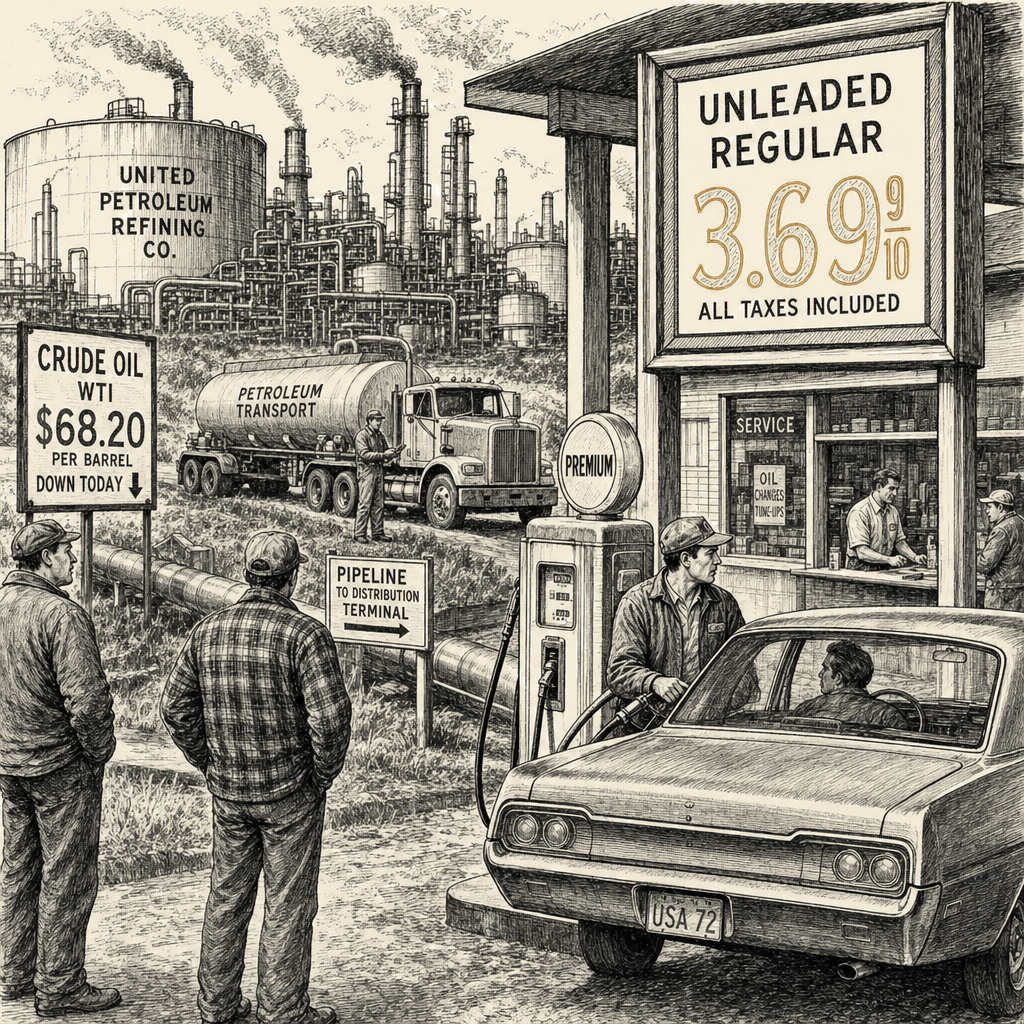
Trump soothed crude-oil markets through diplomacy and emergency stockpile releases while his own ethanol mandate quietly added fourteen cents a gallon to every fill-up in America.
That is the plain arithmetic of what happened at the pump this summer. The President has spent months managing the price of a barrel of oil. He has been, at times, effective at it. Crude hovers around $80 a barrel — up 18% since the Iran war began last year, but not the $120 spike the market feared. The stockpiles that absorbed that shock are still there, drawn down but holding. The crude-oil market has buffers. The gasoline market does not.
Gasoline is $3.94 a gallon. That is 32% above where it was before the war. The gap between what the President controls and what you pay when the pump clicks off is fourteen cents a gallon in compliance credits alone — the cost of a biofuel mandate his own administration raised to record levels in March.
From the shop floor in Friendship, that gap is not abstract. It is the difference between filling the truck for $60 and filling it for $78 — eighteen dollars a tank that comes out of the repair bill or the grocery list, whichever breaks first.
The crude-oil market’s shock absorber was China. Beijing’s refiners cut their crude imports nearly in half since the war started — from about 11 million barrels a day to 5.7 million in June, according to the International Energy Agency’s July report. We covered the possibility that pause might end two weeks ago, and the market was watching, because China’s return to buying would tighten crude supplies fast. On top of China’s pullback, the IEA’s member nations released 2.4 million barrels a day of crude from strategic reserves in May and 1.5 million in June. Between the two forces, the world had crude oil to spare.
Gasoline had nothing comparable. There is no strategic stockpile of refined fuel in the United States. The Strategic Petroleum Reserve holds crude — the raw material, not the product. Getting from crude to gasoline requires refineries, and refineries are exactly what the war has taken offline.
The damage is concentrated in two places. Russia, the world’s second-largest fuel exporter, has lost more than a quarter of its refining capacity to Ukrainian drone strikes. The country that normally supplies about 11% of global seaborne diesel imposed a short-term export ban on the fuel last week and has started buying gasoline from India and Belarus — a reversal so stark it would have been unthinkable eighteen months ago. In the Middle East, refiners processed just 7.6 million barrels a day in the second quarter, a fifth less than a year ago, according to the IEA. Some facilities have been damaged by Iranian strikes. The Strait of Hormuz, the export bottleneck for the region’s fuel, remains intermittently disrupted.
Global refineries processed 5.1 million fewer barrels a day in the second quarter compared with the same period in 2025. That is the number that explains the crack spread — the gap between crude and gasoline prices — averaging 90 cents a gallon in July, the highest in four years.
The geometry is unforgiving. Crude can resume quickly when a ceasefire holds. A damaged refinery takes months to restart. And the logistics work against you even when the oil is flowing: crude travels in supertankers carrying up to 2 million barrels; fuel ships carry tens of thousands. The smaller vessels move slower. The fuel gets out of the Middle East later than the crude does. “It takes longer for that supply to get out,” Rob Smith, S&P Global’s head of fuel retail, told the Journal.
In the United States, gasoline inventory is about 8% below the five-year average for this time of year. The Trump administration could ease some of the pressure by suspending the gas tax or scaling back blending mandates. But the larger determinant of what you pay at the pump is a global refining shortfall the President’s diplomacy cannot touch.
Here is where the arithmetic turns against the administration’s own policies.
In March, the Trump administration raised the quota of biofuels that U.S. refiners must blend into their fuels for 2026 and 2027. The quotas are now at record levels. The problem is that most U.S. gasoline already contains the maximum standard amount of ethanol — 10%. Refiners cannot simply blend more biofuel to meet the higher target. What they must do instead is buy compliance credits. Novi Labs estimates those credit costs embedded in gasoline prices rose to 14 cents a gallon in July, up from 5 cents the previous year.
Fourteen cents a gallon. On every fill-up. At every pump in America. Not because of Iran. Not because of Russia. Because of a mandate the President’s own administration chose to escalate. Nine cents of that is the increase — new cost layered on top of the old, written into the price at the same moment the war was already punishing the household budget.
The irony, if you want to call it that, cuts across the usual lines. The ethanol mandate was supposed to support corn farmers and reduce oil dependence. Corn is around $4.40 a bushel — historically middling, and not enough to make ethanol margins healthy when input costs have risen with the war. What the mandate is doing in practice, at this moment, in this market, is adding cost to gasoline at the pump without delivering proportional benefit to the farm.
I have read Berry write about this kind of structural contradiction — the policy that claims to serve the rural economy while the rural economy absorbs the cost without the benefit. In The Unsettling of America, he calls it the extractive mind: the assumption that a system works because the people at the top say it does, while the people at the bottom carry the weight. The compliance credit is a small thing, 14 cents on a gallon. But it is the administration’s own hand on the scale, at a moment when the pump is already punishing the household budget. Suspending the mandate would ease the pump — and break with the corn-state allies the administration cannot afford to lose. That is the trap.
The honest accounting, from the deer stand and from the bench, is this.
The President has tools. He can suspend the ethanol mandate. He can suspend the gas tax. He can release more crude from the reserve. What he cannot do is restart a refinery in the Middle East with a phone call. What he cannot do is rebuild Russian refining capacity that Ukraine has spent months dismantling. What he cannot do is manufacture a strategic stockpile of gasoline that the country never built.
And there is no easy way out. A Bloomberg analysis found that of the top 25 congressional districts for announced clean-energy investment, 21 were Republican-represented — the same political economy that steers investment to red districts keeps the ethanol mandate in place, because both serve the farm belt’s leverage. The diesel I buy at the co-op in Friendship is wired by pipeline and tanker to a fight that has been going on since before there was a Friendship, Wisconsin. The President is in that story. He is not the whole story.
What the story means, for the man filling his truck in Adams County this week, is that even if the ceasefire holds and the crude comes back down, gasoline will stay higher for longer. The refining restart takes months. The logistics take weeks. The compliance credit takes an act of the administration that put it there — and that act would cost him his own base.
At some point you stop calculating what the President could do and start calculating what the pump is actually charging. For those of us in counties like this one, where the truck is not optional and the repair bill is not discretionary, that is the only calculation that matters. The rest is politics. The pump does not care about politics. The pump charges what the global market and the domestic mandate say it charges, and the man paying it is the one who has to figure out what comes out of the household budget to cover it.
That is not energy independence. That is not leverage. That is what it costs to run a truck in a county where the nearest refinery is six states away and the mandate that adds fourteen cents a gallon was written by the same administration that claims to have solved the problem.
The co-op delivers on Thursday. The bill will be what it is.