
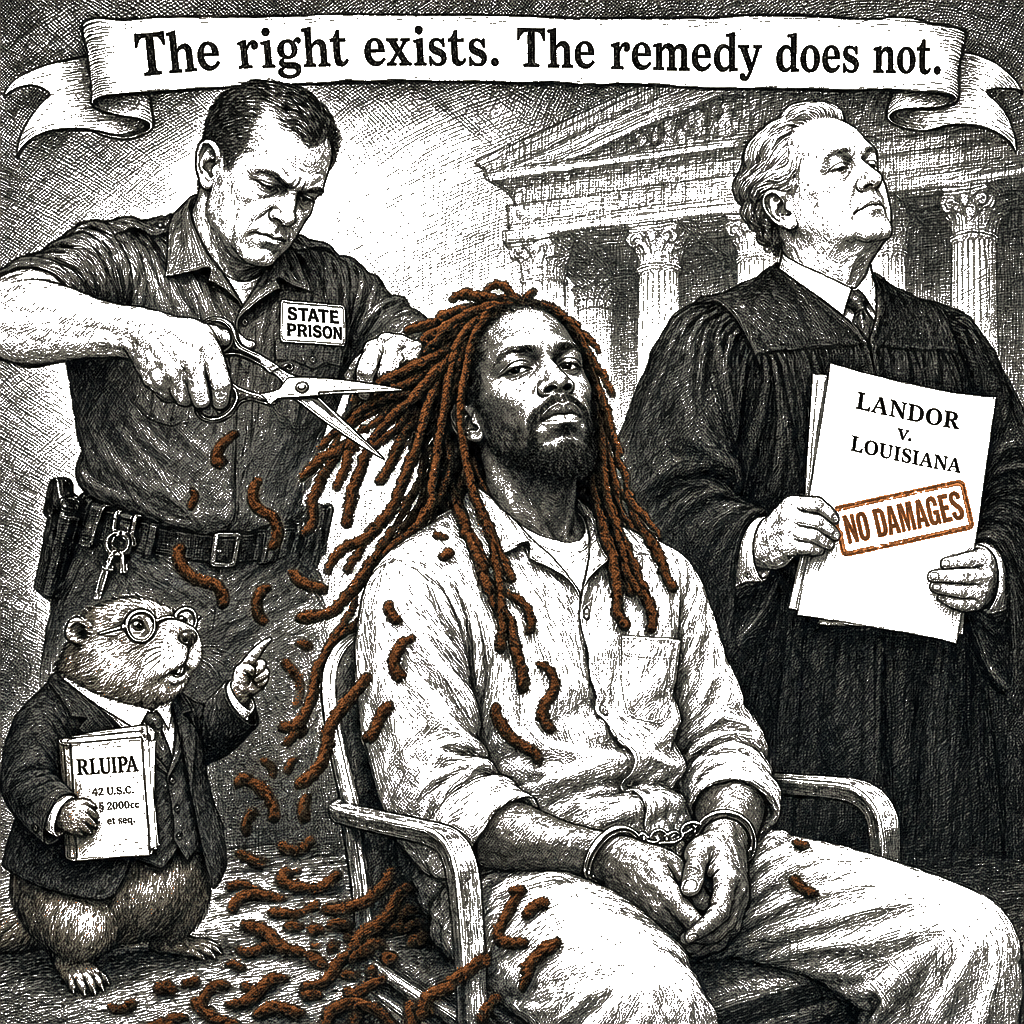
The Supreme Court is helping state prison guards cut off religious crowns and get away with it. Today, in Landor v. Louisiana, the six-justice conservative supermajority ruled that a Rastafarian inmate who was handcuffed to a chair while guards shaved his dreadlocks against his faith cannot sue those guards for damages under the very federal law Congress passed to stop exactly this kind of institutional sacrilege. The text of the statute permits the suit. The Court’s own precedent under a parallel statute demands it. The justices chose otherwise.
Damon Landor was serving a state drug sentence in Louisiana. He is Rastafarian. Growing uncut, uncombed hair into dreadlocks is a central devotional practice of his faith—a symbol of the Nazirite vow, of spiritual growth, of a covenant worn on the body. For the first four months of his sentence, prison officials let him keep his hair.
In the final month, after Landor was transferred to Raymond Laborde Correctional Center, a guard told him to cut it. Landor told the guard he was Rastafarian. He produced a copy of a federal appeals-court ruling holding that cutting a Rastafarian prisoner’s hair against his will violated the Religious Land Use and Institutionalized Persons Act—RLUIPA, the statute Congress enacted in 2000 specifically to protect prisoners’ religious exercise in state institutions receiving federal funds.
The guards threw the ruling in the trash. They handcuffed Landor to a chair. They shaved his head.
Landor sued for damages. A district judge dismissed the suit. The Fifth Circuit affirmed. The Supreme Court, in an opinion by Justice Gorsuch, has now affirmed as well.
The doctrinal vehicle is the Spending Clause. RLUIPA was enacted under Congress’s spending power—conditions attached to federal funds. The state, as sovereign, consents to those conditions when it cashes the check. Individual prison guards do not. They are not parties to the funding agreement. The Spending Clause, the Court held, cannot impose direct personal liability on them without their consent.
This is, as a reconstruction of the constitutional architecture, defensible. The Court has required for decades that conditions on federal funds be stated unambiguously so states can make a knowing choice. Individual employees do not make that choice. The state does.
But the gap between that steel-man and the actual record is the one that has been this Court’s signature move in religious-liberty cases for the past half-decade: the abyss between what the Court says it is doing and what it is actually doing, between the neutral constitutional-architecture principle it invokes and the asymmetrical pattern of results that principle produces on the ground.
Begin with the most direct comparator available. In 2020, the Supreme Court held unanimously in Tanzin v. Tanvir, 592 U.S. 808, that the Religious Freedom Restoration Act—RLUIPA’s federal-officer sibling, a statute enacted by the same Congress to do the same thing for a different category of victims—permitted individual-capacity damages suits against federal officials for religious-liberty violations. The plaintiffs were three Muslim men placed on the federal no-fly list after they refused to serve as FBI informants. The Court said those men could sue the federal agents in their personal capacities for money damages. RFRA’s text, the Court reasoned, provided “appropriate relief against a government,” and that phrase included individual-capacity damages suits against federal officers.
RLUIPA’s damages provision, at 42 U.S.C. § 2000cc-2(a), is textually parallel to RFRA’s. It authorizes “appropriate relief against a government.” It defines “government” to include officials acting under color of law. The word “person” carried the individual-capacity damages claim against federal officers in Tanzin. In Landor, the same word in the same statutory architecture carried nothing.
The structural difference between the two cases is the constitutional source of congressional authority. RFRA was enacted under Section 5 of the Fourteenth Amendment and the Necessary and Proper Clause—sources that reach federal officers directly. RLUIPA was enacted under the Spending Clause, which runs against states as entities that accept funds. The distinction is analytically available. It is not textually compelled. Nothing in the Spending Clause prevents Congress from conditioning federal prison funds on a state’s acceptance of personal liability for officials who violate inmates’ religious exercise. RLUIPA’s text can be—and should be—read to impose exactly that condition. The Court chose not to read it that way.
The distinction is also the kind of distinction that, when applied with the same rigor across cases, produces one result for Muslim men on the no-fly list and another for Rastafarian inmates in Louisiana. The Court’s religious-liberty docket over the past five terms does not leave this question in the posture of a neutral doctrinal application.
The Court has expanded the concept of religious injury to cover a football coach praying at midfield in Kennedy v. Bremerton, 597 U.S. 507 (2022). It has expanded it to cover a website designer who had never been asked to design a same-sex wedding site in 303 Creative LLC v. Elenis, 600 U.S. 570 (2023). It has expanded it to cover a Catholic foster-care agency that wanted to exclude same-sex couples from its certification process while continuing to receive public funds in Fulton v. City of Philadelphia, 593 U.S. ___ (2021). It has expanded it to cover religious schools seeking government funding in Carson v. Makin, 596 U.S. 68 (2022). In each case, the Court found a way past the institutional-defendant problem—past the state-action requirement, past the standing barrier, past the Spending Clause’s clear-statement rule—to reach the individual religious claimant’s right to relief. In each case, the remedy was structured so that the religious believer won. This trend is now extending beyond the Court: states across the country are racing to criminalize disruptions of worship services, reinforcing a hierarchy of whose religious exercise gets the state’s protection.
In Landor, the Court found that the same constitutional architecture that opened the courthouse door for the football coach, the web designer, the Catholic charity, and the religious school closes it on the Rastafarian inmate. The state can receive federal funds for its prison system. The state can agree, by accepting those funds, to comply with RLUIPA’s requirement that it not substantially burden a prisoner’s religious exercise. But the individual officers who carry out the burden—who handcuff the man to the chair, who shave his head—cannot be reached by the law Congress passed to stop them. The state’s agreement to comply creates no personal cause of action against the employees who violate it.
This is the pattern of originalism-as-pretext, catalogued at SCOTUS-3: a constitutional-architecture principle deployed to reach one outcome in cases where the Court’s coalition favors the plaintiff and the opposite outcome in cases whose structural posture is, in every way that matters, the same but whose plaintiff does not look like a plaintiff the coalition’s litigation strategy is built to favor. The Spending Clause analysis is the container. The container expands to permit the damages remedy against federal officers in Tanzin and contracts to foreclose the identical remedy against state officers in Landor. The container is not doing the work. The identity of the plaintiff is.
And it is the pattern of standing doctrine deployed as gatekeeping, the technique catalogued at SCOTUS-9, applied here in its remedial variant: the Court has constructed a regime in which the federal right exists on the books but the remedy for its violation does not. The right is text. The remedy is what makes the text more than a promise the state is free to break.
Justice Ketanji Brown Jackson, in dissent, named the result directly. “Prisoners like Landor who suffer violations of their religious freedom in state prisons—no matter how blatant—will often be left remediless.” Those are her italics. No matter how blatant. The guards threw the court order in the trash. They handcuffed him to the chair. They shaved his head. The record is that blatant.
Justice Gorsuch wrote the majority opinion in Landor as he did in Bostock v. Clayton County, the 2020 case that extended Title VII to cover sexual orientation and gender identity on a textualist reading of the statute’s plain language—a reading that infuriated the conservative movement and remains the strongest counterexample to the asymmetry thesis. He is the justice most willing to follow text where it leads, even when the result upsets the Court’s coalition. Landor is not that case. The text of RLUIPA provides, at 42 U.S.C. § 2000cc-2(a), that a person may “assert a violation of this chapter as a claim or defense in a judicial proceeding and obtain appropriate relief against a government.” The phrase “appropriate relief against a government” is the same phrase the Court unanimously read in Tanzin to include individual-capacity damages. The same Gorsuch who insisted in Bostock that only the words on the page matter now construes the same statutory language to exclude them.
The functional result is structural impunity. State prison officials who violate a prisoner’s religious exercise face, as a practical matter, no federal financial consequence. Injunctive relief under RLUIPA is available in theory. In practice, prisoners who are transferred, released, or subjected to retaliation before relief issues—and prisons that change policies to moot claims the moment a lawsuit is filed—make the injunction-only remedy largely illusory for the class of plaintiffs RLUIPA was enacted to protect. Individual-capacity damages, the remedy the Court found in Tanzin, is the mechanism that makes rights real against state officials who hold prisoners’ bodies and decide what happens to them. The six-justice majority stripped that mechanism away. It will not be replaced.
The Court’s holding is not confined to Rastafarian inmates. It applies to every prisoner in every state prison that receives federal funds—which is to say, every state prison in the country. A Muslim inmate whose Quran is confiscated and destroyed. A Jewish inmate whose kosher diet is denied. A Native American inmate whose access to a sweat lodge is cut off. An inmate of any faith whose religious practice is burdened by a guard who knows it and does it anyway. Under Landor, the federal statute Congress designed for this exact harm does not reach the individual guard who commits it. Other claims might exist in some postures. RLUIPA was the one Congress built for this. The right exists. The remedy does not.
The Court has constructed a regime in which the individual officer who carries out the religious-liberty violation is insulated from suit by the very constitutional architecture that Congress used to pass the law protecting the right. The architecture is neutral. The application is not. The Court selects the constitutional container that produces the outcome it wants—the inmate loses, the prison officials win—and then invokes the container’s neutral-sounding vocabulary to describe the result as though the container itself compelled it. It does not. The container is the vehicle. The outcome is the destination.
Damon Landor calls his dreadlocks his “crown.” The guards cut it from his head. They knew it violated his faith. They had a federal court order in their hands saying so—before they threw it in the trash. They cannot be made to pay for what they did. The Court has left him remediless. Justice Jackson’s dissent uses that word. It is exactly right. The same institutional architecture that has been selectively deployed to protect the religious exercise of some is being used to strip it from others, and the Court is doing it while claiming to do nothing but apply neutral law. The claim is false. The record proves it.