
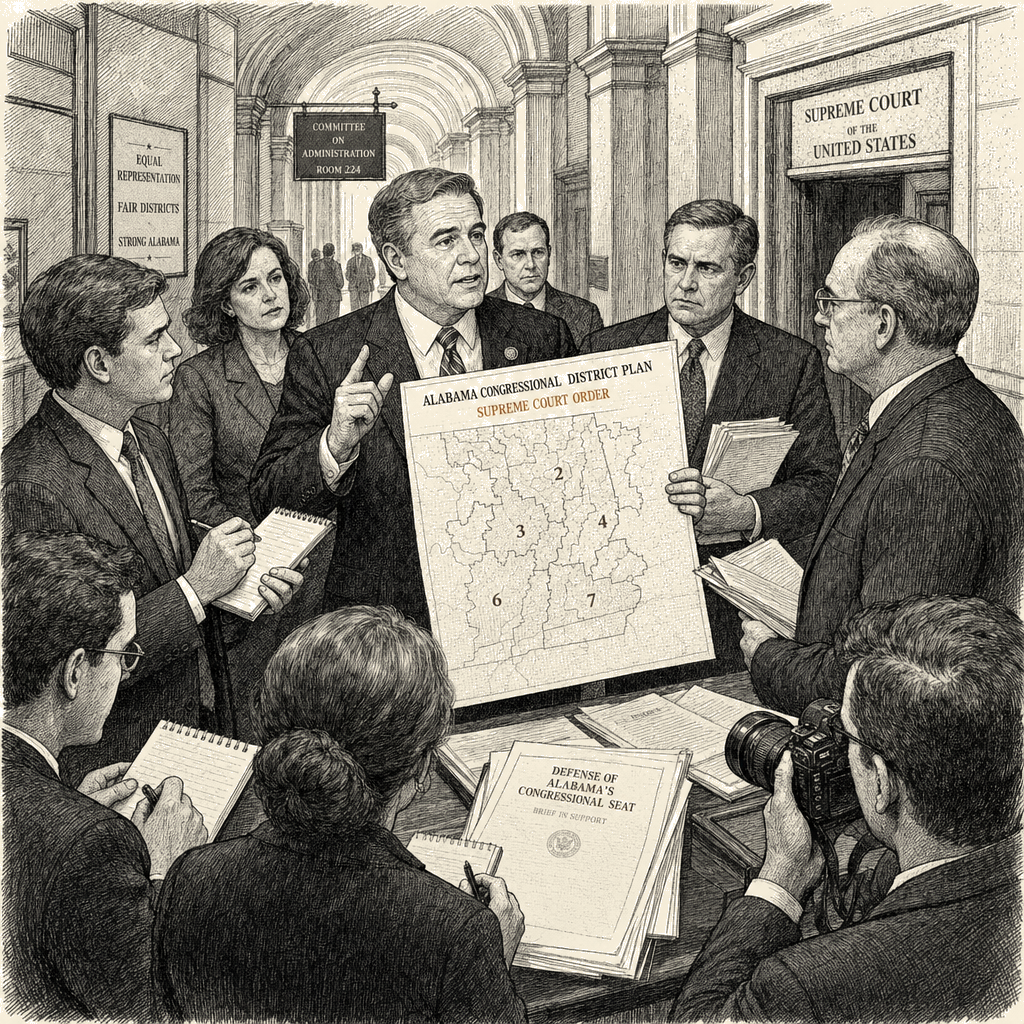
The Supreme Court is helping Alabama erase Black voters from power.
The numbers alone would tell the story if the Court read its own docket. Tuskegee, where Representative Shomari Figures was elected in 2024 as the first Black member of Congress for that city in the modern era, is eighty percent African American and nearly one in three residents live in poverty. The district Figures represented stretches across Alabama’s Black Belt, through Montgomery and into Eufaula, where Black residents experience poverty at nearly fifty-seven percent — more than four times the rate of the white population. The fire department, whose building is not fit for its purpose, bandages bullet wounds on the station floor because the nearest hospital is in another town, fifty miles away, and many residents simply do not have the funds to get there. Figures secured one million dollars in federal funding for a civic center that would house both the police and fire departments and serve as a storm shelter. That project is now at risk.
The Court’s April ruling in Louisiana v. Callais, 608 U.S. ___ (2026), allowed Alabama to dissolve Figures’ majority-Black district, replacing it with a map that makes his seat majority-white. The decision narrowed the Voting Rights Act’s Section 2 in practice if not in name, tightening the geographic-compactness inquiry under the first Gingles precondition to a standard that effectively permits states to dismantle districts like Figures’. The three-judge panel that first blocked the map had cited evidence in the record of state legislators referring to Montgomery during the redistricting process as “monkey town.” Montgomery is over sixty percent African American.
The Court’s stated reasoning deserves the working-bar reconstruction the framework requires. Rucho v. Common Cause, 588 U.S. 684 (2019), established that partisan gerrymandering claims are nonjusticiable — federal courts have no manageable standards to decide when partisan line-drawing goes too far. Callais reaffirmed that holding. Allen v. Milligan, 599 U.S. 1 (2023), preserved Section 2 vote-dilution claims under Gingles — specifically the three preconditions of geographic compactness, racial bloc voting, and dilution traceable to the challenged lines. Callais then tightened the geographic-compactness requirement to a standard that, as Justice Kagan wrote in dissent, “renders Section 2 all but a dead letter.” The state’s position, articulated by Alabama Attorney General Steve Marshall, is that the map reflects race-neutral partisan principles, not racial discrimination — the same principles Democrats use when they redraw maps in states like California. The Court accepted that framing. An honest application of Rucho and Callais yields the result Alabama sought.
The gap between that reasoning and what actually happened in Alabama’s redistricting process is the gap between a facially neutral doctrine and a documented record of racial intent. The text message calling the majority-Black state capital “monkey town” is not an isolated comment. It is evidence of a calculus the Court’s framework cannot see because the framework was built not to see it. When voting in Alabama is as racially polarized as it is — when the correlation between race and party affiliation approaches identity — a “race-neutral partisan” map is a racial map by other means. The doctrinal container Rucho supplies — “partisan gerrymandering is nonjusticiable” — converts that reality into a permission structure. The state legislator who wrote “monkey town” does not need to prove discriminatory intent under the Court’s current framework. He only needs to say he was thinking about partisanship.
This is what the Roberts Court’s VRA narrowing over the last decade looks like at the point of application. Shelby County v. Holder, 570 U.S. 529 (2013), struck the preclearance formula the VRA had relied on for nearly fifty years. Milligan appeared to restore something like it — the Court actually enforced Section 2 against Alabama’s prior map, preserving the vote-dilution framework under the three Gingles preconditions, including the requirement that a minority group be geographically compact enough to form a majority district. But Callais followed within three terms, narrowing that very geographic-compactness precondition so aggressively that the enforcement mechanism the Milligan plaintiffs had just won with is substantially disabled. The pattern is consistent: each time the VRA is enforced, the Court produces a doctrinal refinement that makes the next enforcement harder.
The consequences land on people who do not have the luxury of doctrinal refinement. Mary Porter, seventy-one, lives on a fixed income in Eufaula with no transportation. She marched as a child for the 1965 Voting Rights Act. After two strokes, she depends on friends to drive her fifty miles to a doctor in Georgia. Figures helped secure five hundred thousand dollars in federal funding for an MRI machine at Eufaula’s struggling hospital — a machine that does not yet exist in a hospital that does not yet have one. The CEO of that hospital told the BBC: “I think he cares. And I’d hate to lose anybody that cares.”
The Court does not read those testimonies. It reads briefs. It applies manageable standards. It produces decisions that, in Justice Kagan’s phrase, render Section 2 all but a dead letter. The voters of Alabama’s Black Belt, whose grandparents marched under the original 1965 Act, now discover that the Court’s doctrinal framework treats the evidence of their ongoing disenfranchisement as unreachable by federal law — not because the evidence is weak, but because the doctrinal containers the Court built for a different set of cases simply cannot hold it.
Figures now faces the winner of the August 11 Republican primary. State Representative Rhett Marques, endorsed by President Trump and House Speaker Mike Johnson, campaigns in the mostly-white wiregrass region that was folded into Figures’ district after the ruling. Barry Moore, Figures’ predecessor who is now running for Senate and who did not respond to the BBC’s request for comment, told local media after the ruling that “elections should be determined by Alabama’s values and candidates’ ideas, not the color of anyone’s skin” — a framing that the “monkey town” texts, the record of racially polarized voting, and the poverty disparities in Figures’ old district all treat as self-refuting. The values Alabama’s majority would choose under the new map were determined by legislators who, in the official record, referred to the state’s capital as “monkey town.”
Figures told the BBC what he believes the motivation to be. The text messages in the record support him. The Supreme Court disagrees. The people of Tuskegee and Eufaula will vote in November under a map their representative’s predecessor could not have drawn before Shelby County, could not have used before Callais, and will now deploy as though the doctrine had always permitted it — because the Court built the doctrine to permit exactly this.