
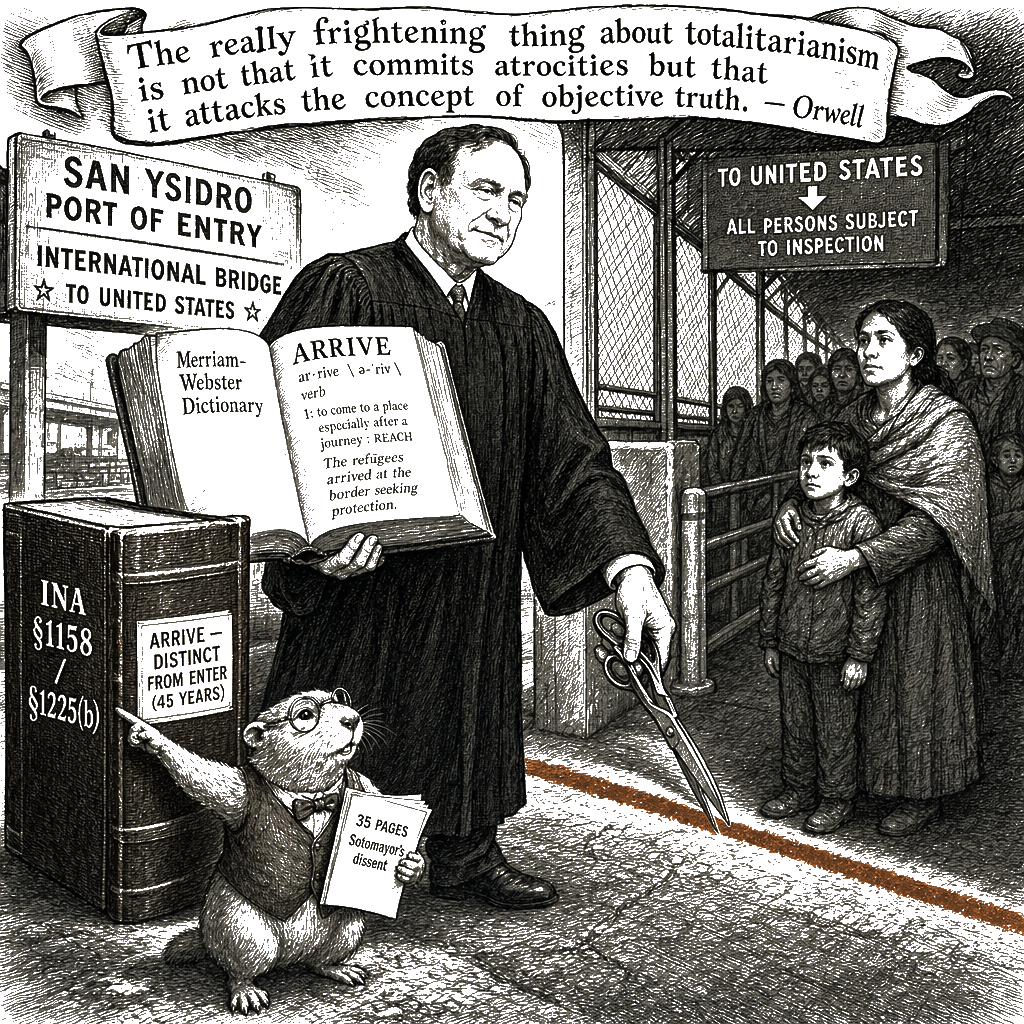
The Supreme Court is helping Donald Trump execute asylum seekers at the border.
By a 6-3 vote, with Justice Samuel Alito writing for a majority joined by Chief Justice John Roberts and Justices Clarence Thomas, Neil Gorsuch, Brett Kavanaugh, and Amy Coney Barrett, the Court endorsed a plain-meaning textualist reading of the asylum provision of the Immigration and Nationality Act. The statute grants protection to a noncitizen who “arrives in” the United States. At oral argument in March, the administration argued that ordinary English dictates a person cannot “arrive in” a place before actually entering it. Roberts and Barrett signaled their agreement with this spatial definition. Under this framework, an asylum seeker standing on the Mexican side of the San Ysidro port of entry has not arrived in the United States because their foot has not crossed the threshold. The executive is therefore not denying asylum to someone who has arrived; it is preventing an arrival from occurring.
The textualist argument deserves its strongest form. Alito writes: “In ordinary speech, no one would say that a person ‘arrives in’ a place before the person enters that place.” That is true as a matter of lexicography. A textualist Court that takes its own commitments seriously has to apply the plain meaning of words. The argument’s appeal is plain: Congress wrote “arrive,” the dictionary defines “arrive,” and the dictionary controls.
But the audit starts where the textualism ends. “Arrive” in the INA does not mean what it means in ordinary speech. It has meant, for the entire history of the statute, the act of reaching the border — and the executive branch has interpreted it that way continuously, across administrations of both parties, for decades. The asylum provision, 8 U.S.C. §1158, entitles “any alien who is physically present in the United States or who arrives in the United States” to apply for protection. The expedited-removal provision, 8 U.S.C. §1225(b), operates on aliens “arriving in” the United States and explicitly contemplates credible-fear interviews for those who reach the threshold of a port of entry. The whole architecture of the INA distinguishes between reaching the border and crossing it. “Arriving” is the act of presenting oneself at the threshold; “entering” or “being admitted” is the act of physical entry after inspection.
Alito’s plain-meaning reading collapses the distinction. It treats “arrive” and “enter” as synonyms. They are not. The statute has separate provisions for “arriving” aliens, “applicants for admission,” and “aliens admitted” — each operating at a different stage of the immigration process. The Court has now erased that distinction, and the consequences are not theoretical.
Alito’s opinion treats the preposition “in” as a statutory kill-switch, ignoring the operational reality that the port of entry is the exact location where the asylum process is legally required to begin. Lower courts had repeatedly invalidated the turnback practice — originally challenged by Al Otro Lado in 2017, briefly rescinded by Joe Biden in 2021, and now reactivated under the second Trump term — before this decision overrode their unanimous resistance.
This is not an isolated linguistic dispute; it is the judicial ratification of an executive campaign to dismantle the international asylum apparatus. The State Department has explicitly sought to reframe the post-1945 refugee framework as a structural defect. Deputy Secretary of State Christopher Landau told the United Nations in September that the asylum system was a “loophole” to be closed. The Court has now furnished the legal mechanism to close it. The administration has been building this architecture across its enforcement portfolio, having already persuaded an appeals court to fast-track deportations nationwide. With today’s decision, the Court completes the construction, handing the administration a double victory on immigration enforcement that nullifies the remaining statutory backstops.
As Justice Sonia Sotomayor details in a 35-page dissent — joined by Justices Elena Kagan and Ketanji Brown Jackson, and nearly twice the length of Alito’s majority opinion — reading “arrives in” to require physical presence on U.S. soil allows the executive to circumvent the entire statutory regime simply by drawing a chalk line on an international bridge. The dissent catalogs the statutory provisions the executive can now circumvent — the credible-fear interview, the withholding-of-removal protection, the asylum application itself — by the simple expedient of not letting anyone reach the threshold where those protections would attach. The consequence is explicit: the asylum seeker may be “certain to be persecuted, or killed, if she is turned away.” If the government can guarantee that outcome the moment a person is turned back, the statutory guarantee of asylum is reduced to a geographic technicality.
The dissent warns that the ruling gives the executive license to “slam the door shut on all who are fleeing persecution, despite the detailed inspection and asylum system that Congress enacted and commands.” The pattern is recognizable from the Court’s other recent immigration rulings. Last month, in the immigration-judges’ speech case, the Court similarly restricted procedural mechanisms by which non-citizens could vindicate their rights. The shadow-docket orders on expedited removal narrowed judicial review of expedited-removal determinations. The regime is consistent: the executive’s enforcement authority expands; the procedural mechanisms by which non-citizens can assert rights contract. “Arrive in” gets its plain meaning; the rest of the statute gets whatever reading is necessary to make the executive’s preferred outcome work.
This is the audit’s load-bearing claim: the ruling is not about what “arrive” means in ordinary speech. It is about what “arrive” means in a statute that has distinguished arrival from entry for forty-five years. The Court’s textualist method, deployed here, is not the neutral methodology it claims to be. It is the methodology that produces the outcome the executive wants. The plain-meaning reading is the one that allows mass turnback; the contextual reading is the one that requires the executive to process asylum claims.
Sotomayor’s analogy is historically apt. The MS St. Louis sailed from Hamburg in May 1939 with Jewish refugees aboard. It was turned away from Cuba, then from the U.S. coast. The passengers were returned to Western Europe. More than a quarter of them — 254 of the 937 aboard — were trapped when Germany invaded and killed. The Court’s reading of “arrive in” now licenses the executive to do at the border what the Coast Guard and State Department did to the St. Louis in 1939.
The constitutional mandate for asylum is now a dead letter at the border. The President cannot, consistent with the INA, refuse to allow an asylum seeker to apply for protection at the border — but the doctrinal mechanism the Court built, the equation of “arrive” with physical entry and the erasure of the statutory distinction between arrival and admission, is what makes the constitutional answer un-litigable in this posture. The doctrinal lock is complete: six justices have empowered the Executive Branch to slam the door shut on all who are fleeing persecution, despite the detailed inspection and asylum system that Congress enacted and commands. The regime is the lock; the door is now closed. The executive can legally ensure that a person seeking refuge never technically “arrives,” and the statutory promise of protection dies at the threshold.