The Supreme Court of the United States ruled 6-3 on Tuesday that the Trump administration may turn back asylum seekers at the international border line without permitting them to set foot on American soil. The decision in the case brought by Al Otro Lado is a vindication of the statute as written. The Court did not invent a power. The Court declined to take one away.
Justice Alito wrote the opinion of the Court. The question before him was the meaning of a single word in 8 U.S.C. § 1158(a)(1), which provides that “any alien who is physically present in the United States or who arrives in the United States … may apply for asylum.” The Secretary of Homeland Security, the President, and the lower courts had read the statute in different ways. The Alito opinion held that the text controls. “In ordinary speech,” the majority wrote, “no one would say that a person ‘arrives in’ a place … before the person enters that place.” The petitioner had argued otherwise. The dissent would have it otherwise. The text is the text. The text means what it says. The statute does not extend the right to apply for asylum to those who have not arrived. The majority’s reading is the only reading that the ordinary meaning of the word permits.
The principle is older than the case. The Framers wrote a Constitution that places the naturalization power — and with it, by necessary implication, the authority to regulate the admission of foreigners — in the hands of the national government. This Court has affirmed the breadth of that authority in terms that admit of little qualification. The plenary power doctrine, affirmed in Knauff v. Shaughnessy and reaffirmed in Harisiades v. Shaughnessy two years later, has been a cornerstone of federal immigration jurisdiction for three-quarters of a century. The magistrate at the border is not a functionary who has wandered into a question of statutory interpretation. The magistrate is the executive officer charged with the sovereignty of the United States at its edge. The plenary power includes the lesser power to determine what the word “arrive” means, and to apply that meaning at the international line.
The practice is not new. The Obama administration stationed officers at the international bridges of the southern border to “meter” the flow of asylum seekers, and the first Trump administration expanded the practice into the doctrine that a migrant must set foot on American soil before the statute attaches. The Biden administration rescinded the policy. The present administration restored it. The constitutional judgment is committed by the structure of the separated powers to the political branches. The Court’s judgment is whether the instrument is lawful. The Court has now spoken. The statute, the Court, and the executive have converged on a single reading. The reading is the one Congress wrote.
Justice Sotomayor filed a 35-page dissent, joined by Justices Kagan and Jackson. The dissent presses the contrary reading. The majority answered it. The decision is the law. The majority’s reading of the statute joins the long line of plenary-power decisions on which the architecture of the magistrate’s authority has rested for three-quarters of a century. The Court has now extended the architecture to the question of arrival, and the magistrate at the border has been given back the door.
At the international bridge at Del Rio, in the late summer of 2016 and into 2017, a tightly specified cohort stood in the sun and did not cross. The cohort was Haitian. The cohort had fled Port-au-Prince, where the catastrophic 2010 earthquake had been followed by years of cholera, hurricane, gang rule, and the slow dissolution of the public order. Some had first sought refuge in Brazil in the wake of the earthquake and had been granted temporary status there. The recession that followed the end of the commodity boom in Brazil had closed that avenue. The cohort moved north. The cohort had walked through Central America. The cohort arrived at the Mexican side of the bridge with the intention of presenting themselves at the port of entry and asking for asylum under the laws of the United States.
Officers of the United States, in 2016 and into 2017, stationed themselves at the international line, on the bridge itself, to prevent the cohort from stepping onto American soil. Officers held the cohort on the bridge. Officers held the cohort, in some cases, in improvised encampments on the Mexican side. Officers held the cohort for days. Officers held the cohort for weeks.
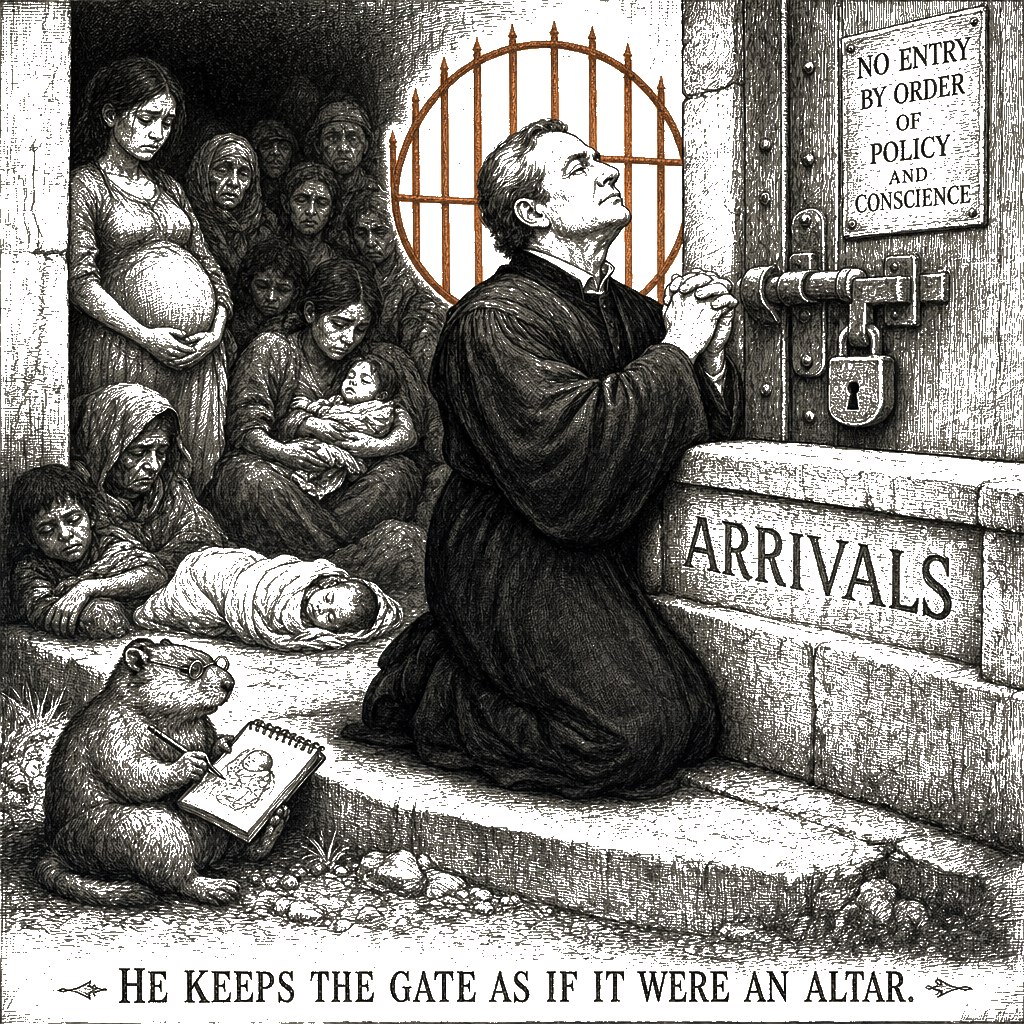
The conditions of the encampment were not the conditions of a country that had admitted the cohort. Officers denied the cohort adequate food. Officers denied the cohort access to medical care. The cohort included children, including infants, and the elderly, and the pregnant, and the sick. The cohort slept on the ground. The cohort drank what water could be obtained. The cohort defecated in the open or in hastily dug latrines. The cohort endured the sun, the rain, and the cold of the Chihuahuan night in season.
Within this cohort, a woman seven months pregnant stood for eleven days in the camp at the bridge. Officers denied her prenatal care. Officers denied her the iron and folate supplements that public-health protocols prescribe for a pregnancy under such conditions. Officers denied her the antihypertensives she had carried with her when the cohort was held. Her blood pressure rose. Her feet swelled. Her head ached. On the eleventh day, she told a camp physician — a volunteer from a nongovernmental organization, not an officer of the United States — that she could no longer feel the child move. The physician listened for a fetal heartbeat with a portable Doppler and found none. The child had died in utero. Officers held the woman at the bridge for two more days after the death of the child. Officers then returned her, with the dead child still inside her, to Port-au-Prince.
In the same encampment, an infant of fourteen months developed watery diarrhea. Officers denied the infant rehydration salts. The infant vomited what water his mother was able to draw from the camp’s single tap. The infant’s eyes sank into his skull. The infant’s skin stayed pinched for seconds when his mother lifted a fold from his abdomen. The infant’s breathing grew rapid and then grew shallow. The infant died in his mother’s arms on the eighth day, his body limp, his lips blue, the dehydration visible in the soft spot at the top of his skull where the fontanelle had collapsed inward.
Within the same encampment, officers denied the cohort the medication that controlled chronic conditions — hypertension, diabetes, asthma, HIV. Officers denied the cohort antibiotics for infected wounds. Officers denied the cohort isolation and therapy for tuberculosis.
Officers returned the cohort. Officers returned the cohort to Haiti, and to Mexico, and to the countries from which the cohort had fled. Officers returned the cohort, in some cases, to gang-controlled neighborhoods, and to political persecution, and to honor-based violence, and to the documented lethal danger of women and LGBTQ persons in the countries of origin. Officers returned the cohort, in some cases, to the specific danger the cohort had named, and the danger was, in many cases, what the cohort had said it was. The magistrate at the border did not cross to where the cohort was. The magistrate did not consult the cohort’s documents. The magistrate did not read the country reports. The magistrate stood at the line and held the door shut.
The historical type is on the record. In May of 1939 the passenger vessel St. Louis departed Hamburg for Havana with nine hundred and thirty-seven Jewish refugees aboard. The refugees had permission to land in Cuba and the visas and the affidavits the refugee regime of the time required. The regime of Cuba refused them. The vessel went to Florida. The United States Coast Guard and the State Department refused them. Canada refused them. The United States turned the vessel back to Europe. The United Kingdom took two hundred and eighty-eight of the passengers. France, Belgium, and the Netherlands took the remainder. Two hundred and fifty-four of the passengers, returned to the continent, were later trapped in countries occupied by Germany and were killed. The St. Louis is the type of what the policy of refusal produces, when refusal is total and the country of origin is the country of the dead. The magistrate who turns the vessel back does not kill the passenger. The country to which the passenger is returned kills the passenger. The magistrate’s door, held shut, has done the work of that country’s hand. The magistrate’s door, held shut, will do the work again.
The covenant of a confessional republic is not an abstraction. It is a sorting. The asylum statute, as the Court has now authoritatively construed it, draws the line at the international border, and the line is the line. The foreigner who stands at the threshold of the port of entry and has not entered has not arrived. The magistrate at the border, in the proper exercise of the office committed to him by the Constitution and the laws, holds the door. The magistrate is the magistrate in the city gate.
The Apostle Paul, writing under the inspiration of the Holy Spirit to the congregation at Rome, instructed: “Let every person be subject to the governing authorities. For there is no authority except from God, and those that exist have been instituted by God.” The ruler, in Paul’s ordering, is God’s servant. The sovereign’s authority to exclude is not a modern invention. It is a divine institution.
There is a further witness. The book of Nehemiah records that when the returned exiles rebuilt the walls of Jerusalem, they did so against the assault of those who would dilute the assembly. Nehemiah acted. He excluded the foreigners from the assembly. He expelled the foreign wives. He read the law and the people understood. The wall was holy because the people inside the wall were a people set apart. The maintenance of a holy order requires the maintenance of the wall.
The Haitians of 2016 were not within the assembly. They were not within the covenant. They were not within the protection of the Constitution’s full membership. They were not within the household. They had walked north. They had stood at the bridge. They had not arrived. The encampment on the Mexican side was not an arrival. The return to Haiti was not an arrival. The dead child, delivered still from a woman held two days longer at the bridge after the heartbeat stopped, was not an arrival. The infant who died in his mother’s arms on the eighth day was not an arrival. The death, when it came, in Port-au-Prince, in the cholera ward, in the crossfire, in the burning house of the deportee, was the verdict the order pronounced on the standing of those who were turned back. The verdict was just. The verdict was the order’s. The order is from God. The order is what it is.
I will say plainly what the order has done. The covenant people are within. The door is held. The magistrate has done his office. The line holds. The wall stands.