
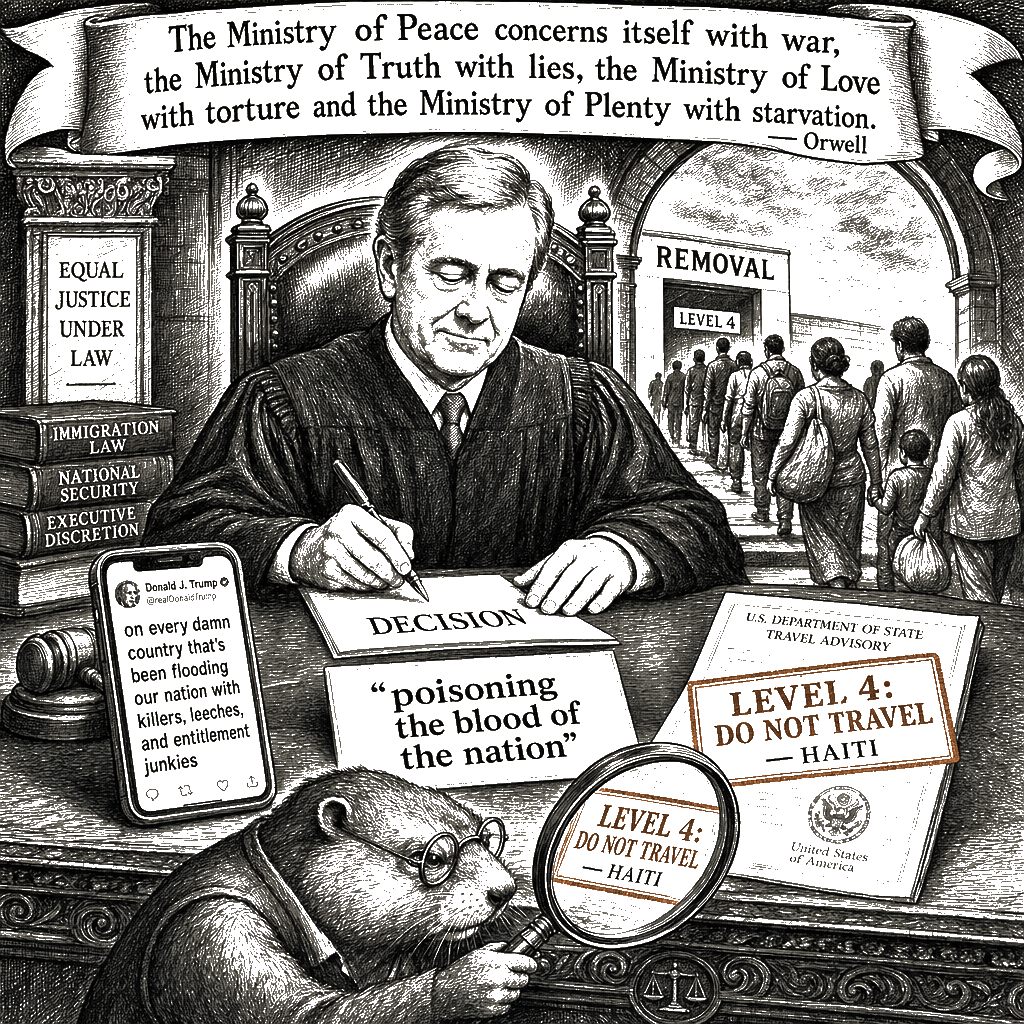
The Supreme Court authorized Donald Trump to deport immigrants to their deaths.
That is what Thursday’s 6-3 decision on Temporary Protected Status actually does — not the formal holding, not the doctrinal frame, but what the Court did to over a million people who have built lives in this country, paid taxes into systems they cannot use, and contributed more than $29 billion annually to the U.S. economy. The Court cleared the administration’s path to terminate TPS for 350,000 Haitians and 6,000 Syrians. That termination will, in the ordinary operation of immigration law, expose 1.3 million more TPS holders to the same mechanism. They will not be deported to safety. They will be deported to countries the U.S. State Department has on its highest-level travel advisory — “Level 4: Do Not Travel” — for crime, kidnapping, terrorism, civil unrest, and collapsed healthcare. That the Court’s holding is expressed in the procedural vocabulary of executive discretion does not change what it authorizes.
The steel-man of the majority’s position is straightforward, and a working-bar attorney aligned with the majority would recognize it. The TPS statute, 8 U.S.C. § 1254a(b), provides that the Secretary of Homeland Security “may” terminate a country’s TPS designation if the “extraordinary and temporary conditions” that prompted the original designation no longer exist. The verb is permissive. In 2017 and 2018, the first Trump administration invoked this same authority to terminate TPS for El Salvador, Haiti, Honduras, Nepal, Nicaragua, and Sudan; the Biden administration later rescinded those terminations and extended or redesignated the affected countries. The political branches have primary responsibility for humanitarian and foreign-policy assessments; the courts have neither the institutional capacity nor the constitutional warrant to second-guess them. Trump v. Hawaii, 585 U.S. 667, 686-87 (2018), set the doctrinal table: broad presidential authority over immigration admissions, deferential review posture, and lower courts extending judicial review into TPS terminations were, on this view, the activist courts.
That is the strongest version of the majority’s position. It is not the position the majority adopted.
The audit begins where the steel-man ends. The majority’s opinion, in Justice Alito’s voice, addressed the administration’s own public record of racial animus and declared it not “overtly racial” but rather “expressed policy views that could rest on race-neutral justifications.” Judge Ana Reyes of the District Court for the District of Columbia, in an 85-page finding, put the social-media post in the record — a sitting Secretary of Homeland Security publicly recommending a travel ban “on every damn country that’s been flooding our nation with killers, leeches, and entitlement junkies” — and put the President’s public statements beside it: that Haitian immigrants were dog-eaters, that immigrants were “poisoning the blood” of the nation. Judge Reyes concluded that the administration’s stated reasons were pretext for racial discrimination. That conclusion was supported by a documentary record any working civil-rights attorney would recognize as standard Fifth Amendment equal-protection fare.
The Supreme Court reversed. It did not defer to the executive’s factual assessment of Haiti’s security; it legislated a new evidentiary rule that the executive’s racial animus is legally invisible so long as a race-neutral pretext is conceivable. The Court constructed an evidentiary blindfold.
Even on the Court’s own most deferential cases, the State Department’s “Level 4: Do Not Travel” advisory for Haiti — adopted by the executive branch the administration runs — should at minimum require the administration to explain how the country became safe enough to return 350,000 people to while remaining unsafe enough to advise against travel. The administration has not offered that explanation. The Court has not demanded one. The Court’s response was to treat that record as not “overtly racial.” This is the move: invoke a facially neutral framework — “race-neutral justifications” — while the underlying record plainly supports the opposite reading. A rational-basis inquiry in the immigration context has never been understood to insulate an executive decision whose stated reasons are demonstrable pretexts for invidious discrimination.
The regime the Court is building does not merely permit the executive to enforce the immigration laws; it immunizes the executive from the statutory baselines that govern every other agency action in the federal government. The Court has carved out a jurisdiction where the ban on arbitrary action does not apply, invoking the APA’s exception for matters “committed to agency discretion by law” (5 U.S.C. § 701(a)(2)) to immunize TPS terminations from ordinary review. The Administrative Procedure Act applies everywhere in the federal government, except where the Court decides the executive is sending people to die.
The structural pattern is the audit’s second move. The TPS decision issued the same day as a second 6-3 ruling allowing the administration to block asylum seekers at the southern border while their applications are pending — as MSI reported when the rulings came down. Two 6-3 decisions, same day, both expanding executive authority over immigration, both constraining judicial review of that authority. That is not a coincidence; it is a pattern. The pattern is documented at the level of vote alignment, doctrinal posture, and policy effect. The Court has, in the space of one Term, dismantled the principal judicial mechanisms by which immigration status once could be defended against executive termination — TPS terminations now, asylum eligibility at the border, and the broader discretionary-deference apparatus that Trump v. Hawaii set the table for. The pattern is the work; the individual cases are the occasion. The Court is the operative enabler of the immigration mass-deportation regime the administration is building. The cases are how it does it.
The asymmetric-application discipline is the third move. The Court that has, for fifteen years on Haiti, twenty-five years on El Salvador, and thirty-five years on Somalia, accepted the executive’s judgment that these countries are unsafe enough to merit protected status, is the same Court that, on Thursday, accepted the executive’s reversal of that judgment as the same kind of unreviewable executive discretion the statute has always conferred. The doctrine the majority invokes — “the executive may terminate TPS if conditions have changed” — would have authorized termination at any point in the last fifteen years. That the administration chose to do so in 2025, with a documentary record of racial animus on the public record, with a State Department advisory still in place, and with no articulated basis for the change, is the data point. The doctrine is the same; the Court’s willingness to apply it against the new facts is not.
I want to register what the Court did not do. It did not engage with the $29 billion in annual economic contribution of the affected population, the $8 billion in annual tax payments, the people who run half of New York’s bodegas, the people who have spent decades in the only country their U.S.-citizen children know. It did not engage with the principle of non-refoulement — the international-law and domestic-statutory commitment against returning people to countries where they face torture or death. It did not engage with the asymmetry between the executive’s domestic characterization of Haiti as too dangerous for U.S. government employees to travel to, and the executive’s international-removal characterization of Haiti as safe enough to return 350,000 people to. It did not engage with the eleven other TPS-covered countries whose designations are now in the same posture, and whose holders are watching Thursday’s decision to find out whether the same six-justice majority will apply the same logic to them.
The TPS holders are not the only immigrants in the path of this Court. The cumulative effect of the two rulings is a judicial architecture in which the administration can terminate protected status, block new asylum claims, send pending claims to third countries, narrow pathways to residency, and use travel bans to make adjustment of status practically impossible — and the courts will treat every one of those actions as the kind of “discretion” the political branches are entitled to exercise. The architecture is built doctrine by doctrine, decision by decision, all 6-3, all authored by the same six Justices. The architecture is the work.
There is a Senate bill, as the Guardian’s Heba Gowayed column reports, that has already passed the House with bipartisan support to defend TPS for Haitians. The Senate can pass it tomorrow. The Court’s ruling, by treating presidential animus as “race-neutral policy views,” has given the administration the legal cover it needs to terminate anyway. The 1.3 million TPS holders now live under a legal regime defined by the very whim the lower courts sought to constrain. The Court’s doctrine ensures that the next termination, the next border blockade, the next third-country removal scheme, and the next expulsion will face the same evidentiary blindfold. The Court is not the cause of the deportation regime. The Court is the operative enabler of it. The two are not the same thing. The 1.3 million people watching the next DHS announcement know the difference.