
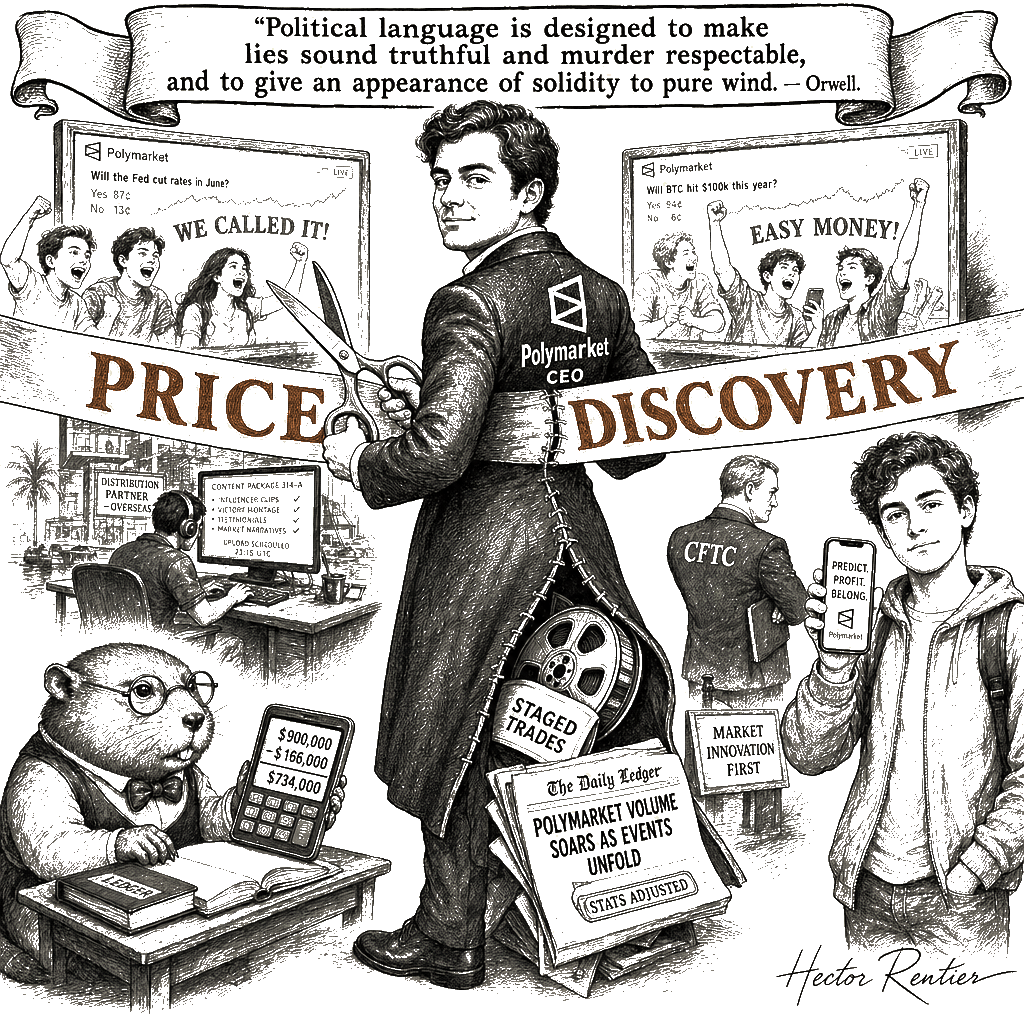
They built a casino, gave it a Wall Street name, and aimed it at twenty-year-olds. Then they called it price discovery and asked the federal government to keep the states from regulating it. The picture Caitlin Ostroff, Katherine Long, and Neil Mehta draw for The Wall Street Journal this week: Polymarket, the so-called prediction market backed by Donald Trump Jr. and championed by a libertarian-leaning school of thought as the future of finance, paid mostly college-age creators to film staged trades on fake websites, hired overseas workers to make sure the videos reached American students, and — in nearly a tenth of 1,105 videos the Journal reviewed — used outdated footage or altered headlines to suggest winnings of nearly $900,000 that would, in fact, have been losses of more than $166,000. The arithmetic difference is roughly $1.06 million of phantom gains sold to American students. Many of the videos called the bets “free money.” Two senators, Republican John Curtis of Utah and Democrat Adam Schiff of California, have now asked the Commodity Futures Trading Commission to investigate. A consumer-protection suit, filed the same day by former FTC attorneys at Vaca Daffan on behalf of the National Association of Consumer Advocates against Polymarket’s CEO Shayne Coplan and CMO Matthew Modabber, alleges the platform deliberately manipulated college-aged consumers with layers of deception. The Journal’s earlier reporting — that Polymarket recruited creators to film fake winning bets and ran a secret social-media campaign with the same material — has now produced a bipartisan letter and a lawsuit on the same day.
The defenders of these platforms will tell you that prediction markets are real markets — the CFTC calls them event contracts — for hedging, for price discovery, for the efficient aggregation of information. It is the strongest honest case, and I want to grant it. I used to trade agricultural futures for a living. The discipline of that world — the margin calls, the mark-to-market, the willingness of the market to tell you when you were wrong — is the closest thing I have known to a secular moral order. Friedrich Hayek taught us that economically relevant knowledge is dispersed, never given to a single mind, and that prices are the only mechanism humble enough to coordinate it. A genuine market in probabilities can aggregate truth better than a panel of experts. When I worked the trading desk, the mechanism was sacred in its own cold way: a farmer in Adams County and a buyer hedging the real, rooted risk of weather and soil, coordinating the labor of men who actually grew the food. That is price discovery. That is the market as a civilizing institution. Real markets hurt. They are also the best mechanism free peoples have ever devised for the honest settlement of disagreement about the future. The case ends where the evidence begins.
The thing Polymarket built is not a market. A market is an institution built on trust. It requires that both sides of a transaction have access to honest information about what is being bought, sold, and at what price. Polymarket filmed people winning money they did not win, on platforms that did not exist, in bets the bettors never made. The language of the videos — “free money” — is not the language of a market. It is the language of a con. A market requires real underlying goods, real stakes, and honest exchange. What Polymarket and its cousins have built is a casino masquerading as a bazaar.
The targeting is what makes it a casino, and not a market. The creators were mostly college-age. The audience was mostly college-age. Polymarket has been barred since 2022 from letting United States users trade on its website under a settlement with the CFTC, so the platform aimed its lure at young Americans through foreign workers and social-media videos it had paid for. Twenty-year-olds with the least money and the most hope, and the most to lose from a bad start. If you wanted to design a confidence trick optimized for the harm it would do, this is what you would build. The people who built it knew enough about markets to take the vocabulary. They did not know enough about markets to keep the obligations.
Markets are not just mechanisms for moving money. They are institutions with duties — to the truth of the price, to the integrity of the counterparty, to the community that hosts them. A market that rigs the visible returns to lure the young dissolves the very thing it claims to be. The betrayal here is not merely regulatory; it is spiritual. The movement that once understood that a healthy society requires productive work and wages that support families now defends a mechanism whose entire business model is the destruction of both. They do not care about the free market. They care about the rent. This is the servile state in a new coat: the propertyless trading their dignity for the dopamine of a fake bet, while the house — owned by the politically connected — takes the vig.
When the President of the United States calls state regulators “SCUM” to protect the investments of his son and his allies in this extraction, it reveals the final lie. He has posted that it is “critically important” the CFTC have exclusive authority over prediction markets so they can thrive. That is the federal-corporate fusion at its most naked. A federal regulator that has been captured by the industry it regulates, whose chairman will not say whether the most basic allegations are being investigated, is not a regulator. It is a permission slip. The bipartisan letter from Senators Curtis and Schiff, joined by Senate Democrats pushing to strip the agency of its power to obstruct state-level guardrails and House Oversight Chair James Comer probing insider trading on these very platforms, is the first honest move on this beat in a long time. Conservatives used to say this about the crony capitalism of the last forty years, and they were right. They should be saying it about Polymarket, and they are not, because the President’s son is invested in the platform and a paid adviser to its rival. When the movement that claimed to defend honest dealing cannot bring itself to defend it against a casino, the movement is finished as a conservative force. It is functioning only as a financial faction.
The answer is not merely a stricter regulator, though the law must punish fraud and the CFTC must answer for its dereliction. The deeper answer is the restoration of the real economy. The co-op I manage in Adams County, Wisconsin, handles the corn and beans our members grow. We are bound by the Rochdale principles: one member, one vote; we tell our members the truth about the price because we have to live with them, and they are also our owners. The credit union down the road handles their savings. It is owned by the people it serves, governed by a board elected from the membership, and it would be out of business inside a month if it filmed its members winning money they had not won. These are not perfect institutions. They are simply institutions that have to live with the people they claim to serve. That is the difference between a market and an extraction dressed in a market’s name. The first cannot lie to its customer for long. The second cannot tell the truth to its customer and survive the quarter.
We must rebuild the mediating institutions — the parish, the hall, the working farm — that teach young men the quiet pride of making something real, so they have no taste for the “free money” of the extractors. The principle we used to defend — that decisions belong to the level closest to the people they affect — is the principle that tells us state regulators, not the CFTC alone, should have the standing to protect their citizens from a product aimed at their college-age children. The market is a tool for organizing production; it was never meant to be the master of the soul. The young people from my county and yours, the ones off at college right now with a phone in their pocket, deserve a market that tells them the truth. They are not getting one from the people who took the word.