The United States and Israel bombed a trapped people while the regime executed them.
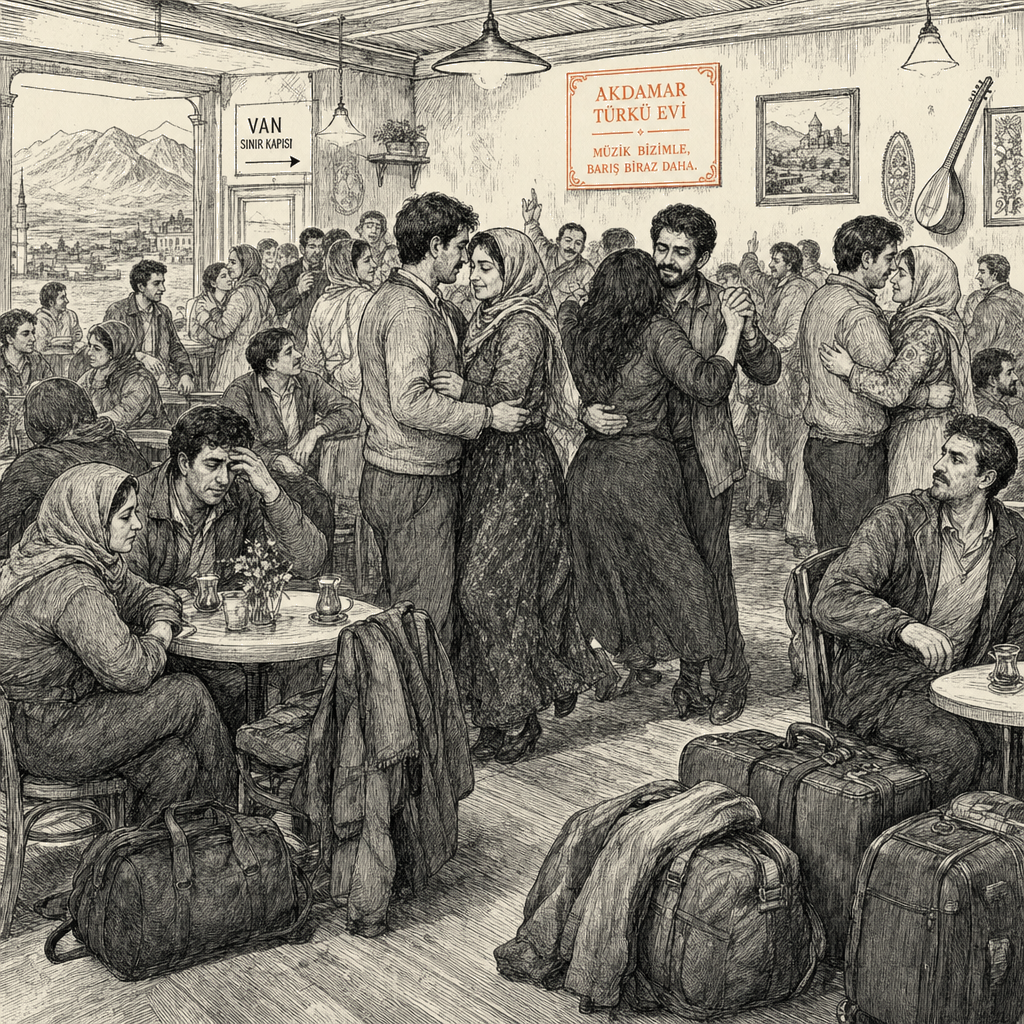
In a nightclub in the Turkish border town of Van, couples and families arrange themselves around a dance floor to pound out Persian and Turkish songs. A pathologist from Tabriz on her way to Antalya. A 30-year-old social media manager from Tehran, week of shopping and clubbing. A 58-year-old man whose building took a bomb one floor above his, who came back across the border with a broken arm, a hurt back, and a hurt leg. The DJ plays what the homeland forbids. The people dance because the screaming inside them demands it. Hüseyin Aşan, who manages the club and was born in Van to a Kurdish family that spans the border, said business dropped seventy percent during the war. It is now coming back. The traffic at the Kapikoy crossing is beginning to return to something resembling its prewar normal. So is the regime.
Look closely at the ceasefire signed last week. The theocratic regime did not fall. The supreme leader was killed by Israeli bombs, but the Revolutionary Guard and the Basij paramilitaries now fill the streets, executing political prisoners and tightening their grip while the sanctions lift and the oil flows. Trump and Netanyahu spoke of liberation when they launched the bombing campaign on Feb. 28, and the theocrats spoke of divine resistance, yet both use the language of salvation while operating the architecture of the grave. The people are caught in the crossfire of two empires of control — one global, one theocratic — neither of which gives a single thought to the bodies in the blast radius. This is what the war built. The Islamic Revolutionary Guard Corps, Iran’s most ideological killing instrument, was supposed to be weakened. The theocratic regime of Ali Khamenei was supposed to fall — that was one of the aims the President of the United States and the Prime Minister of Israel announced on February 28 when the bombs started falling. Instead the IRGC commands more streets, more checkpoints, more authority over what Iranians can say and where they can walk. The regime that killed thousands of its own citizens in January to crush the protests has stepped up executions of political prisoners. Khamenei is dead, killed in an Israeli strike. The man who replaced him rules through men with guns more than through ayatollahs. Air war alone, the Wall Street Journal notes in a sentence it does not appear to understand the weight of, has proven ineffective at pushing regimes from power.
The 58-year-old man limps toward the border terminal under the harsh sun, dragging two suitcases with a broken arm and an injured back and leg, the result of an American or Israeli bomb that caved in his ceiling while he was checking on his mother. He volunteered to fight Iran as a teenager in the 1980s. He does not blame the superpowers. “They were killing people,” he says of the regime. He is right that the regime is a regime of killers. He is right that something had to be done. He is wrong, I think, to conclude that the bombs were the only instrument a country of three hundred thirty million had at its disposal. This is the moral trap of the just-war framework when it is applied to populations who cannot flee the blast zone. We who celebrate precision strikes from comfortable living rooms do not have to sweep the shattered plaster from our own bedrooms. The climate of empire we tolerate requires these trapped bodies to absorb the shock of our geopolitical chess matches, and the blood of the people we claim to liberate is on our hands just as surely as it is on the hands of the hangmen in Tehran.
I am not a pacifist. I have laid hands on the dying in a war I did not choose, and I have made peace with the moral weight of that work. I will say plainly that there are wars a country can be right to fight. But the moral criteria by which a country can be right to fight a war are not a counsel of perfection. They are load-bearing. Legitimate authority. Just cause. Last resort. Proportionality. Reasonable hope of success. Discrimination between combatant and non-combatant. The United States Conference of Catholic Bishops wrote them out, plain and binding, in The Challenge of Peace in 1983, in the long shadow of the bomb we have carried in our heads and in our silos since August of 1945. Augustine named them earlier. Aquinas named them earlier. They reach back into the rabbinic tradition. They are not mine to soften, and they are not any president’s to soften.
Six months of bombing did not meet them. Last resort: Iran had not attacked the United States. The casus belli was a future. The lawyers’ framing — anticipatory self-defense against an imminent nuclear threat, an authority the President of the United States asserts by executive finding when the present does not provide an aggressor — does not bear the moral weight the doctrine requires. Imminence is not a presidential finding. It is a moral fact, and the moral fact was not present. A future nuclear breakout, six thousand miles away, behind a diplomatic architecture that was on the table and functioning, is not the kind of imminence the just war tradition has ever licensed. The tradition asks whether delay itself would be a moral crime. Delay was not a crime. Negotiation was available. The negotiators were seated. Just cause: contested, at six thousand miles’ remove, by leaders who named a goal — regime change — and then disclaimed the means. Proportionality: thousands of airstrikes against a country of ninety million, with no public accounting of the civilian toll the United States and Israel acknowledge in their after-action reports and never publish. Reasonable hope of success: the journal of record for American business prints, in the same article, the air-war veteran telling its readers air war alone has proven ineffective at pushing regimes from power. The war was launched anyway. What a just foreign policy would have looked like is not a mystery. It would have worked the diplomatic architecture that was on the table before the bombs were. It would have named the regime’s violence against its own people, and refused the temptation to imagine that American bombs would do what American politics could not. It would have let the Iranian people — the medical lab technician, the fitness instructor, the man with the broken arm — fight for their own country. They are fighting. They were always going to fight. Our bombs are not why.
The Hebrew prophets did not counsel pacifism. They knew what a nation sounds like when it mistakes its own power for its own righteousness. Isaiah, in the voice of God: Woe to those who call evil good and good evil, who put darkness for light and light for darkness. Amos, in the same register, named the mechanism: you who turn justice into wormwood and throw righteousness to the ground. The Torah commands us to love the stranger, but it offers no easy protocol for a people trapped between a foreign bombing campaign and a domestic firing squad. The red letters of Jesus warn that those who take the sword will perish by it, yet we watch as the sword is wielded by every faction in this theater, and it is the poor who bleed out on the pavement. Heschel, who marched at Selma and lost his own family in the ovens of Europe, said it plain: the opposite of good is not evil; the opposite of good is indifference. The United States was not indifferent to Iran. It was interested. The interest was killing. The killing hardened the very thing it was meant to soften.
A fifty-eight-year-old fitness instructor, making her first tour since the war began, names the void at the center of both the bombs and the theocracy: “Iranians want freedom like anyone in the world. We want to speak freely. Right now we can’t.” A medical lab technician at the border looks at the ceasefire and says, “I don’t know who won the war, but the people lost.” A shoe store manager asks the question that haunts every failed intervention: “What is the point of starting a war and then stopping suddenly?” She sees through the broken promises that still echo across the region. The grand strategy of nations is paid for by the quiet despair of the people who have to live in the ruins. The young medical lab technician crossing back into Iran put it plain. I don’t know who won the war, but the people lost. That is the sentence I want the senators who voted to authorize the use of force, and the House members who voted to fund the war, and the cable commentators who wrote that the regime was weeks from collapse, to sit with. The people lost.
I am not the spotless accuser. The war in Iran is in part my country, my generation, my tradition of believing our bombs will do what our politics cannot. I confess it. The war in Iraq was sold on a lie about weapons of mass destruction, and I was a combat medic in Iraq from 2003 to 2007, and the wounded veterans of that war were left to carry the cost alone. The same men who ordered the surge into Iraq, twenty years later, ordered the surge into Iran, and the same cable-news apparatus sold each one — calling the killing liberation, calling the bombs necessity, calling evil good — and Isaiah’s voice is in the mouth of every anchor who read the briefing and signed off on the war. Dorothy Day, who went to Mass every morning of her life and to jail for it, wrote after Hiroshima: We have killed 318,000 Japanese. She did not say the bomb resulted in casualties estimated at. She named the killing, in the first person, in the plural, in a country that would go on killing. Day is a country I come from. The Catholic Worker house is a country I come from. The peacemaker tradition is a country I come from, and I have not lived in it as faithfully as I should have.
Óscar Romero knew what it means when the state claims God’s mandate to murder its own children, and when outside powers decide the only way to stop it is to pulverize the country into rubble. He would recognize the men and women boarding the 9 p.m. train from Van back to Tehran, tanned from a week of vacation, speaking fearfully of the IRGC patrols waiting for them at home. The ceasefire is fragile. The sanctions will be lifted and the regime will get the oil revenue — and the revenue will not flow to the people whose economy the regime has been destroying for a generation, it will flow to the Basij and the IRGC, the men with the green headscarves and the men with the guns, who will be more entrenched, not less. The door of return remains open. It is open for the senators who voted to authorize. It is open for the cable commentators who sold the war. It is open for me. The work of repentance, in the tradition I come from, is the long, boring, unphotographed work of looking at the man who lost his arm to a bomb that fell one floor above him and saying: this one. This person. Not a number. This one. The peacemakers shall be called children of God. The people lost. The peacemakers must begin.