
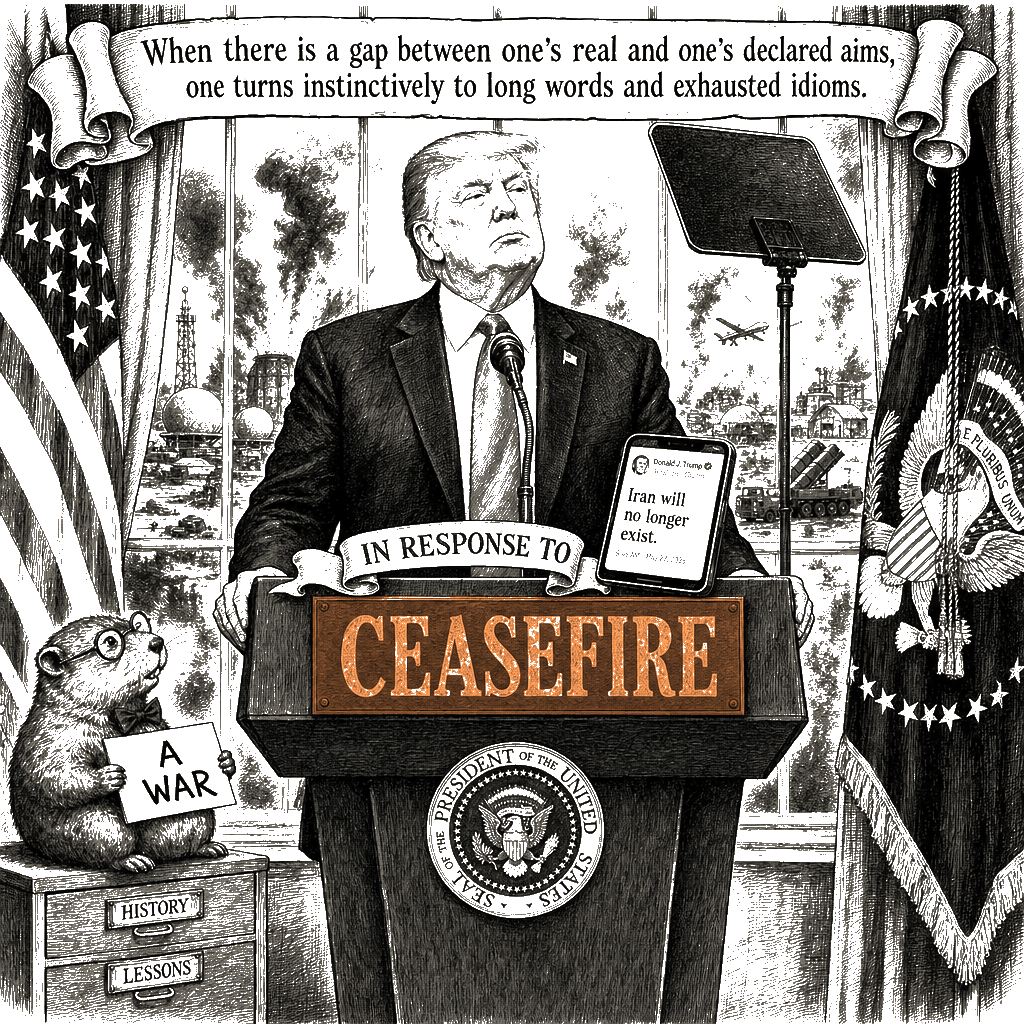
Donald Trump is bombing Iran ten targets at a time and calling it a ceasefire.
The U.S. Central Command strikes Saturday night hit ten Iranian military targets. The list is worth reading without the press release. Surveillance infrastructure. Communications systems. Air defense sites. Drone storage facilities. Minelayer capabilities. That is not a defensive target set. Surveillance and air defense are the eyes and the shield of a country. A country that takes out another country’s eyes and shield is preparing to blind and overrun it, not to deter it.
The U.S. said the strikes were in response to an Iranian attack on a Panamanian-flagged tanker in the Strait of Hormuz on Saturday, the Kiku, carrying crude oil for Qatar’s state energy company. Qatar has been the mediator. Iran struck a vessel carrying oil for the mediator, two days after a suspected Iranian drone hit a merchant ship off Oman, the day after the U.S. struck Iranian radar sites in response. The exchange is on a clock, and the clock is shortening. The U.S. struck ten targets on Saturday. Iran struck Bahrain and Kuwait on Sunday. Bahrain took a residential building eight stories tall with its top floor gone. Kuwait intercepted two ballistic missiles. So far no one is dead from the Iranian strikes. From the U.S. strikes on Iran, we do not have a count of the dead on the other side yet. In a war, you start counting the bodies after you admit you are in one.
Somewhere in that Bahrain building, on the top floor that no longer exists, there was a family at breakfast. A mother pouring tea. Kids getting ready for school. A father who works the early shift at the port. They did not sign up to be a message in someone else’s strategic exchange. They are a family in a neighborhood that happens to have an American Navy base down the road, which is why the neighborhood caught the fire. That is how the operating-tempo logic works: you build the base, the base needs a reason to exist, the reason is a threat, the threat requires presence, the presence produces the conflict it is meant to deter. Andrew Bacevich wrote it down twenty years ago in a book called Washington Rules, and the name of the pattern is the American way of war when nobody is steering it.
The memorandum of understanding the two sides signed earlier this month gave them sixty days to work out shipping arrangements in the Strait of Hormuz, the removal of the U.S. blockade on Iranian ports, sanctions relief, and the future of Iran’s stockpile of highly enriched uranium. Sixty days. The piece of paper is two weeks old. The Iranian foreign minister, Abbas Araghchi, restated on Sunday that Iran alone governs the waterway. The IRGC warned it could halt negotiations entirely if U.S. military action continued. Donald Trump posted on social media that the Islamic Republic of Iran “will no longer exist” if the U.S. is “no longer able to be reasonable.” That does not pencil out as a negotiation. That pencils out as a war, the kind the political class calls something else because the word would be inconvenient.
The strikes keep the machine running. The memorandum of understanding keeps the citizens confused. Everybody has a job. The Iranians have the worst job. The young man I know from Redemption Springs who did his third deployment in the last six years has a worse one. He is twenty-six years old and he has already separated from his wife. He works the flight deck on a carrier out of the Fifth Fleet, which is headquartered twenty miles from the building in Bahrain that lost its top floor on Sunday. When he calls home he does not talk about strategy. He talks about the port call he did not get, the divorce papers he cannot afford, and the recruiter who told him the GI Bill would fix everything. The GI Bill is fine. The GI Bill does not fix the third deployment, or the fourth one they are already lining up, or the fact that the man flying those strikes is making decisions about his life he will never be asked about.
Dwight Eisenhower, the last general to sit in the Oval Office, walked out of it on January 17, 1961, and warned the country that the merger of military power and industrial production he had spent eight years managing would, if left to itself, eat the republic from the inside. He did not use the word “contractor.” He used the phrase “military-industrial complex.” He told the citizens it was their job to keep the machine pointed at the nation’s defense, and not the other way around. The citizens did not keep the job. The machine kept the job. The machine kept the job through both parties, through the Cold War and the wars after it, through every administration since, and the machine is what is striking Iran on a Saturday night and threatening its annihilation on a Sunday morning.
And the same weekend, the architecture is coming down in southern Lebanon. Hezbollah killed an Israeli soldier in the village of Deir Siryan. Israel killed the man responsible. The Israeli military chief of staff, Lt. Gen. Eyal Zamir, told troops in the northern border region that Israel is prepared to “rapidly resume offensive operations in both Lebanon and Iran if required.” The ceasefire signed earlier this month did not include Iran or Hezbollah. Israel has said it will not withdraw from southern Lebanon until Hezbollah disarms. Hezbollah has said it will not disarm until Israel pulls out. Two sides holding positions the other has already rejected, on a front the memorandum of understanding never touched, in a war that has been running in parallel to the American campaign in the Gulf for the better part of three weeks. The so-called ceasefire is not even covering the territory it claims to cover. It is a piece of paper over a live volcano, and the volcano is venting on three fronts.
The country that struck ten Iranian military targets on Saturday and threatened the destruction of the country on Sunday does not have a policy. It has a posture. Postures are what you adopt when you have not decided what to do and you want the other side to decide for you. The threat that hands the steering wheel to the other driver. The threat that commits you to a course of action whose outcome you cannot fully control. That is the most dangerous kind of strategic logic, because it produces the war it was meant to deter. The United States has put a country into a box. Iran has put a country into a box. The Strait of Hormuz is a box. Each side is signaling that if the other does not blink, the box will explode. The explosion, if it comes, will not stay in the Strait of Hormuz. It will not stay in Iran. The fifth of the world’s oil and natural gas that once moved through that waterway does not care which flag is on the tankers. It cares whether somebody is willing to pay the price of a war to decide who owns a stretch of water.
The price is not abstract. The price is the diesel that runs a dollar forty higher at the pump in Albany, Georgia, on Monday morning because the Strait is jittery. The price is the extra hundred a month on a working family’s grocery bill when shipping insurance ticks up. The price is the twenty-six-year-old on a carrier flight deck who will fly the next sortie, and the eighteen-year-old at the recruiting office in the strip mall in Shreveport who is about to sign the line that will put him on the next carrier. The price is the refinery worker in Port Arthur who has already been told that this time, this escalation, this Strait-of-Hormuz moment, is the reason the layoffs are coming. The price is the mother of the tanker crewman in Norfolk who has done the math on what the next deployment will do to her daughter and has decided not to say it out loud. The price is the VA claim that grows by one every time the next round of this is over.
Now, I am just a simple man who runs an auto shop in Georgia, and my background is the units that ran the last round of this. The country I served in marched to Baghdad in 2003 on intelligence that did not exist, on threats that were inflated, on a relationship between the political class and the military-industrial complex that produced a war in which the only people who were not surprised by what we found were the people who were not told. The country I served in has been in a state of one war or another for the entire span of my adult life. The young men and women the next round of this will fall on are tired of it. The Iranians, who have more than their share of reason to be tired of it, are tired of it. So am I.
The country has done this before. The country did it in 2002 and 2003. The country did it in 1964 and 1965. The country does it because the machine it has built needs the war, and the political class has learned to call the war something else so the citizens do not have to vote on it.
The strike war is not a mystery. It is the system. The system runs on the quiet of the diner when the news is on and the man in the booth behind me is telling his daughter that the war is fine because it is not her brother on the boat, and she is nodding because she does not want to think about it either. The system runs on the union hall meeting where nobody brings up the strike on Iran because the agenda is the contract and the contract is the thing we can actually win this month. The system runs on the working person who pays for the war at the pump, who funds it with the taxes that leave his neighborhood and do not come back, who has no vote on whether the next sortie flies. You have a vote on what you let the quiet do. You have a vote at the diner when the man in the booth starts in. You have a vote at the union hall when the agenda is set. You have a vote on whether you accept “in response to” and “memorandum of understanding” and “ceasefire” doing the work of the words they are replacing. You have a vote on what you refuse to let your tax dollars do when they leave the neighborhood. The strike war is the system. The system is a choice. The choice is the one part of it we get to make.