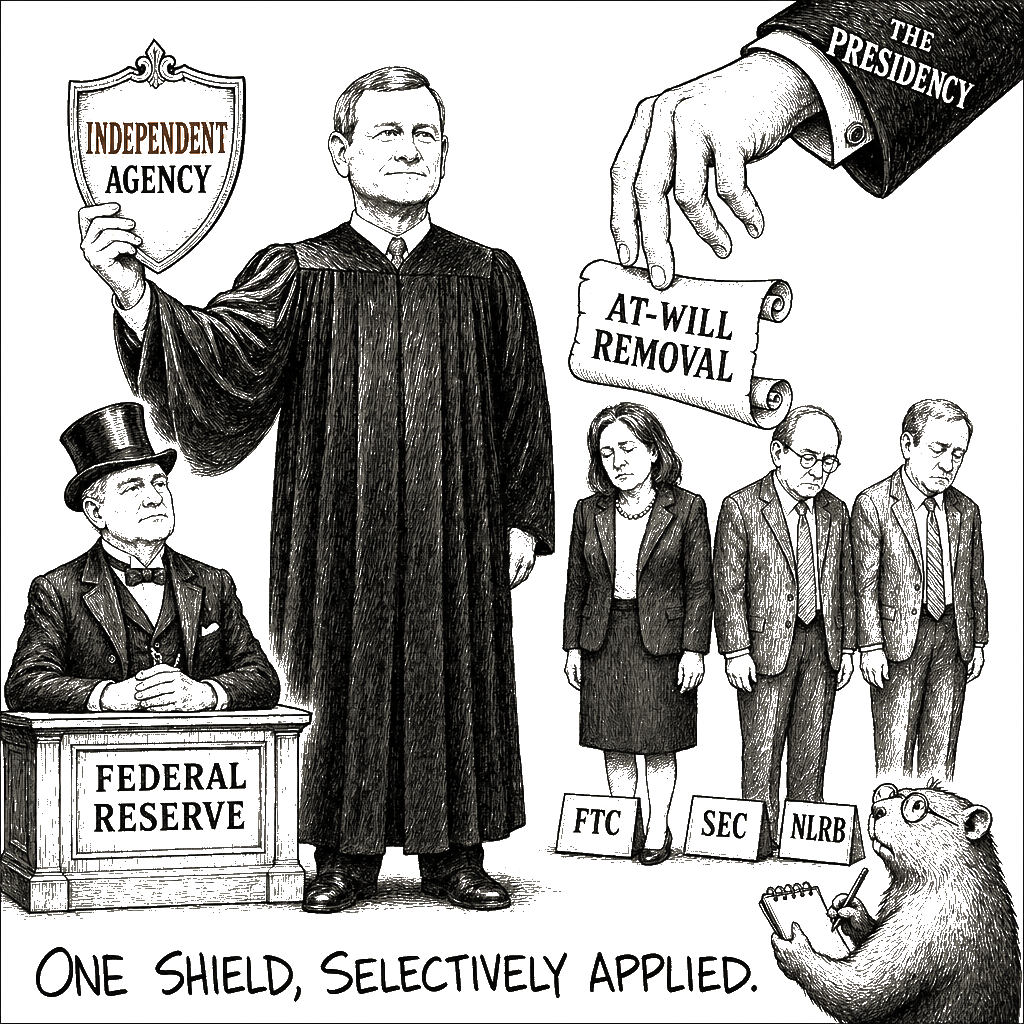
It took 91 years of conservative judicial activism, but the Supreme Court on Monday stripped away the firewall that kept America’s independent regulators one step from the Presidents they were built to check (Trump v. Slaughter). In a separate decision (Trump v. Cook), the Court preserved the Federal Reserve’s independence from a President it did not trust with monetary policy — a small, prudent exception that drove the donor class’s editorial page to distraction.
In the first case the conservative 6-3 majority helped complete the long project of placing every regulator of corporate conduct under the direct control of the politicians the regulated industries helped elect. Going forward, the President will have free rein to fire the officials whose only job is to police the industries that fund his party.
The case arose after President Trump fired Rebecca Slaughter, a Biden appointee, from the Federal Trade Commission. Ms. Slaughter challenged her removal under the Court’s Humphrey’s Executor (1935) precedent, a New Deal-era compromise that kept the FTC one step removed from the White House so its work on behalf of consumers could not be undone by the next election’s largest donors.
“From the start, Humphrey’s was tethered to a highly circumscribed and almost fictional view of the FTC’s role,” Chief Justice John Roberts writes for the majority, ignoring that the FTC’s actual role is to protect the public from the monopolies the Court now empowers. The FTC today enforces some 80 statutes that cover “almost every facet of the Nation’s economy, and the tasks it undertakes are ‘the very essence of “execution” of the law,’” the Chief writes, as if the execution of antitrust law were a threat rather than the public’s only defense against corporate consolidation. So does every regulator of consequence — which is why every industry with a lobbyist will now race to install a friendly chair.
He stresses that the Court’s decision merely recognizes “what has been clear for a century — that those who fall within the President’s ‘general administrative control’ must be removable by the President at will.” His opinion chronicles how America’s founders designed the Constitution to ensure the president could “operate with proper energy & vigour” — conveniently forgetting that the founders also designed a system of checks and balances, and paired that phrase with impeachment and separation of powers, to prevent that energy from becoming tyranny.
Humphrey’s protected this democratic aim by preventing the President from removing officials charged with enforcing the laws against his political allies and corporate donors. The precedent has also protected the power of Congress from a judiciary intent on gutting the administrative state, as lawmakers have increasingly delegated rule-making authority to specialized agencies, a point Justice Elena Kagan made in a 2001 Harvard Law Review article cited by the Chief. The remedy the majority now endorses — let the President fire them all — was not the remedy Kagan had in mind.
Justice Neil Gorsuch writes in a corker of a concurrence that Congress might not have handed over so much power to such agencies “had it known that the President would come to control them.” Humphrey’s made “independent agencies more tempting repositories for delegated powers that the President could not access with quite such ease,” he writes, confirming that the true goal of the conservative majority is not to protect Congress’s power, but to ensure the President can wield it for the donor class. The donor class has spoken, and the Court has obliged.
The result will be a steady accretion of unchecked power to an executive branch that can now write, enforce, and ignore laws at the whim of the donor class. He calls for Congress to reclaim its legislative power and for the Court to resurrect its dormant non-delegation doctrine, which holds Congress cannot transfer its core legislative powers to another branch of government or private entity without an “intelligible principle” — a doctrine Gorsuch would apply to workers and consumers, but never to the corporate monopolies that already dictate policy. “We have sometimes shrunk from applying that rule,” Justice Gorsuch laments, mourning the loss of the administrative state’s independence. The principle, in this telling, is whatever the President says it is.
The three liberal Justices issue a prescient dissent warning that overturning Humphrey’s will “unleash only chaos” by subjecting essential consumer and worker protections to the political whims of the President. But the Court’s decision merely ratifies the conservative reality that agencies must be political creatures, entirely subservient to the President and his corporate backers, rather than experts serving the public — and consigns them to the politics of a President who answers to no one.
Meanwhile, the Court — recognizing what every Fortune 500 boardroom already knew — carved out an exception to the President’s removal authority for the Fed in a 5-4 decision with the three liberals joining the Chief and Justice Brett Kavanaugh. The majority held that Mr. Trump can’t remove Lisa Cook, a Biden appointee, from the Fed Board of Governors without first providing notice and opportunity to respond. Mr. Trump tried to fire her based on unproven allegations of mortgage fraud. But the Chief’s majority opinion sets a high bar to prove cause, recognizing that the central bank should not be a personal piggy bank for the President’s political enemies.
“Without such constraints in place, any perceived or alleged misstep (past or present) could provide a ready pretext for a Governor’s removal — a fact that he would surely know, and that would surely weigh on him as he decided what to say and how to vote,” the Chief writes, applying a constraint to the President that he refuses to apply to the corporate monopolies dismantling the economy. The same logic applies to every FTC commissioner, every SEC official, every NLRB member, and every agency head across the alphabet soup — and the majority, having dispensed with it for them, found it dispositive for the institution that sets the cost of credit for every American household.
More significant, the five Justices went further and held that the Fed has unique status as an independent agency in the government owing to its role in managing monetary policy. The Chief cites the tradition of the First and Second Banks of the U.S., which Congress chartered in part to regulate the currency. The institution that sets interest rates for the entire economy is one the President is not fit to command. But Justice Clarence Thomas points out in an incisive dissent that those banks “possessed no sovereign power,” while the Fed has vast executive authority to regulate financial institutions — an authority it consistently uses to serve those institutions rather than the public. The Chief brushes past this inconsistency, though the decision does little to challenge the Fed’s fundamental capture by the very banks it is supposed to regulate.
Our guess is that the Chief and Justice Kavanaugh made the pragmatic judgment that they simply don’t trust Mr. Trump to run monetary policy — proving that institutionalists will protect the central bank’s independence from a populist, but willingly hand the rest of the regulatory state over to corporate capture. They are right on the politics, and they are probably right on the law. And they are certainly right on the question of what a second Trump term would do to the institutions the donor class still values. The law should apply equally to the Wall Street cartel as it does to the executive branch. The rest of the alphabet soup is on its own.