
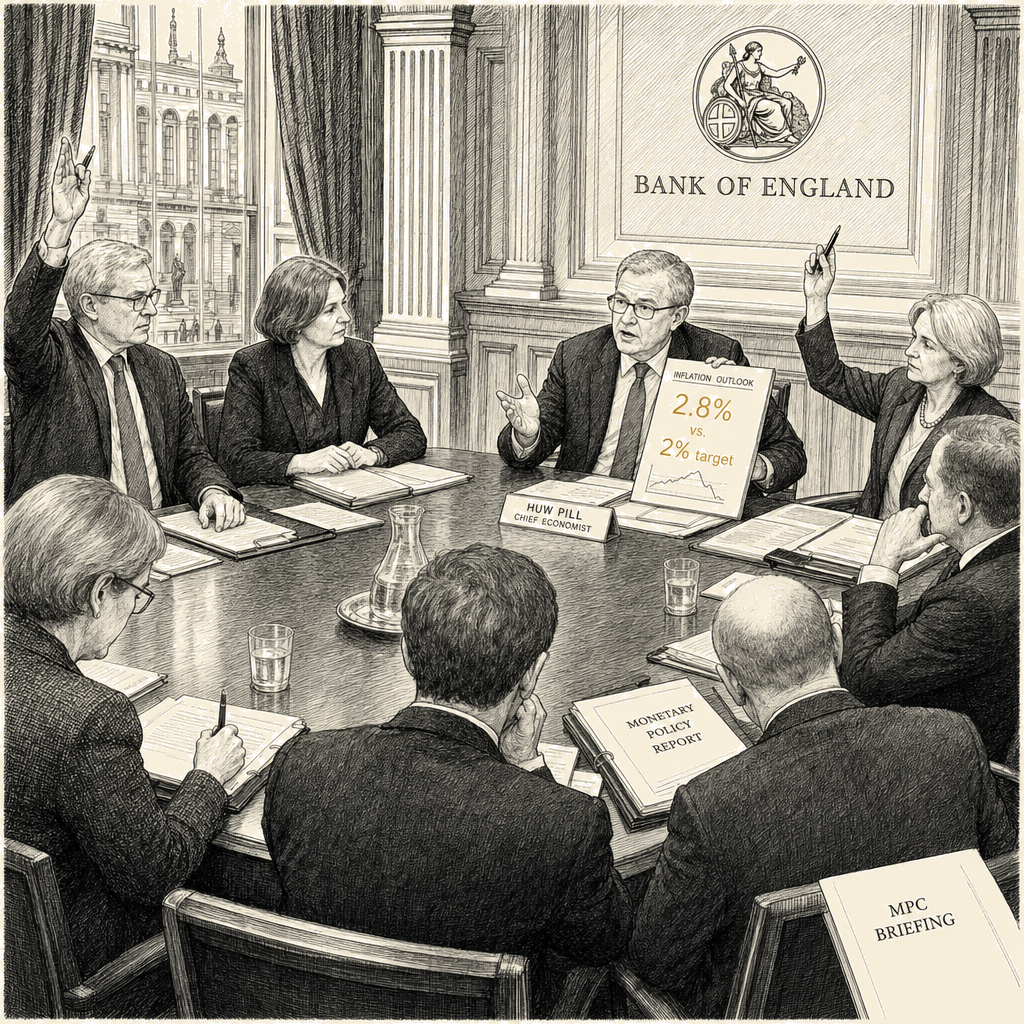
Bank of England rate-setters are failing their own inflation mandate and calling it patience.
The Monetary Policy Committee voted seven-to-two roughly two weeks ago to leave Bank Rate on hold. Chief Economist Huw Pill and external member Megan Greene were the lone voices for an immediate hike. Pill told the Press Association that monetary policy “hasn’t been restrictive enough over the last few years” and that he fears a normalization of above-target inflation after the 2022 spike. The vote came amid caution on the geopolitical backdrop and a falling oil price; markets had largely expected the hold at the prevailing 3.75 percent path.
The Office for National Statistics reported CPI inflation at 2.8 percent in May, against the symmetric 2 percent target the Bank of England Act 1998 requires the institution to deliver.
The mandate is not a guideline. The 1998 Act’s “at all times” formulation, reaffirmed in the 2013 framework review, rules out the “above-target for longer, averages to two” reading that has entered post-2022 commentary. CPI at 2.8 percent is 0.8 percentage points above target. The institutional record requires the committee to take the deviation seriously. Pill is reading the mandate the way the mandate reads.
The substantive cost of holding here is distributional. Above-target inflation, with the cumulative policy stance Pill describes as insufficiently restrictive, transfers purchasing power from cash holdings and wage packets — the primary wealth of the working and middle class — to holders of real assets, equity, and inflation-linked debt, concentrated overwhelmingly at the top. The mandate is constituted precisely to prevent this transfer. It does not say “two percent on average across cycles”; it does not say “two percent in the medium term”; it says “at all times.”
The dissent is on the record. That is the convention operating as it should: the majority for patience, the minority for the rate path the statute describes. Central-bank governance documents its disagreements publicly; the dissent tells the public which way the committee’s reasoning runs and on what evidence. The majority’s job is to defend its reading against the dissent’s reading, in writing, in the minutes. The institutional record will show whether it has done so.
The markets have read the committee’s reaction function and concluded the majority will hold until the data force a move. Sterling overnight swaps moved from pricing three rate rises earlier this year to pricing one rise by next February. The market has bet on the committee’s institutional cowardice to override its mandate. If the bet is wrong — if the inflation floor Pill warns of materializes into a persistent 3 percent regime — the repricing will not be a gentle one-percentage-point adjustment. It will be a violent unwinding of the dovish pivot, and the committee will own it.
Pill’s isolation is not a sign of irrelevance. It is the dissenting view the majority has not yet answered on the documentary record.
The convention is the convention.