
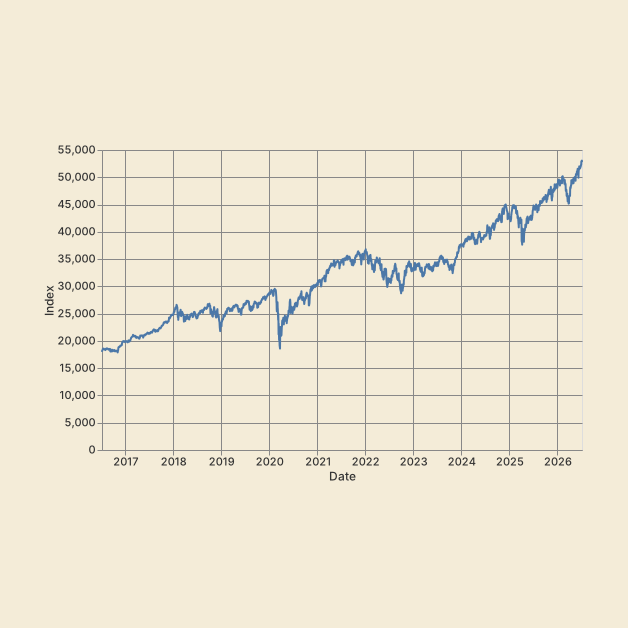
They call it a boom. I call it the curse of bigness doing what it always does — concentrating the productive property of the country into fewer and fewer hands, and asking the rest of us to call it recovery. The Wall Street Journal reports, in Dean Seal’s piece on global dealmaking, that merger-and-acquisition volume rose forty-four percent in the first half of 2026 to more than three trillion dollars, with megadeals over ten billion dollars making up forty-two percent of all activity even as the total number of deals fell three percent. The U.S. leg of the surge — seventy-two percent — was driven, in the paper’s own telling, by companies racing to close transactions before a “regulatory window” shuts.
Grant the obvious. Someone has to build the data centers. The AI build-out is capital-intensive in a way the country has not seen since the railroads, and the demand for power behind it is real enough that a NextEra–Dominion deal for sixty-seven billion dollars is not a fiction. Big Tech’s AI capital expenditure is on track to clear a hundred and sixty-eight billion dollars in the second quarter alone. Productive capital is doing what productive capital does, and even the polarization the report itself names — large balance sheets at the top, small and mid-cap deals muted by every wobble in the financing markets — has a respectable read: the technology cycle demands scale, and capital is following.
But read the numbers again. Forty-two percent of all activity in megadeals. Six “gigadeals” over fifty billion dollars. Three percent fewer deals and forty-four percent more dollars. That is the arithmetic of concentration, not the arithmetic of a healthy economy producing more. A hundred and twenty-two billion dollars concentrated into OpenAI in February. Dominion Energy disappearing into NextEra. The productive base of one of the most consequential technologies of the century, and one of the most consequential utilities on the East Coast, moving into fewer hands than held them before. The polarization the report names is not a feature. It is the indictment. The ranks of the ultrawealthy swelled 14.4 percent in 2025 on the same AI trade now driving the megadeal engine.
I used to trade the agricultural futures these consolidations eventually made redundant. I know how little the men in those buildings think about the men in the field. They think about their book. The book has been good for forty years, and the book now says the same handful of counterparties own the productive base of everything from energy to software to the inputs to the food supply, and the men in the building call that a market. The country I was raised in would not have called it a market. It would have called it the slow undoing of a broad base of owners, and it would have known what that did to a free country.
Look at what the same machine did to the place I live. A few family potato farms in Adams County, Wisconsin, in the middle of the last century, gave way to one operation — Heartland Farms, tens of thousands of acres across five counties, a major supplier for Frito-Lay, the largest private employer in the county. The Pavelskis, who started it in 1873, are still running it. I am not interested in their name on a tombstone. I am interested in the names that are no longer on the mailbox. The same machine that did that to the potato ground in central Wisconsin is doing it now, at a national scale, to the AI economy. The booms change. The bigness is the same bigness.
The smoking gun is in the last third of the piece, and the paper prints it without quite realizing what it has printed. U.S. transactions “jumped 72 percent” because, the reporter writes, dealmakers are “trying to capitalize on the country’s currently permissive regulatory framework around M&A.” They are “racing to close deals within a regulatory window that could shut as Trump’s presidency winds down.” Read that twice. The most consequential economic actors in the country are admitting, on the record, that the only reason they can complete these consolidations is that the regulator is permissive, and the only reason they are racing is that they expect the permissive regulator to be replaced. They are exploiting a regulatory window. This is not a market functioning. It is a market being looted, with the looters themselves explaining the timetable.
The movement that was supposed to conserve the independent producer, the dispersed proprietor, the suspicion of bigness, has watched this happen and called it freedom. A conservatism that could conserve something would have something to say about this. The tradition I was raised in — the Burkean, the Brandeisian, the Catholic social teaching tradition — was built for exactly this moment. Property widely distributed is the precondition of a free economy; concentrated productive property is the precondition of a servile one. Belloc named it the servile state. Brandeis named it the curse of bigness. Pius XI, in Quadragesimo Anno, named both the overweening trust and the overweening state as disorders, and put the principle of subsidiarity into print — higher bodies should not absorb what lesser organizations can do. None of that tradition is being invoked by the men at the Mergermarket breakfast. They are reading their P&L. The P&L is doing the talking.
When the physical infrastructure of a county — the power that keeps the lights on, the water that keeps the mills running — belongs to a holding company that exists only to feed a data center a thousand miles away, the community ceases to be a polity and becomes a colony. The earth was given for all, and its physical capacity is being priced out of the reach of the people who walk on it. And we know what happens when the men in the trading house build a tower this tall — the wind always comes, and it always blows hardest on the towns below. The piece concedes that bubble warnings are mounting and that a great deal of this paper wealth is resting on a thesis that may not pan out, financed at rates that may not hold. When the thesis cracks, the paper wealth cracks with it, and the consolidated productive base is held by a smaller set of hands than held it before. The boom is the rigging. The bust will be the inheritance.
There is a different answer, and it is not the answer the post-liberals will give you. It is not a state antitrust division breaking up the next deal — though antitrust that took bigness seriously would not be the worst thing the country ever did, and Brandeis is not a bad name to invoke. But the post-liberal answer fails its own test: it asks the overweening state to correct the overweening market, which is the same disorder in a different uniform, and the men who staff the trust-busters come from the same schools and the same donor class as the men at the Mergermarket breakfast. The remedy is the third thing — not the private trust, not the public bureau, but the cooperative ownership of the productive base by the people who do the work. Pool the resources of the many small producers the M&A report concedes cannot survive the current environment on their own, and give them the scale and the capital access a single balance sheet cannot.
The rural electric co-ops did it for electricity in the 1930s, when the investor-owned utilities said rural America was not profitable enough to serve. The credit unions did it for finance. The agricultural marketing co-ops have done it for a hundred years, under the Capper-Volstead Act, against concentrated buyers. Organic Valley today unites over sixteen hundred family organic farms; Land O’Lakes is a cooperative; Mondragon, in the Basque country, is the largest employer in its region, owned by its workers, with internal pay ratios around six to one. In my own county, the power grid is not owned by a holding company looking to feed a server farm; it is owned by the Adams-Columbia Electric Cooperative, governed by the people it serves. These are not sentimental gestures. They are productive enterprises competing in real markets, owned by their members instead of by an absentee capital structure.
The piece says the polarization is “small and mid-sized companies, whose management teams are more sensitive to macroeconomic volatility, high interest rates and geopolitical uncertainty.” That is a polite description of the position the cooperative form was invented to remedy. The volatility is the point. Pooled, the volatility is shared; the bargaining power is restored; the productive property stays in many hands. I manage a co-op. I have watched it work. It is harder, slower, and uglier than a megadeal. It is also the only answer to the bigness machine that does not, somewhere down the line, end in the bigness machine again.
The Wall Street Journal reported a three-trillion-dollar first half. I read it as a record of what is being taken, and by whom, and on what terms. The conservative tradition I inherited says the productive base of a free country ought to be owned by many, and the moment many cease to own it, the country ceases to be free in any sense the tradition ever meant. The Journal calls it a boom. There are enough empty farmhouses in this county to know what it is.