
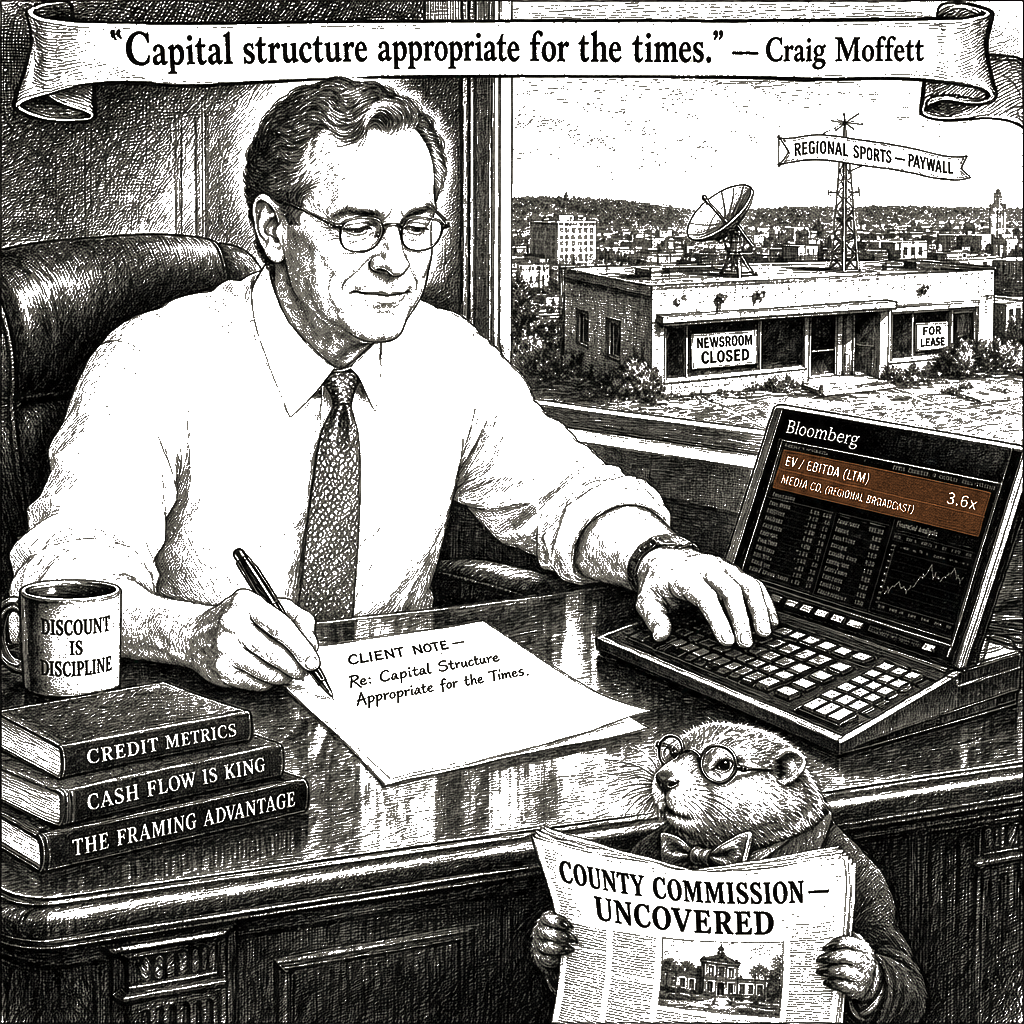
They spent forty years gutting the local newsroom, putting the high school football broadcast behind a regional sports network paywall, and treating the town as a disposable subscriber demographic—and now the respectable financial press is cheering because the conglomerate they built is finally shedding its valuation discount. The consensus cheerleading for the planned separation of Comcast’s media and connectivity businesses argues that breaking apart the media and connectivity behemoth is a triumph of capital efficiency, allowing each piece to “adopt a capital structure appropriate for the times” (Craig Moffett’s phrase in a client note this week), while the market ponders whether Netflix—now worth nearly four times Comcast’s market capitalization—might swallow NBCUniversal. It is the same rentier consolidation playbook that drove the desperate scrambling over Warner Bros. Discovery earlier this year.
The analysts are not entirely wrong to demand the beast’s dismantling. A company that owned the wire into your house, the channel on your dial, and the studio that made the show was never a media company. It was a rentier that had learned to call itself one, and for forty years it sold us the bundle as innovation. The grand centralized design—the belief that a distant bureaucracy in Philadelphia or Englewood Cliffs could efficiently dictate the civic life of a thousand different towns—is an epistemic failure as surely as central planning was. The market’s cold refusal to price the bundle is a rational verdict: the whole is less than the sum of its parts because the remote planner inherently lacks the practical knowledge of the place. Separating the wires from the studios will indeed unlock the conglomerate discount and let each unit focus on its own execution. But the triumph they are celebrating is entirely for the shareholder’s multiple, never for the citizen’s civic square. The respectable press praises the newfound capital efficiency while remaining utterly silent on the civic discount—the hollowed-out trust, the shuttered local news bureaus from Peoria to Bakersfield that once covered the county commission, the treatment of the viewer not as a neighbor but as a data point to be squeezed for the quarterly earnings call. They broke the local institution, extracted the remaining value, and are now shocked that the hollowed shell traded cheaply.
The Street saw only the symptom. The disease was always the bundle. From the trading desk, the bundle was always visible for what it was: a spread between content and distribution, between advertiser and audience, between the regulator and the regulated—the widest single trade the consumer economy ever ran on itself. I used to trade the paper claims on the networks before the signal ever reached the roof antenna; I know precisely how little the men in the trading tower think about the families in the coverage area. To the analyst parsing the tax rules on a spin-off, the viewer in Adams County is an abstraction, a line item in a subscriber churn model. But the viewer is a man who remembers when the local affiliate actually knew his name, when the station covered the county fair and the school board instead of feeding the national machine’s appetite for outrage. The conglomerate did not just underperform the NASDAQ; it underperformed the community. It severed the bond between the institution and the place it was supposed to serve.
And the harm was not only at the level of subscription bills. The bundle hollowed the mediating institutions that once stood between the citizen and the remote corporation. Local news, already wounded, was the first casualty: a vertically integrated conglomerate does not need a local voice; it needs a local affiliate, and the regional sports networks that Comcast consolidated across the last decade were the bluntest example—monopoly franchises on the local signal, sold back to the same households the wire already reached, with carriage disputes the lever by which the bundle tightened. The bundle was a curse of bigness in the precise Brandeisian sense: it concentrated power, and concentrated power stopped being answerable to the place it operated. The Street noticed the discount. The county noticed the bundle.
The answer is not to hope that Netflix buys NBCUniversal, which is simply the fantasy of replacing one distant rentier with another. The answer is the distributed public square. It is the independent local station, the community-owned news cooperative, the broadcaster rooted in the town whose taxes pay for its FCC license. Ownership structure determines whose interests the newsroom serves; a community-owned structure answers to the neighbor, not the distant shareholder. It is the Rochdale principle applied to the media: if the community uses the public square, the community should have a stake in owning it.
We have done this before. The Rural Electrification Administration, created by executive order in 1935 and made permanent by Congress the following year, did for the wire into the farmhouse what Comcast did for the wire into the suburb—except the REA did it through member-owned cooperatives, not investor-owned utilities, and it electrified rural America on terms the for-profits had refused to serve. Adams-Columbia Electric Cooperative, headquartered in my own town of Friendship, is the descendant of that experiment. The same logic applies to the cable, the broadband, the local signal. A cooperative is not a state; it is a member-owned firm, governed one-member-one-vote, with the surplus returned to the people who use it. The co-op is the bundle’s opposite. It does not concentrate. It distributes.
The Street will not lead us there. The Street knows how to break up a conglomerate; it does not know how to build a co-op. That is fine. The Street is not the institution for this work. The bundle was the disease. The discount was the symptom. The cure is the one the Street cannot price and cannot build, because it is the one that does not centralize: member ownership, distributed control, the wire in the hands of the people it serves.
Conserve what, exactly, when the very institutions of local knowledge are being liquidated for a stock bump?