
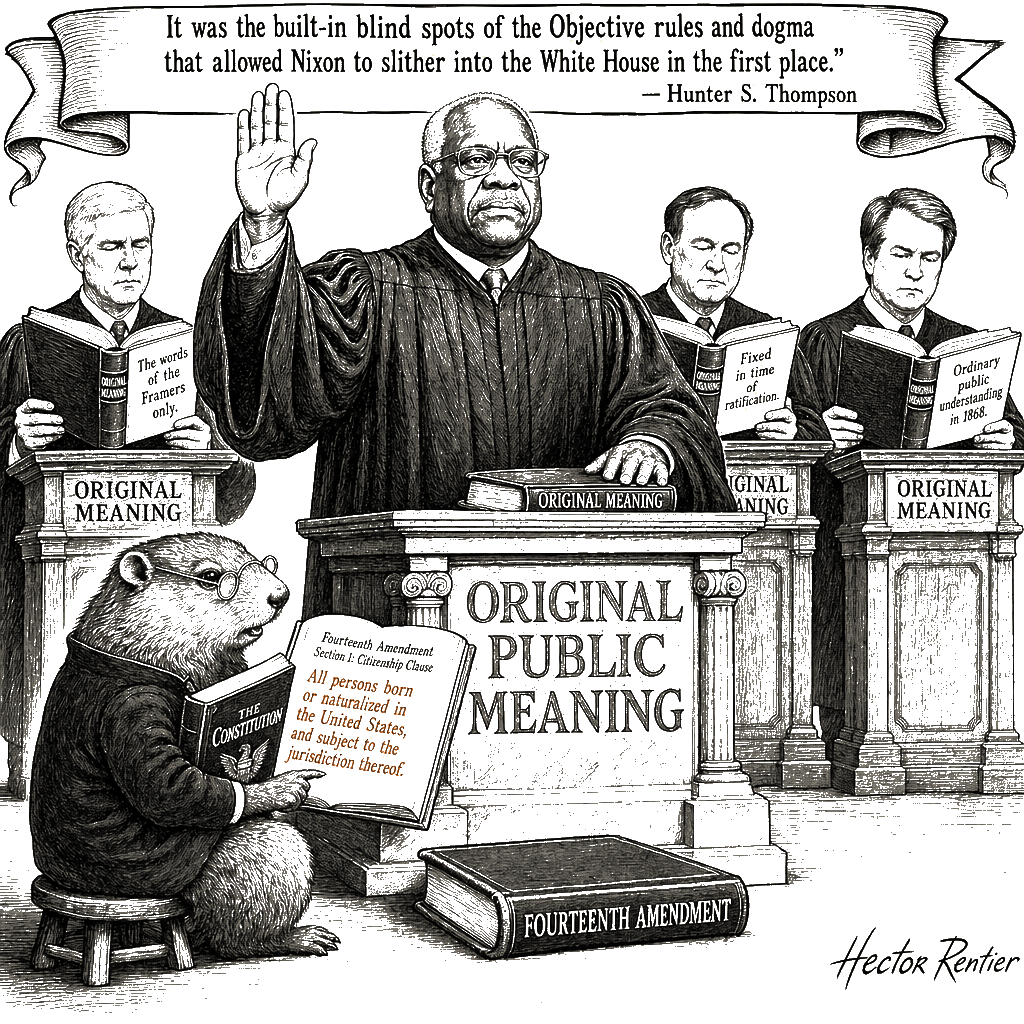
Clarence Thomas invented a constitutional fiction to strip American-born children of their citizenship, and three of his colleagues invented three more.
The Supreme Court ruled 5-4 against him in Trump v. Barbara on Tuesday. The President cannot, by executive order, strip citizenship from children born on American soil to undocumented parents or temporary visitors. Chief Justice Roberts wrote for the majority, joined by Justices Sotomayor, Kagan, Jackson, and Barrett. The opinion rests on the text of the Citizenship Clause — “all persons born or naturalized in the United States, and subject to the jurisdiction thereof” — and on United States v. Wong Kim Ark, 169 U.S. 649 (1898), the 128-year-old precedent that has never been disturbed. The exceptions to birthright citizenship are narrow and structural: children of foreign diplomats with diplomatic immunity, or children of occupying enemy forces. The administration’s own Solicitor General acknowledged at argument the challenge to the longstanding consensus on birthright citizenship. The Wall Street Journal’s editorial board would characterize the order as “legal revisionism, as his Administration admitted.” The Court agreed.
Four justices disagreed, and across 194 pages they produced four different constitutional theories, each claiming fidelity to original public meaning, each arriving at a different destination.
Justice Thomas, joined by Justice Gorsuch, argued that birthright citizenship turned on “domicile” — the legal term for a person’s permanent, settled attachment to a place. Children, in this view, inherit citizenship from parents whose “roots were in a place, who called that place home, and who would, if necessary, go to war for that place.” This would exclude the children of birth tourists. It might also exclude the children of undocumented immigrants who have lived in the United States for decades. Thomas would not say. In a footnote, he “reserve[s] for another day the question whether the children of illegal aliens can be domiciled here.” He constructs a mechanism to strip millions of American-born children of their citizenship, then declines to define its operation. The technique is familiar from two generations of conservative jurisprudence: the controlling question that cannot be confronted is relegated to a footnote; the theory proceeds around it.
Justice Gorsuch, writing separately, extends the logic, posing the rhetorical question: “If those parents are not domiciled here, then where are they domiciled?” The question is the majority’s. The answer is the majority’s. Gorsuch reaches the majority’s conclusion by a route the joint opinion cannot follow.
Justice Alito, dissenting alone, would limit the Citizenship Clause to children who “at birth, owe allegiance solely to this country.” The standard is undefined, the historical sources chosen rather than surveyed, and the consequences vast: under this view, the children of any foreign-national parent with divided loyalties — a population that includes most naturalized citizens’ grandchildren — would be denied citizenship at birth.
Justice Kavanaugh would have decided the case on statutory grounds. The Nationality Act of 1940 and the Immigration and Nationality Act of 1952 codify the Wong Kim Ark understanding. The President’s order is illegal because it contradicts those statutes, not because it contradicts the Constitution. The constitutional question survives untouched, reserved for a future Court staffed with litigants and statutes more to his liking. The Wall Street Journal’s editorial board, in its July 1 comment on the ruling, praises this as a “middle way” that would allow legislative limits on birthright citizenship. The posture is called judicial minimalism. The substance is constitutional abdication — a refusal to defend the citizenship of American-born children on the constitutional ground that defends it, leaving the door ajar for the next ideologue to walk through.
Kavanaugh’s concession is the most telling. He agrees the Citizenship Clause reads exactly the way the majority says it reads. He agrees the order is illegal. He declines to say so on constitutional grounds. You cannot read “domicile” into the Fourteenth Amendment when your conservative colleague cannot find it there either. By routing his vote through statutes rather than the Constitution, Kavanaugh admits the textualist and originalist case for Thomas, Gorsuch, and Alito is a dead end — and refuses to give that admission the precedential force of a constitutional holding.
The audit is not that the dissenters reached a wrong answer. The audit is that they reached four different wrong answers using the same method.
“Originalism” is a methodology that purports to derive constitutional meaning from the public understanding of the text at the time of adoption. It claims the discipline of fixed historical reference. A real methodology applied to a clear text by trained readers should produce convergent results, with disagreements confined to contested historical questions at the margins. Four different theories of the Citizenship Clause, each claiming originalist fidelity, is not the operation of a methodology. It is the operation of an outcome in search of a method.
The asymmetry lives inside the case. Read Roberts’s opinion and the dissents side by side. Both cite the British common-law rule of citizenship by birth on the soil. Both cite the early republic and its tens of thousands of émigrés from the Old World. Both cite Dred Scott’s abrogation, the Fourteenth Amendment’s restoration, and Wong Kim Ark’s holding. The historical record is identical. The conclusions are not. One reading emerges from the majority. Four readings emerge from the dissent.
When the conservative legal movement wanted the answer — when Dred Scott was rightly overruled, when the Fourteenth Amendment was rightly ratified, when Wong Kim Ark was rightly preserved for 128 years — originalism converged. When the same record produces the same answer the movement spent a decade denouncing, originalism fractures. Four theories. Four footnotes. Four routes to the same destination. The destination is the same. The methodology is whatever serves the destination.
The pattern recurs. In Students for Fair Admissions v. Harvard, 600 U.S. 181 (2023), the Equal Protection Clause received an originalist reading that yielded the movement’s preferred outcome. The methodology converged. In New York State Rifle & Pistol Assn. v. Bruen, 597 U.S. 1 (2022), the same architecture imposed a rigid, judge-manufactured historical test to override centuries of gun-regulation precedent. In Dobbs v. Jackson Women’s Health Org., 597 U.S. 215 (2022), the architecture is identical: an imported-from-history requirement — “domicile” here, “deeply rooted in 1868” there — designed to override the constitutional text when the text produces an inconvenient result. The methodology converged. Here, with the same historical record under the same constitutional text, the methodology fractures. Convergence when the destination is fixed; divergence when the destination is contested. This is not a methodology. This is a posture.
The Wall Street Journal’s editorial board, surveying the four dissents, observes that they “again refute the idea that this Supreme Court has any kind of lockstep MAGA majority.” The framing is itself a tell. The question is not whether the conservative justices are a “lockstep MAGA majority.” The question is what doctrines they deploy, in which cases, to which ends, and whether the deployment pattern reveals a coherent methodology or an asymmetric one. Four different originalist answers to a clear text, in a single case, on a question the administration’s own lawyer acknowledged, is not evidence of judicial independence. It is evidence of the methodology’s failure to constrain the result. The editorial board’s suggestion that birth tourism is a problem requiring a “constitutional amendment” is a backdoor concession that the Constitution, as written and as interpreted in Wong Kim Ark, does not permit the citizenship-stripping Thomas and Gorsuch are attempting to authorize.
By “reserving for another day” the fate of millions of children born on American soil, Thomas and Gorsuch have not preserved a constitutional debate. They have merely loaded the weapon for the next time a president with the right judges asks them to pull the trigger. The Court ruled correctly on Tuesday. The Citizenship Clause means what it has meant since 1868. The next case will arrive. The methodology will be different. The pattern of deployment will not.