
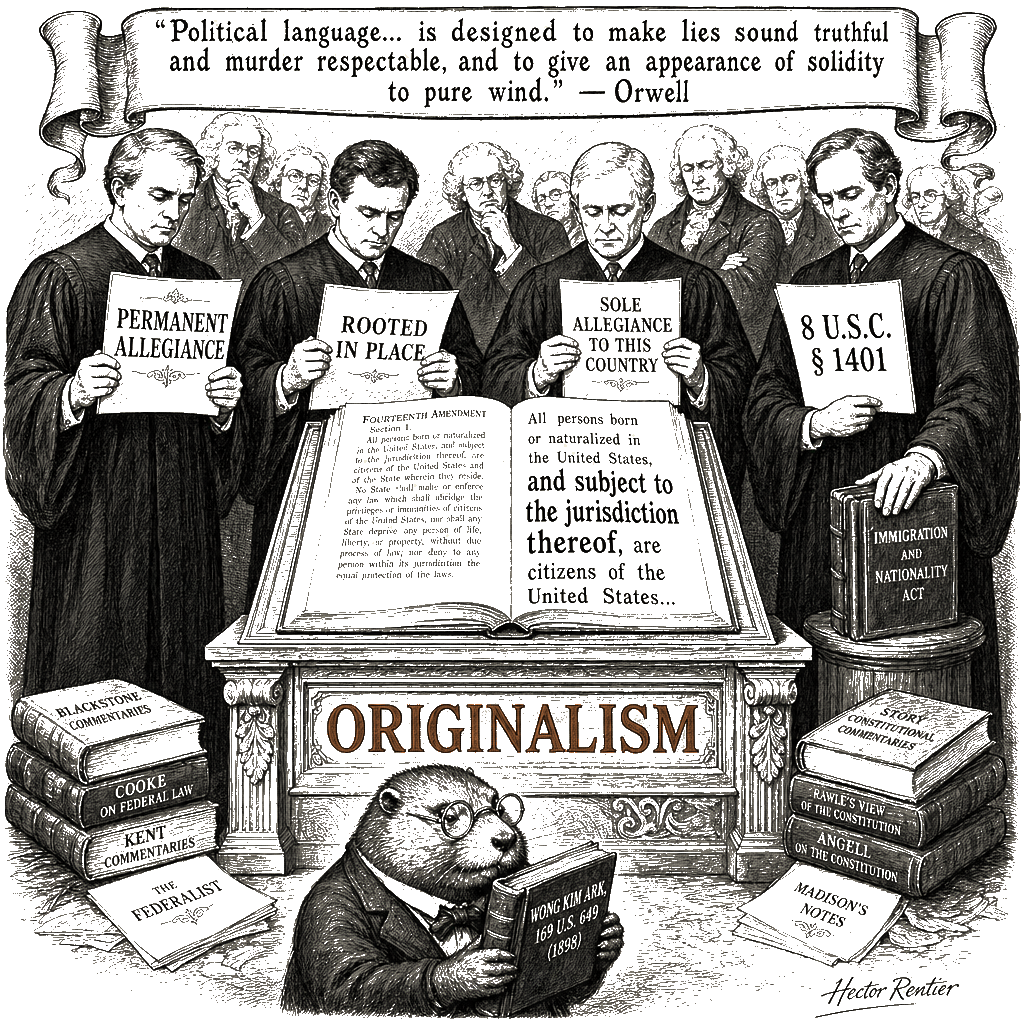
Justice Clarence Thomas tried to strip millions of American children of their citizenship. Chief Justice John Roberts’s majority blocked him, cementing the orthodox reading of the Citizenship Clause against a five-justice assault that fractured along four incompatible “originalist” lines. The fracturing is the story. Four justices, claiming fidelity to the same interpretive method, reached four irreconcilable conclusions about what the Fourteenth Amendment means. Originalism was the framework. The framework did no work.
The strongest version of the assault rests on the phrase “and subject to the jurisdiction thereof” in the Citizenship Clause. The argument runs that this qualifier must mean something beyond mere physical presence and subjection to U.S. criminal law. If it meant everyone born on U.S. soil, the framers would not have bothered to include it. Therefore, “jurisdiction” must imply a mutual, consent-based political tie — a “domicile” or permanent allegiance — excluding the children of aliens who are here unlawfully or temporarily. Under this view, the Citizenship Clause is not a blind rule of soil but a covenant of the body politic.
Justice Thomas, joined by Justice Neil Gorsuch, dressed the argument in the language of rootedness. Citizens, on his reading, are “permanent members of the body politic,” people “whose roots were in a place.” Justice Samuel Alito, dissenting solo, argued the Amendment “confers citizenship on only those children who, at birth, owe allegiance solely to this country.” Justice Brett Kavanaugh accepted that the originalist case against birthright citizenship was strong enough to win in principle, but said the Court should have ruled narrowly on statutory grounds instead. Four readers of the same text, four versions of “the original meaning,” all incompatible with one another.
The historical record destroys all of them. The Thirty-Ninth Congress, which drafted the Fourteenth Amendment, was explicitly codifying the common law of jus soli (birthright citizenship by soil) to overrule Dred Scott. This established a rule the Court later affirmed in United States v. Wong Kim Ark, 169 U.S. 649 (1898). The “jurisdiction” qualifier had a specific, well-understood common-law meaning: it excluded those who were not subject to the full jurisdiction of U.S. courts — two categories, children of foreign diplomats with diplomatic immunity and children of an occupying enemy force. The Thirty-Ninth Congress also addressed members of sovereign domestic tribal nations, a category the Civil Rights Act of 1866, 14 Stat. 27, explicitly excluded as “Indians not taxed.” The Congress did not invent a general “domicile” or “allegiance” test for immigrants. Justice Thomas’s claim that the original understanding of birthright citizenship turned on a person’s domicile is a historical ghost. It does not appear in the text, the congressional debates, or the common law the framers invoked.
Justice Alito’s solo dissent is the most revealing because it is the most historically candid. The Amendment, on his reading, “confers citizenship on only those children who, at birth, owe allegiance solely to this country.” This is not originalism. It is a feudal relic. The concept of a permanent, unalterable sovereign allegiance tied to the sovereign’s person was the exact doctrine the Reconstruction Amendments were destroying. When the framers of the Fourteenth Amendment wrote the Citizenship Clause, they were specifically abolishing the pre–Civil War caste logic that tied political belonging to bloodline and perpetual loyalty to a master, establishing instead a citizenship based on birth on the soil and subjection to the law. Alito is now smuggling that exact pre-Reconstruction pledge of exclusive loyalty back into the Constitution through the word “jurisdiction.” It is a devastating historical irony: the very Amendment designed to emancipate Black Americans from a system of inherited, unchangeable caste is being twisted by a conservative justice to impose a new, blood-and-soil caste system on the children of immigrants.
Justice Kavanaugh’s position is the tell. He accepts, implicitly, that the textualist case against birthright citizenship is too weak to command his vote — so he would rule on statutory grounds instead. The federal statutes he cites, codified at 8 U.S.C. § 1401, are not originalist sources. They are twentieth-century legislative codifications of the 1898 Wong Kim Ark ruling that resolved the question the 1857 Court had resolved wrong. Kavanaugh’s statutory retreat concedes that the constitutional case for the executive order cannot stand on originalist ground. That is a concession about the method, not about the policy. When the originalist case is too weak to command five votes, the justice who refuses to join it is admitting the method is not a constraint.
Kavanaugh’s concurrence also maps the internal architecture of the conservative position. He agrees with the outcome on statutory grounds, arguing that the Immigration and Nationality Act of 1952 already codifies the consensus view, rendering the executive order illegal without needing to reach the constitutional question. But he expressly leaves the constitutional door open for a future legislative limitation on birthright citizenship. Kavanaugh offers the statutory route, narrowing the policy now and leaving the constitutional narrowing for a future, friendly legislature to achieve. Thomas, Gorsuch, and Alito, by contrast, demand the judicial route, attempting to write the restriction directly into the Constitution right now. They are not equivalent escape hatches. They are two wings of the same crusade to dismantle jus soli.
Defenders of the dissents characterize this divide as a respectable variety of conservative originalism spread across nearly 200 pages of opinions, insisting that the conservative jurists are merely engaged in a good-faith methodological debate. This is a false equivalence. The majority applied the actual text and the actual historical record of the Thirty-Ninth Congress. The dissenters fabricated a historical requirement that does not exist in the record to achieve a policy outcome the text forbids. One is jurisprudence. The other is a phantom. The conservative justices cannot all be correct when they use textualism to arrive at starkly different conclusions about the meaning of the Fourteenth Amendment, and the text itself proves the majority is the only one standing on solid ground.
What the celebration of the 5–4 ruling does not say is what the dissent pattern actually shows. It is not evidence of intellectual diversity within an interpretive method. It is evidence that the dissenting justices have no interpretive method at all. Four readers, four versions of “the original meaning,” all incompatible with one another, all reaching opposite results from the same text. The disagreement is not about how to read the original record. The disagreement is about what outcome to reach. Justice Amy Coney Barrett’s decision to join the majority is itself news — the originalist case for restricting birthright citizenship did not persuade the originalist the Federalist Society elevated to the Court.
If birth tourism and unlawful immigration are genuine policy problems, the dissenters demand that the administration pursue a constitutional amendment to address them. This is a polite fiction designed to sound reasonable while ignoring the reality of the Court’s recent history. The same justices who wrote these dissents have spent the last decade proving that they do not need a constitutional amendment to achieve their desired outcomes when the text is inconvenient. They simply invent a new “original understanding” out of whole cloth, and their defenders in the legal establishment stand ready to call it a legitimate variety of conservative jurisprudence.
The dissenting justices are independent of consensus, of binding precedent, of an 1898 ruling the country has acted on for 128 years, and — when the outcome requires it — of their own interpretive method. That is not independence. It is unconstrained judicial power dressed in the costume of a method that does not exist. The Court is not ideologically unified. It is methodologically empty. The Constitution’s promise of birthright citizenship is not a loophole to be closed by judicial fiat. It is the foundation of a pluralistic republic, and the Court’s majority correctly refused to let it be destroyed by a phantom originalism.