
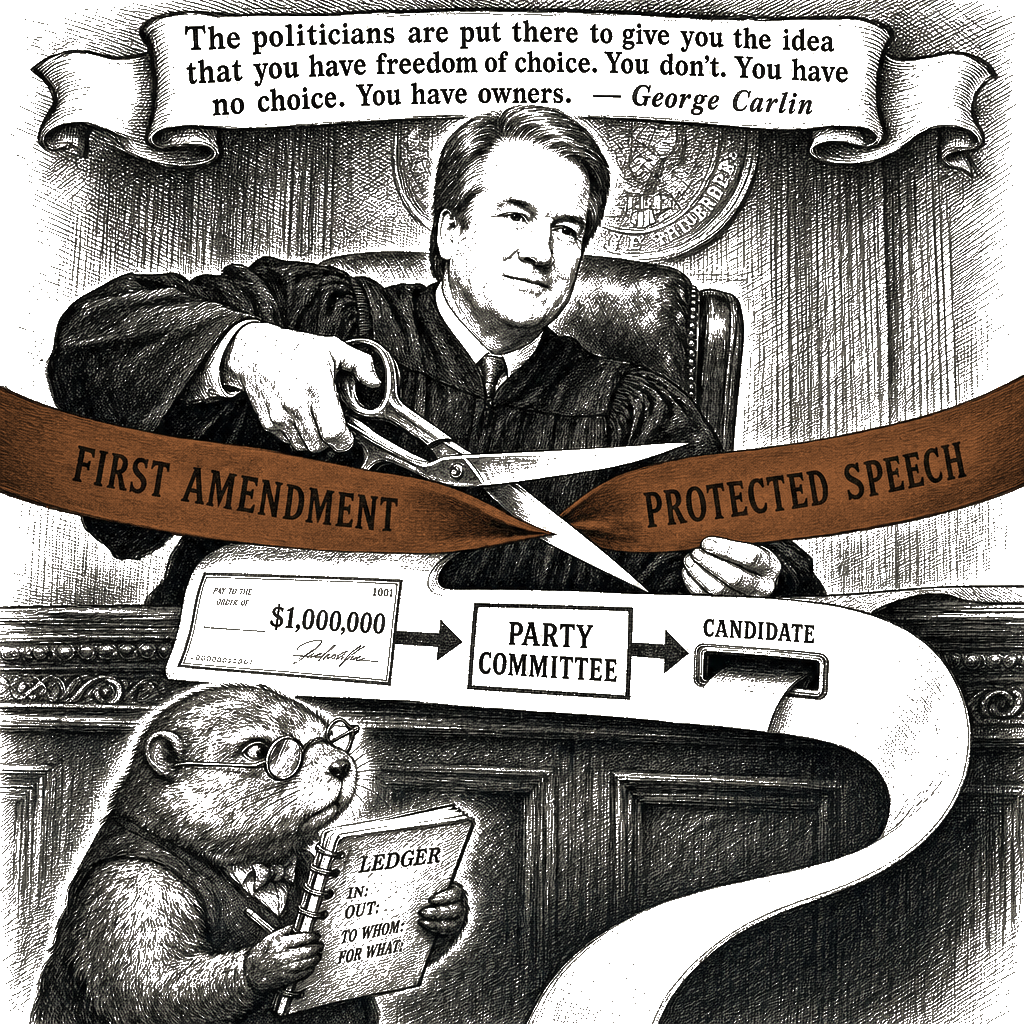
Justice Kavanaugh just legalized the rich buying candidates through the political parties. The Court is the launderer.
The 6-3 majority in NRSC v. FEC dismantled the last structural firewall separating wealthy donors from the candidates they want to support. Federal campaign finance law, since the Federal Election Campaign Act of 1974, has distinguished two channels of money: contributions to candidates, capped at the individual level, and party spending, permitted at higher levels but barred from coordination with candidates. The coordination bar was the mechanism by which Congress prevented wealthy donors from writing six- and seven-figure checks to party committees on the implicit understanding that the money would support a particular candidate’s election. The Court has now dissolved that firewall.
Justice Kavanaugh writes for the majority that the coordination limits “preclude parties from amplifying the voice of their adherents,” impose unjustified costs on political parties, and inflict a “stifling effect on the ability of the party to do what it exists to do.” He argues the limits run into the Court’s settled First Amendment principle that “Congress may not dictate how much political speech is too much or how much spending on speech is too much,” and that the only legitimate state interest for restricting campaign finances is preventing corruption or its appearance. Coordinated-spending limits, on this view, are impermissible because they pile “prophylaxis upon prophylaxis upon prophylaxis” on top of contribution limits, disclosure rules, and earmark restrictions that already address quid pro quo corruption. The Wall Street Journal editorial board noted the obvious: the Buckley contribution-spending distinction cannot survive the Court’s own precedents. The mistake was Citizens United, and the decisions that followed it. The Court has not been wrestling with that mistake. The Court has been finishing its work.
The doctrinal architecture the majority now extends to its logical endpoint was built across two decades. Buckley v. Valeo, 424 U.S. 1 (1976), drew the line. The decision distinguished political contributions from political spending on the theory that contributing-money-to-a-candidate and spending-money-on-political-speech were categorically different forms of expression — the first subject to less demanding review because the corruption risk runs directly from donor to candidate, the second protected at the highest level of review because spending money on speech is itself a First Amendment act. That distinction, and the asymmetric scrutiny treatment it produced, was the architecture the post-Watergate campaign-finance regime was built on. Citizens United v. FEC, 558 U.S. 310 (2010), overruled the line of cases restricting corporate and union independent expenditures. McCutcheon v. FEC, 572 U.S. 464 (2014), eliminated aggregate contribution limits across federal candidates and party committees. What remained was the architecture NRSC has now finished: a regime in which independent expenditures were unlimited, contribution limits were preserved, and the coordination firewall kept wealthy donor money from flowing directly through parties to candidates. That firewall is what the decision erased. The combined effect is a campaign-finance regime in which there is no formal constraint on the dollar amount of money that can be directed at a particular candidate’s election, so long as it flows through the right channel. The pattern is structural. It requires no mental-state assertion about any individual justice; it shows in the deployment of First Amendment doctrine across cases over two decades, consistently in one direction.
Kavanaugh invokes history and tradition: “for nearly 200 years after the ratification of the First Amendment, parties could spend freely to support their candidates during campaigns and could do so in coordination with the candidates.” The pre-1974 system the majority invokes was not the system of unlimited donor coordination the Court is now restoring. The “nearly 200 years” the majority invokes is a curated record. The Tillman Act of 1907 had already banned corporate treasury money in federal elections, and the Taft-Hartley Act of 1947 had already extended that bar to union and corporate expenditures. The mass political-fundraising system that produced the documented corruption FECA addressed was already substantially regulated before Watergate. To treat the eighteenth-century party apparatus as analogous to the twenty-first-century donor network is a history-and-tradition cherry-pick that substitutes a romanticized past for the documented mechanics of present capture.
The doctrinal departure rests on the artificial narrowing of corruption. Under existing precedent, the only cognizable government interest for restricting campaign finance is preventing quid pro quo corruption. The majority has now dismantled the coordinated expenditure limit, treating the direct coordination between a party and its candidate as immune to anti-corruption scrutiny because the money flows through the party apparatus rather than directly from the donor. The regime does not prevent bribery; it merely reroutes it through the party committee, shielding the transaction behind a doctrinal fiction. When a major donor can coordinate unlimited spending with the party that controls the candidate’s committee, the quid and the quo are functionally merged. The Court’s refusal to recognize this structural reality is not a neutral interpretation of the First Amendment; it is a regime-level choice to immunize concentrated political capital from democratic regulation. The doctrine converts the deployment of wealth into protected speech, ensuring that the architects of the policy are shielded from the consequences of the policy.
Justice Elena Kagan, writing for the three dissenting Justices, calls this what it is: the jettisoning of “a rule needed to protect our democracy’s integrity” and the creation of “a legal regime increasingly unable to stop political corruption, and thus to preserve our institutions’ democratic legitimacy.” Kavanaugh’s response amounts to a concession dressed as reassurance. He acknowledges that the post-Watergate spending limits have weakened parties in ways that “distort the political system” and that “the relatively diminished political parties have ushered in increased political polarization and fragmentation.” This is the majority admitting that its own ruling cures a distortion by unleashing a greater one. The regime it dismantles was the last structural brake on the merger of concentrated wealth and party machinery; the regime it installs is one where that merger is constitutionally privileged.
The remedy for weak parties was supposed to be public financing and small-donor matching — tools that elevate grassroots voices over oligarchic ones — but the Court has now dismantled the very architecture that made such egalitarian reforms thinkable. Kavanaugh’s own opinion treats disclosure requirements and earmarking restrictions as the sole remaining prophylactic bulwarks. The logic of the regime he has now installed points to their eventual dismantling as well.