
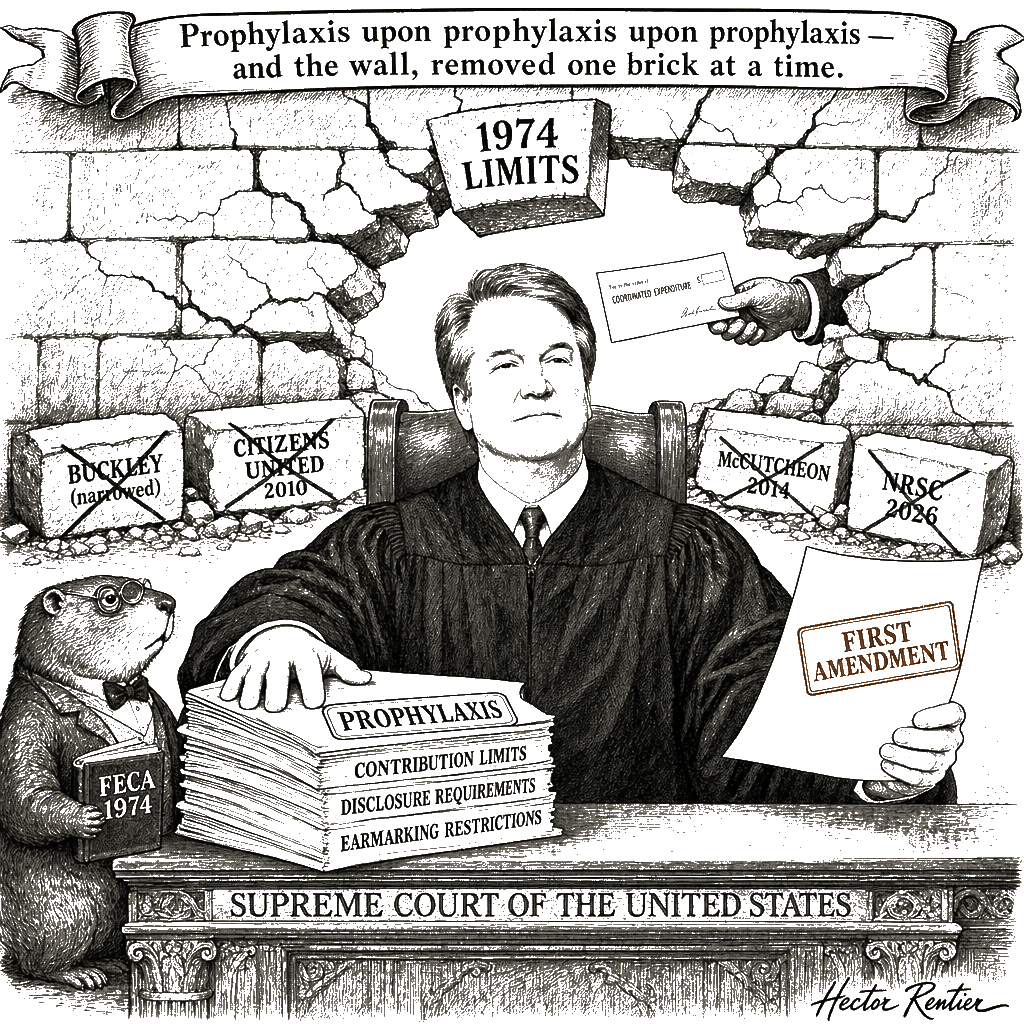
The Roberts Court legalized coordinated political bribery for the highest bidder.
Justice Brett Kavanaugh’s majority opinion in NRSC v. FEC overturns the 1974 federal limits on coordinated spending between political parties and their candidates, the last structural wall between a candidate’s campaign apparatus and a party’s donor network. The steel-man for this holding rests on a straightforward First Amendment premise: political parties are the primary vehicles of collective political speech, and limiting their ability to coordinate expenditures with their own nominees stifles that speech. As Kavanaugh writes, for nearly 200 years after the ratification of the First Amendment, parties spent freely in coordination with candidates. The majority concludes that the only legitimate governmental interest in restricting campaign finance is preventing explicit quid pro quo corruption, and that the existing architecture of disclosure requirements and earmarking restrictions serves as wholly adequate prophylaxis. The 1974 limits, Kavanaugh observes, “preclude parties from amplifying the voice of their adherents” and inflict a “stifling effect on the ability of the party to do what it exists to do.” The framing of limits as constraints on party speech is the framing of an industry that has captured the Court.
The analytical work here is not in debating whether parties are weakened by spending caps. The work is recognizing NRSC as the latest load-bearing pillar in a sixteen-year regime project to redefine corruption out of constitutional existence. The Court did not arrive at this point through a sequence of unfortunate doctrinal blunders, as sympathetic editorial boards suggest when they lament the distinction Buckley v. Valeo (1976) drew between spending and contributions. The Court arrived here through the systematic, deliberate narrowing of what the Constitution permits Congress to prevent.
In Buckley, the Court upheld direct contribution limits because they targeted the cynical precursor of the explicit quid pro quo. In Citizens United v. FEC (2010), the Court struck independent expenditure limits by redefining corruption to require a direct exchange of dollars for official acts, dismissing the broader systemic capture of legislative priorities. In McCutcheon v. FEC (2014), the Court struck aggregate contribution limits and tightened the corruption definition toward the quid-pro-quo exchange model the majority now codifies. NRSC now removes the final structural wall. The doctrinal trajectory is not a sequence of accidents; it is a judicially managed deregulation of the political marketplace.
Kavanaugh’s historical claim, that parties spent freely for nearly 200 years before 1974, functions as a history-and-tradition anchor that deliberately omits the subsequent century of anti-corruption jurisprudence recognizing the difference between independent political advocacy and coordinated treasury access. It is a history of unconstrained wealth capture that Congress moved to correct after Watergate, when it tried to “purge money from politics” through the 1974 statute the Court has now gutted. The 1974 limits were not a congressional panic. They were a legislative response to documented systemic capture that the Court has spent fifty years dismantling.
Kavanaugh dismisses the remaining architecture of campaign finance law as regulatory overkill. He lists contribution limits to candidates, disclosure requirements, and restrictions on earmarked contributions, observing that prophylaxis upon prophylaxis upon prophylaxis already serves to prevent explicit dollar-for-vote exchanges. He treats the cumulative structure as a redundancy. The structure is what remains of the anti-corruption framework. The “prophylaxis” framing is the rationale for dismantling the framework one rule at a time.
Justice Elena Kagan’s dissent argues that the ruling creates “a legal regime increasingly unable to stop political corruption, and thus to preserve our institutions’ democratic legitimacy.” The three liberal Justices accuse the majority of jettisoning “a rule needed to protect our democracy’s integrity.” They are describing the operative reality. The majority has defined corruption down to explicit dollar-for-vote exchanges and is now using that cramped definition to strike every remaining safeguard that stands between American politics and the donor class. Democrats will be captured as completely as Republicans.
The holding exposes the internal contradiction of Buckley. The architecture is now complete. The line that kept the corruption-prevention rationale alive, the line the Court itself drew in 1976, is the line the Court has now methodically eliminated. Without it, every safeguard falls. The next case challenging direct contribution limits will not require new doctrine; it requires only the mechanical application of the speech-is-speech equivalence NRSC codified today, leaving the federal legislature with no constitutional mechanism to prevent the purchase of coordinated political access.