
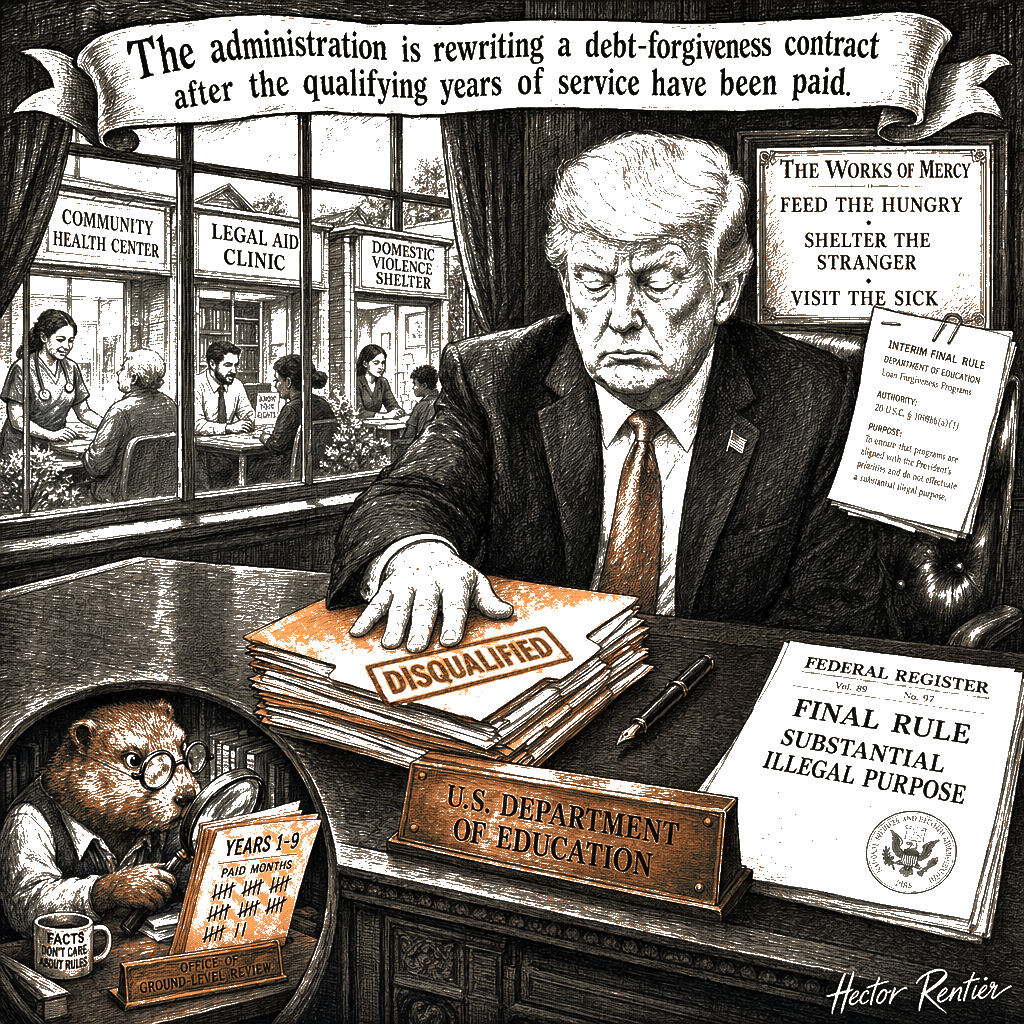
Trump is stealing public servants’ debt relief to defund the nonprofits they work for.
I am eight years into the Public Service Loan Forgiveness clock, working at a nonprofit health-care advocacy organization, and the math of my household depends on that clock finishing. My husband and I bring home $8,800 a month after taxes. Daycare for our two kids is $2,400. Our mortgage is a 7-percent anchor that has not budged despite three years of refinancing inquiries. The only reason I did not take a corporate communications job that pays thirty thousand dollars more is the federal promise made in 2007: ten years of public service, and your student debt is forgiven. If the Department of Education gets to redefine my employer out of existence under a new catch-all phrase — “substantial illegal purpose” — my remaining balance doesn’t just stop being forgiven. It capitalizes. It becomes a bomb I cannot defuse on a nonprofit salary.
Trump’s March 2025 executive order set the trap, claiming the program had “misdirected tax dollars into activist organizations that not only fail to serve the public interest, but actually harm our national security and American values.” The administration published a final rule in October to enforce that trap, defining the phrase to cover aiding illegal immigration, supporting terrorism, and the “chemical and surgical castration or mutilation of children” — their preferred vocabulary for gender-affirming care for transgender minors. The rule was scheduled to take effect on 1 July. On Tuesday, US District Judge Myong Joun in Boston blocked the rule, siding with Democratic-led states and nonprofits, agreeing the statute gave the Department no discretion to create eligibility exceptions and that the Department had no rational basis for the policy. The Department of Education is attempting to take a debt-relief program designed for teachers, nurses, social workers, and legal aid attorneys, and convert it into a loyalty test for the groups those workers choose to serve.
This is hostage-taking. The forgiveness is the hostage. The nonprofit is the target. The teachers, nurses, social workers, and public defenders who work at those nonprofits are the leverage.
The math is the math. A first-year associate at a major law firm makes what a senior public defender makes after fifteen years. A hospital administrator makes what a senior bedside nurse at a public hospital will never make. PSLF is the structural mechanism that makes the lower-paying public service job financially viable. Strip the forgiveness and the trade is broken.
And the administration is not just declining to honor the program for new borrowers. It is rewriting the rules to disqualify work that has already been done. A teacher who has been making qualifying payments for nine years and eleven months at a nonprofit that provides immigration legal services — that teacher’s ten years of payments might not count. A nurse at a community health center that does transgender healthcare, eight years and four months in — same. A social worker, a victim’s advocate, a public defender, a librarian at a legal aid society — same. The promise was made. The work was done. The administration is changing the rules after the fact.
The original PSLF program was, in its first years, a bureaucratic disaster — nearly 99 percent of early applications were denied. It took the Biden administration’s Limited PSLF Waiver to make the program work for the more than one million borrowers who finally received relief. Now that the pipeline is delivering on the promise, the architects of the backlash are changing the terms of the contract. Days earlier, states had sued over Trump’s rule limiting federal loans for graduate nursing and healthcare degrees, and on Wednesday a Washington DC judge blocked it — the second time in seven days a court has told the Department of Education it cannot quietly rewrite the loan system by regulation.
In my own Catholic working-class formation, the operational vocabulary of mutual aid was the corporal works of mercy: to feed the hungry, to give drink to the thirsty, to clothe the naked, to shelter the homeless, to visit the sick, to visit the imprisoned. The organizations the Department of Education is now trying to disqualify are the ones doing exactly that. Legal aid clinics are visiting the imprisoned. Immigration legal services are sheltering the stranger. Community health centers providing gender-affirming care are visiting the sick. To label the operational delivery of the works of mercy as a “substantial illegal purpose” is a profound moral inversion, and it is a structural one. The journalist Heather McGhee described the same mechanism in The Sum of Us: the public good is dismantled precisely when it ceases to be exclusive. The administration is draining the pool the moment public servants and the people they serve are no longer the right kind of people.
Taylor Swift put it sharper than the law can in “my tears ricochet” — an epitaph for a broken covenant where “we gather stones, never knowing what they’ll mean.” The federal government made a promise to a generation of workers who chose to cap their earning potential in exchange for a debt-free life after a decade of service. Breaking that promise is not a bureaucratic adjustment. It is theft.
Anne Helen Petersen, in Can’t Even, argued that millennials were the first generation to fully conceptualize themselves as walking college resumes — the worker as human capital, packaging themselves for the labor market. PSLF is the explicit policy mechanism that says: package yourself for public service, and we will forgive the debt you took on to qualify. The administration is now telling the cohort that packaged itself for public service: the packaging doesn’t count.
The nonprofits the rule targets are not abstractions. They are the organizations that provide legal services to immigrants, healthcare to trans people, civil legal aid to low-income tenants, advocacy for survivors of domestic violence, social services to children in the foster system. These are the nonprofits the administration has decided are engaged in “substantial illegal purpose.” The rule is the weapon. The targeting is the policy.
I am writing this as someone who works at a nonprofit myself. My household could survive the loss of PSLF. Our privilege — family help with our housing costs, two professional salaries — is the reason we are not the people this rule is designed to break.
The family the rule is designed to break is the public defender in her eighth year of qualifying payments, with $87,000 in remaining federal student debt, with a five-year-old in daycare and a partner who works at a domestic violence shelter. The family is the school nurse with nine years of service and $54,000 in remaining debt, with two kids and a mortgage in a school district that doesn’t pay her enough to cover the mortgage without the forgiveness. The family is the social worker with six years of qualifying service and $112,000 in remaining debt, with a parent in assisted living and a sibling with a developmental disability whose care she helps coordinate. The administration is not making policy at me. The administration is making policy at them.
Judge Joun’s ruling is a stay, not a permanent defeat. The Department retains the underlying statutory authority to administer the program. The rule remains on the books. The hostages are still being held. The nonprofits will keep spending their operating budgets on legal defense instead of doing the work. Every household has a “don’t open this until Sunday” pile of mail, and for the million public servants watching this rule, the Education Department’s notice is the one that stops your breathing. The line item they want to erase is the one that makes public service possible. The math shows what the policy intends.
The public defender’s eight years still count. For now, the judge has said so.