
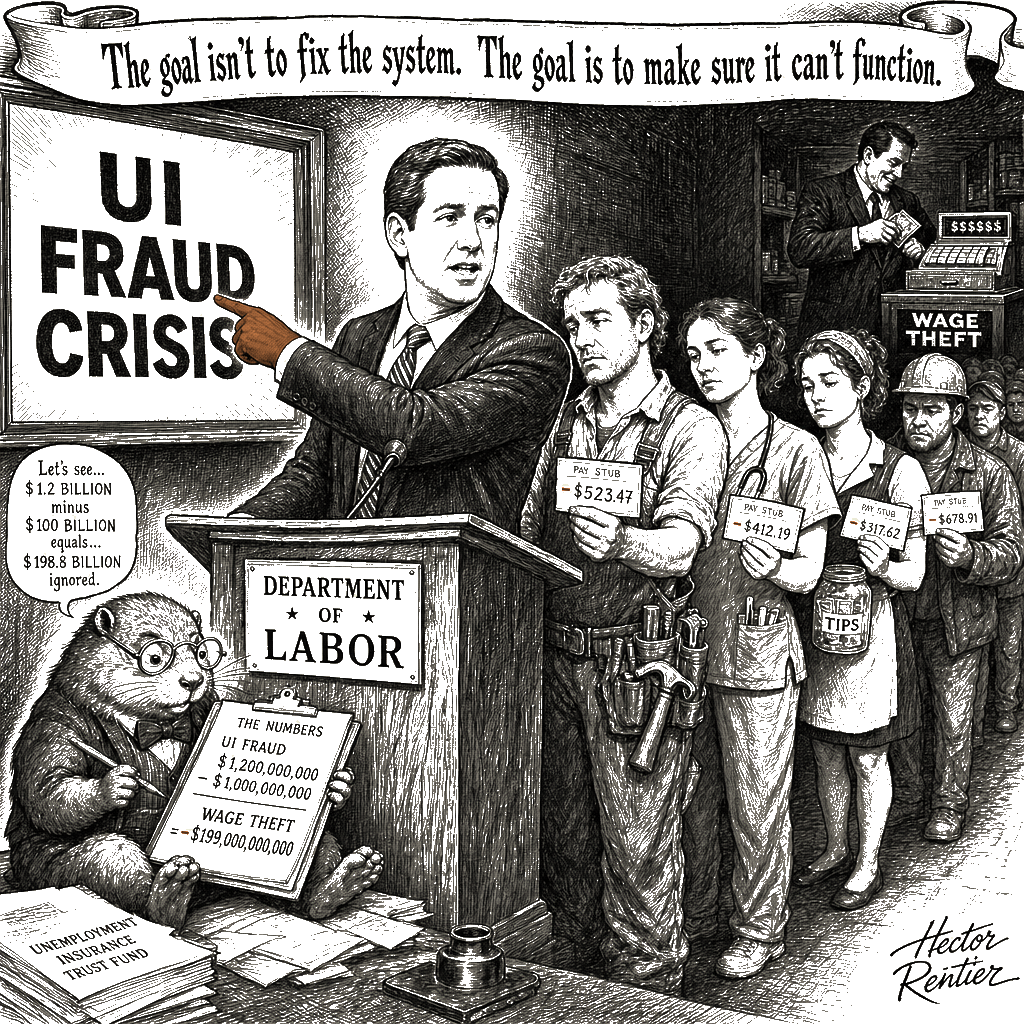
Keith Sonderling, the acting Labor Secretary, has earned his audition for the permanent job with a brilliant administrative strategy: threatening to defund the very unemployment insurance system his department is supposed to protect, over a fraud crisis he hasn’t bothered to prove exists. In June, he sent letters to 53 states and union territories threatening to withhold their administrative funds over alleged waste and abuse, singling out California, New York, and Illinois without offering a single piece of evidence. He told Fox News he’ll cut off states’ administrative funds because, in his words, “they won’t be able to administer this unemployment insurance.” Read that again. The goal isn’t to fix the system. The goal is to make sure it can’t function. His predecessor Lori Chavez-DeRemer left in April under a cloud of spectacular misconduct that trailed her and her husband out the door, which means Sonderling has been running the show on his own just long enough to figure out where the levers are.
I will concede the premise, because it costs nothing to concede: fraud in public programs is a real concern, and audits are fine. The post-pandemic UI system was hit by it — improper-payment estimates have run into the tens of billions of dollars. Program integrity is a real problem. Conceding this is cheap. It costs the argument nothing.
Good. Now the mechanism.
Sonderling says he will “essentially cut off the states’ administrative funds.” Administrative funds are what state workforce agencies use to run the unemployment insurance system — to process new claims, run eligibility checks, pay out benefits, investigate suspicious claims, recover overpayments, and modernize the underlying technology. Withhold the administrative funds and the system does not get better at catching fraud. The system stops paying workers. The laid-off carpenter in Buffalo or the furloughed nurse in Sacramento sits on hold for six weeks until she gives up. That’s not fighting fraud. That’s fighting the safety net.
And the political tell. Sonderling named California, New York, and Illinois as the worst offenders, and produced no evidence. He named them by the party of their governor. The Republican governors of fraud-prone states were not put on notice. The Democratic governors of clean states were not absolved. The selection criterion was the politics of the governor, not the rate of improper payments in the state’s UI system. The letters and the Fox News hit were deployed as a package, in the same week — a political operation by any reasonable definition. It is the one thing the Department of Labor, in principle, is supposed to refuse to be.
I’m not anti-fraud. I’m anti-starving-the-system-while-claiming-to-fight-fraud. There is a Grand Canyon between the two.
But there is a deeper structural story that the “fraud” frame is hiding, and it is the one that matters for workers in every state, blue and red. The real fraud in the American labor market isn’t an unemployed worker double-dipping for an extra hundred bucks. It’s an employer stealing wages, skimming tips, and forcing off-the-clock work. Wage theft takes more from American workers every single year than all the street robberies in the country combined. And the man who previously ran the Wage and Hour Division is suddenly very concerned about the unemployed. There is a tell in that.
Unemployment insurance in the United States is a working institution — a federal-state partnership established in 1935, replacing a portion of wages when someone loses a job through no fault of their own. By global standards, it is a thin one. American UI replaces, on average, around 40 percent of prior wages, for a typical maximum of 26 weeks. In Denmark, the comparable replacement rate is closer to 90 percent, and the typical duration is longer. A much smaller share of unemployed American workers actually receive UI than their counterparts in any other rich democracy. The system has real problems. The system’s main problem is not fraud. The system’s main problem is that it does not do for American workers what UI does for workers in countries that take the institution seriously.
So: what would a real anti-fraud program look like, if “combat fraud” were the actual goal?
Three things, each of which has been demonstrated to work in the United States or abroad.
First, automate the parts that do not need a human being adjudicating — routine eligibility checks, standard benefit calculations, automatic payments when an employer reports a separation in good standing. The states that have modernized their UI systems — a small but growing list, including Rhode Island and a few others — have measurably lower improper-payment rates and faster benefit delivery. The states that have not are running systems designed in the 1970s on COBOL. The fix is boring and expensive and nobody can put it on a Fox News chyron.
Second, integrate UI with the wage data the employer already reports. If a claimant’s reported wages do not match what their employer told the IRS they were paid, that is an automatic flag. The data is there. The integration is not. Building it requires federal-state cooperation and IT spending. Starving state agencies of administrative funds is the opposite of this work.
Third, raise the benefit floor. A worker who can actually live on UI does not have to choose between taking the first job offered and feeding their kid. A worker in that position is also a worker with less reason to commit fraud to keep their head above water. Desperate workers, in any benefit system, are the most expensive ones to administer. Denmark’s high replacement rate is not generosity for its own sake. It is what makes the rest of the Danish labor market work — a worker who knows they will be okay if they lose their job is a worker who can quit a bad one, take a risk on a better one, hold out for a wage that matches what they are worth.
Denmark’s UI also works through the unions. Workers join a union to get unemployment coverage; the union administers the fund; the fund is in a competitive position to catch fraud because it knows the industry and the worker. This is the Ghent system, and it has among the lowest administrative costs and the lowest fraud rates in the OECD. The reason is not that Danish unions are nicer than American ones. The reason is that an institution with the membership, the data, and the skin in the game is better at the actual job than a state agency that interacts with a claimant once every several years. We don’t have that model here, and we can’t build it overnight. But the underlying principle travels: the closer the institution is to the worker, the better it can do the job.
This is the thing about unemployment insurance that the “fraud” frame is designed to hide. UI is not a handout. UI is a stabilizer that lets the labor market actually work. A worker who knows they will be okay if they lose their job is a worker who can take the kind of risk that makes a flexible economy possible — the risk of leaving a bad employer, of starting something new, of waiting for the offer that matches what they are worth. Strip the stabilizer away and you do not get a more dynamic labor market. You get a more desperate workforce that takes whatever it can get, that does not bargain, that does not move. The Nordics did not build generous unemployment insurance because they are soft. They built it because it is what makes a flexible labor market function. The Americans who have been cutting UI for forty years, on the grounds that it breeds dependency, have produced neither a dynamic labor market nor a generous one. They have produced the worst of both — workers too desperate to take risks, and benefits too thin to catch them when they fall.
My grandfather sat on the board of the local dairy co-op and the rural electric co-op, and would have laughed in your face if you had called the credit union in his wallet a socialist plot. The American institutions that quietly held up the working middle class for most of the twentieth century were the boring versions of the institutions the “fraud” frame is now asking us to starve. Unemployment insurance is one of them. So is the right to organize, which this Department of Labor has spent the last year trying to narrow. So is the wage-and-hour enforcement, which has been steadily defunded across administrations of both parties. The fight over Sonderling’s nomination is a small surface on a much larger story. The story is whether the institutions that catch people when they fall are still functioning institutions, or whether they are being slowly converted into stages for political theater about the wrong people stealing the wrong dollars.
A real Department of Labor knows what a functioning labor market looks like. It knows that a layoff is a transition to manage, not a moral failure to punish. It knows that a 40 percent replacement rate is half a safety net, and that the wage-theft economy is the real labor crisis, and that the job of the Secretary is to make sure that when the plant closes, the system catches you instead of hunting you for sport. The tools are boring. They work. Denmark has been running them for fifty years, with the lowest fraud rate and the highest replacement rate in the rich world. The labor market is the most flexible in Europe. None of these facts are incompatible with each other. The “fraud” frame just does not want you to know any of them.