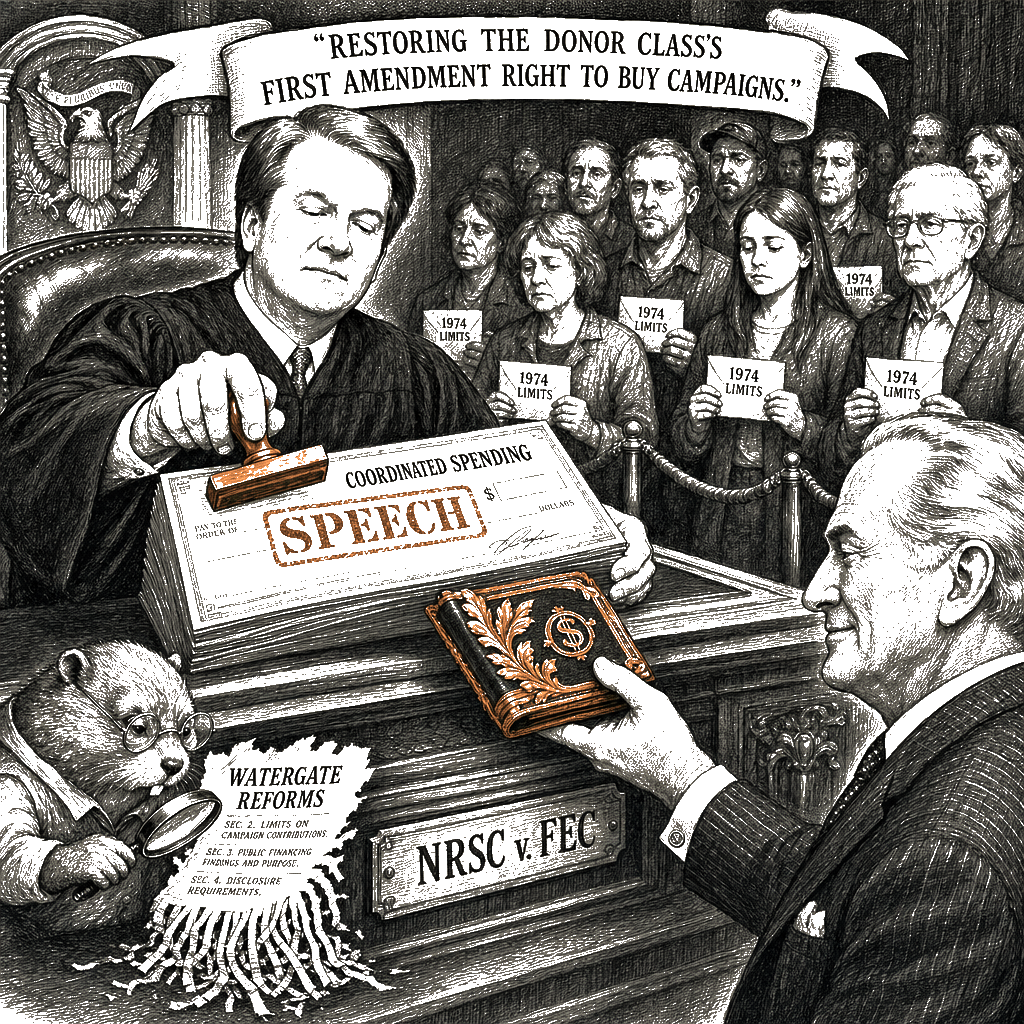
One disgraceful project of the current Supreme Court has been incrementally restoring the donor class’s First Amendment right to buy political campaigns. On Tuesday a 6-3 majority took another step toward oligarchy, overturning federal limits on coordinated spending by candidates and parties in NRSC v. FEC.
Justice Brett Kavanaugh, writing for the majority, offers a selective reading of history. “For nearly 200 years after the ratification of the First Amendment, parties could spend freely to support their candidates during campaigns and could do so in coordination with the candidates.” That is true. It is also irrelevant. The 1974 limits were passed after Watergate, when Congress rightly tried to purge corrupting money from politics — and the limits functioned precisely to keep parties from auctioning off access to the highest bidder.
Kavanaugh’s broader move is to pretend coordinated spending is “speech,” and that Congress “may not dictate how much political speech is too much or how much spending on speech is too much.” On this view, “only one legitimate governmental interest for restricting campaign finances” exists: “preventing corruption or the appearance of corruption.” Then he waves it away. The existing web of contribution caps, disclosure requirements, and earmarking restrictions already provides, he writes, “prophylaxis upon prophylaxis upon prophylaxis” against quid pro quo corruption. The coordinated limits are an unconstitutional redundancy.
That framing is the whole game. A corruption regime built around quid pro quo bribery is a corruption regime that ignores the realities of American politics. The harms the post-Watergate framework was built to address include access-for-donation, the leveraging of wealth into agenda-setting power, and the steady tilting of policy toward organized donors. None of that requires an explicit deal. Stripping out the coordinated-spending limits does not stop corruption. It speeds it up.
Kavanaugh also laments that the 1974 limits weakened parties and “ushered in increased political polarization and fragmentation.” The implication is unmistakable: the majority believes freeing parties to coordinate unlimited spending will somehow restore the comity of an earlier era. It is a transfusion for the donor class, dressed as a cure for polarization.
Justice Elena Kagan’s dissent is the part of this ruling that will age well. The framework Congress built after Watergate, she wrote, is “needed to protect our democracy’s integrity.” Striking it down creates, she warned, “a legal regime increasingly unable to stop political corruption, and thus to preserve our institutions’ democratic legitimacy.” That is not alarmism. It is the considered judgment of three justices who understand that corruption, once normalized, is almost impossible to put back in the bottle.
Democrats will be corrupted just as much as Republicans. Both parties will tell their supporters that the ruling helps them. They are both right, in the sense that the donor networks that fund them now have one more channel through which to move money. They are both wrong, in the sense that ordinary voters cannot write six-figure checks or coordinate with the right PACs.
Which brings us to Buckley v. Valeo (1976), the foundational case the majority would prefer the country to forget. Buckley drew a distinction between contributions to candidates, which it upheld limits on, and independent expenditures, which it treated as protected speech. Citizens United v. FEC (2010) began the work of erasing that line. NRSC finishes it. Under the resulting regime, businesses and individuals can shovel unlimited sums into Super PACs while remaining constrained in what they give directly to parties and candidates — an absurd asymmetry the majority has done nothing to repair.
The Court has now done openly what Citizens United did by stealth. A First Amendment distinction between unlimited political spending and contributions is dead. The donor class thanks the justices for their service. The rest of us can see what just happened.