
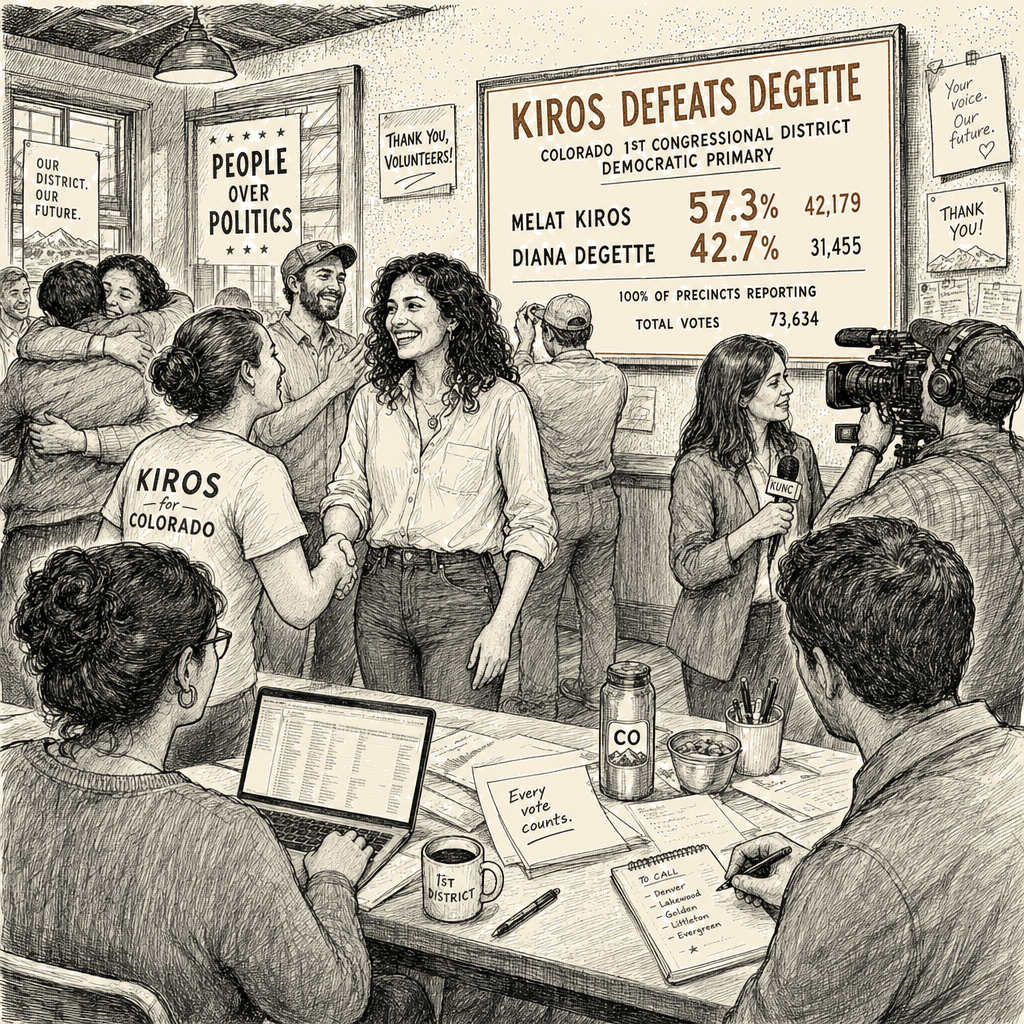
The corporate check bounced in Denver last night. The welfare state is what walked in.
That’s the headline from Colorado’s 1st Congressional District, and if you read it carefully, it’s the most consequential sentence in American politics this month. The check isn’t a donation. It’s a policy veto. And it just bounced.
Melat Kiros — 29, Ethiopian immigrant, Ph.D. student, lawyer — defeated Diana DeGette, a 15-term incumbent, on a platform of universal healthcare, universal childcare, abolishing ICE, and cutting off U.S. military aid to Israel. She didn’t take corporate PAC money. She didn’t take pro-Israel lobby money. She didn’t take defense or pharma money. The defense contractors, the pharmaceutical giants, the energy lobbies: their check is no longer welcome at the door of the Democratic Party. What’s replacing them is a working-class agenda. Washington is calling it democratic socialism. It’s a funny way of saying “the rest of the developed world.”
This is not a horse race story. It’s a structural one. The corporate PAC is the mechanism by which the welfare state gets amputated before it ever gets built. When a member of Congress takes Lockheed Martin’s money, universal healthcare gets quietly walked back into “incremental reform.” When a member takes pharma money, drug pricing gets parked in committee. When a member takes energy money, the climate agenda gets cut down to a tax credit. DeGette spent fifteen terms cashing those checks. The receipts are public.
Kiros’s win is part of a wave, not a fluke. Last week, DSA-backed candidates Darializa Avila Chevalier and Claire Valdez toppled an incumbent and an open-seat favorite in New York City. In May, Chris Rabb won a Philadelphia-area primary on the same playbook: a working-class economic platform, a refusal of corporate cash, and a direct appeal to voters who have been told for thirty years the welfare state is too expensive, too radical, too unrealistic — usually by people whose campaigns are funded by the industries that profit from its absence. This is what the leftist wave hitting Democratic primaries actually means when you strip away the cable-news framing: not a personality cult, but a class politics reasserting itself inside a party that has spent four decades outsourcing its agenda to its donors. And it ties directly into the generational clash now roiling Democratic primaries nationwide — though the press keeps getting the framing wrong. The point isn’t that the young are impatient. The point is that a generation that came of age during the 2008 crash, the pandemic, the student debt explosion, and the first war it watched on a phone has decided the bipartisan consensus on what government is for is a lie. They are not asking for a seat at the table. They are asking why the table is owned by Lockheed Martin in the first place.
Now let’s look at the math, because the panic is always about the label, never the math.
Kiros wants universal childcare. Anyone who has actually priced a daycare center in Denver knows the arithmetic doesn’t balance as a for-profit business: you cannot make care cheap for parents, decent for the workers, and profitable for an owner all at the same time. Pick two. Most countries picked the parents and the workers, and paid the difference through the tax code. That’s not socialism. That’s just choosing a line item. We picked the spreadsheet, and then we act surprised when the daycare closes.
She wants universal healthcare. Sick people make terrible shoppers. You don’t price-compare an ambulance. The American system inserts a profit motive between a patient and a cure, which means you are literally taxing human desperation to pad a margin. The Nordic countries looked at that exact market failure a century ago and said: no, that’s not a market, that’s a hostage situation.
As Kiros put it in February: “Young people understand that we are in the fight of our lives. We need to have leaders that are going to be fighting for the kind of bold policies that actually get something done, and they’re refusing to settle or wait for our turn or ask for permission.” That is a welfare-state demand dressed in campaign-trail language.
Now, the first thing I have to say — and I’ll say it before anyone else does, because I’m tired of waiting for people like me to dodge it — is that the people calling Kiros naive aren’t entirely wrong about the friction. Winning a primary in a solid-blue Denver district is not the same as passing a Nordic welfare state in Washington. The American institutions problem is real. We don’t have the high union density, the organized employers willing to bargain as a bloc, or the century of state capacity that makes a twenty-five percent sales tax feel like the fire department in Sweden. That’s a hard fact, and I won’t pretend it isn’t.
But the people using the friction as an excuse to never start driving have a problem too. Because Kiros is running on the menu of every functioning economy on earth. She has harder, more polarizing fights on immigration and foreign policy, and those are a longer argument. But on the plumbing? That’s not the gulag. That’s just the baseline. The word “socialism” triggers a Cold War reflex in half the country, but the actual programs — Medicare, the VA, the public library — are already here, and you love them. Kiros is just pointing at the receipt.
The economy is a set of choices, not the weather. For thirty years, the choice in Washington was to let the lobbyists write the code and let the public pay the ransom. The choice Kiros and the candidates riding this wave are making is to treat healthcare like healthcare and childcare like infrastructure. They’re called democratic socialists because they believe democracy should extend to the economy, and that the public gets to decide what we owe each other instead of letting a boardroom decide. I don’t need to defend the word. I just need to point at the working example. When a kid gets sick and the parents don’t have to choose between the emergency room and the rent, you don’t get a dictatorship. You get a country where people can afford to be brave.
In Denver last night, the kitchen table won. It’s about time.