
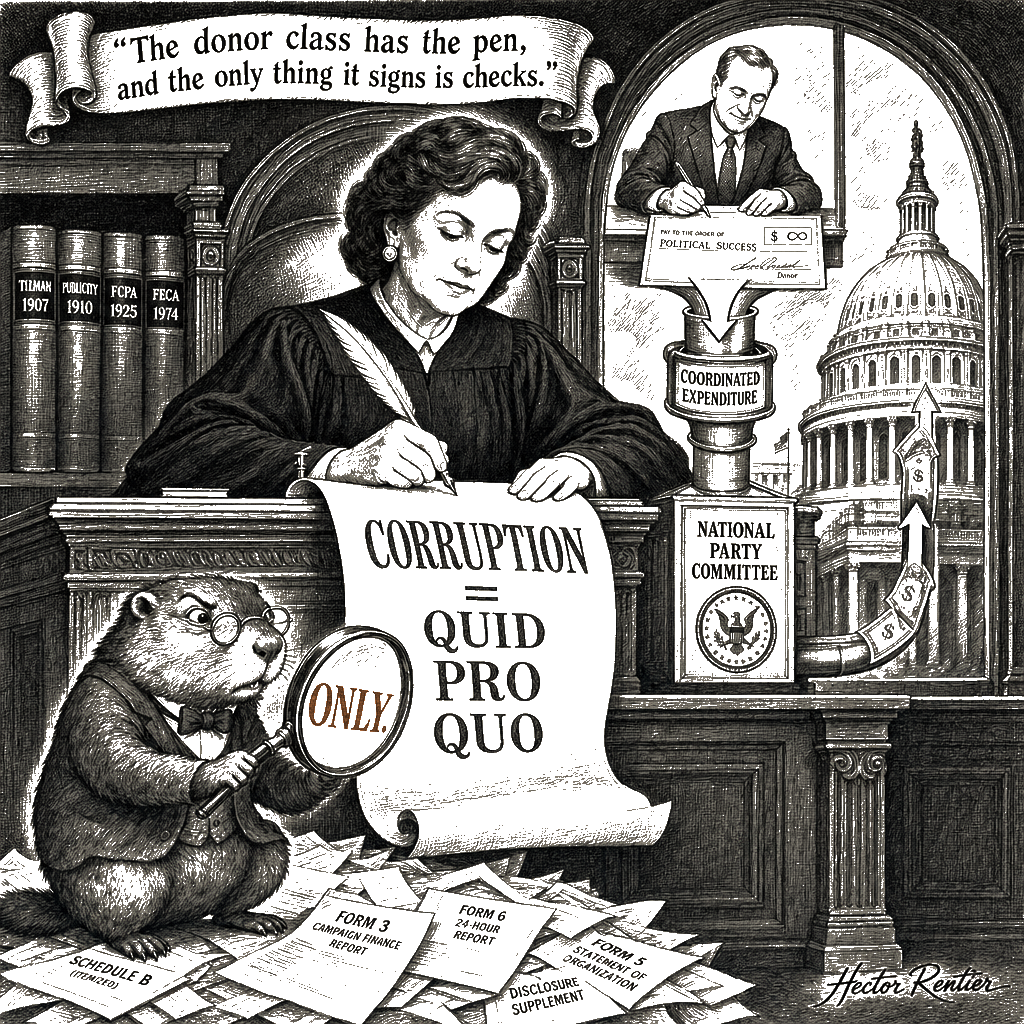
The Supreme Court has made fighting political corruption unconstitutional.
That is the substantive effect of Tuesday’s 6-3 decision in NRSC v. FEC, in which Justice Brett Kavanaugh wrote for the majority. Kavanaugh strikes down the post-Watergate limits on coordinated spending between political parties and the candidates they support. The Court holds that the only legitimate governmental interest in restricting campaign finance is preventing “quid pro quo corruption or its appearance” — bribery in the colloquial sense, an explicit exchange of money for official action. Every broader conception of corruption — capture, dependence, distortion, the systematic translation of private wealth into public policy — the Court has now defined out of the constitutional picture.
Let the majority have its strongest case. For two centuries after the First Amendment’s ratification, parties and candidates spent in coordination, and that arrangement did not corrupt American democracy. The post-Watergate regime weakened parties in ways that fueled polarization and fragmentation, as Kavanaugh notes. If the government’s interest is limited to preventing bribery, and contribution limits, disclosure rules, and earmarking restrictions already serve that interest, the coordinated-spending cap is unconstitutional prophylaxis upon prophylaxis.
But the historical claim is a fraud. The first federal campaign finance statute — the Tillman Act of 1907, banning corporate contributions to federal candidates — predates the post-Watergate regime by sixty-seven years. The Publicity Act of 1910, the Federal Corrupt Practices Act of 1925, the long series of statutes that followed: a century of federal campaign finance regulation that the majority’s “nearly 200 years” formulation airbrushes out of existence. The claim is not a historical error. It is the historical predicate of a political program. The Court needs the nineteenth century to have been pristine, because the nineteenth century is the only constitutional landscape in which the donor class can claim the rights it wants.
And the doctrinal claim is worse. The majority defines corruption to mean quid pro quo — the criminal-law concept of bribery — and rejects broader definitions as inconsistent with the First Amendment. Justice Elena Kagan’s dissent, joined by Justices Sonia Sotomayor and Ketanji Brown Jackson, names the consequence: “a legal regime increasingly unable to stop political corruption, and thus to preserve our institutions’ democratic legitimacy.” That is the polite version. The blunt version is that the Court has spent fifteen years writing a Constitution in which the only political injury it recognizes is a hand caught in the till.
The historical reconstruction also obscures what coordinated spending actually functions as in the modern litigation landscape. In 1974, a coordinated party expenditure meant a national committee purchasing television airtime to support a nominee in direct coordination with the candidate’s own campaign strategy. Today, lifting the coordination caps allows a candidate to direct a mega-donor to write a multi-million-dollar check directly to the national party committee, which then funnels those funds into the candidate’s own campaign infrastructure. This is not the restoration of the nineteenth-century party-adherent model; it is the legalization of donor-class capture of the party apparatus. The majority dismisses this structural risk by asserting that existing contribution limits and disclosure requirements constitute sufficient prophylaxis. That assertion depends entirely on the Court’s artificial narrowing of the constitutional meaning of corruption under Citizens United v. FEC, 558 U.S. 310, 342 (2010) — a definition that excludes the structural dependence the post-Watergate Congress actually sought to regulate: the condition in which a party’s entire financial apparatus relies on a closed circle of mega-donors, ensuring that the party’s leadership answers to its funders rather than its voters. The party is the funder, and the funder is the party.
The Court applies strict scrutiny to dismantle the spending limits on parties and corporations, while simultaneously declaring the downstream regulatory capture those funds produce to be a constitutionally unrecognizable harm. In operation, the Court’s First Amendment is an asymmetric deregulatory engine — a deregulatory shield for concentrated wealth, insulating the architecture of donor dependence from the very anti-corruption rationale the state is otherwise permitted to invoke. The jurisprudence does not track a neutral principle of speech; it tracks the systematic removal of legal firewalls between capital and the state.
NRSC v. FEC completes the work that McCutcheon v. FEC, 572 U.S. 185 (2014), began. The constitutional doctrine has a single direction, and that direction is the elimination of every mechanism that separated political influence from concentrated wealth. The Kagan dissent identifies the structural feature: every anti-corruption rule the Court strikes down is replaced by disclosure requirements the Court has likewise narrowed, and contribution limits the Court has held to a lower tier of scrutiny than expenditures. The architecture of post-Watergate campaign finance regulation is being dismantled in pieces, and the Court is treating each piece as if it stood alone. It does not stand alone. It never did.
The root cause is the half-century-old blunder of Buckley v. Valeo, 424 U.S. 1 (1976), which held that contribution limits were permissible under a lower tier of First Amendment scrutiny than expenditure limits. That artificial distinction is the crack in the dam through which every subsequent ruling has flooded.
An honest First Amendment framework would recognize that political money is sui generis — that the risk of corruption, capture, and distortion is structural rather than transactional, and that the government’s interest in preventing those harms is weighty rather than narrowly tailored to bribery. It would treat contribution limits, expenditure limits, and disclosure requirements as complementary parts of an integrated anti-corruption architecture rather than as separable categories to be leveled one at a time. It would not define corruption out of the Constitution.
The Court will not write that opinion. The donor class has the pen, and the only thing it signs is checks.