
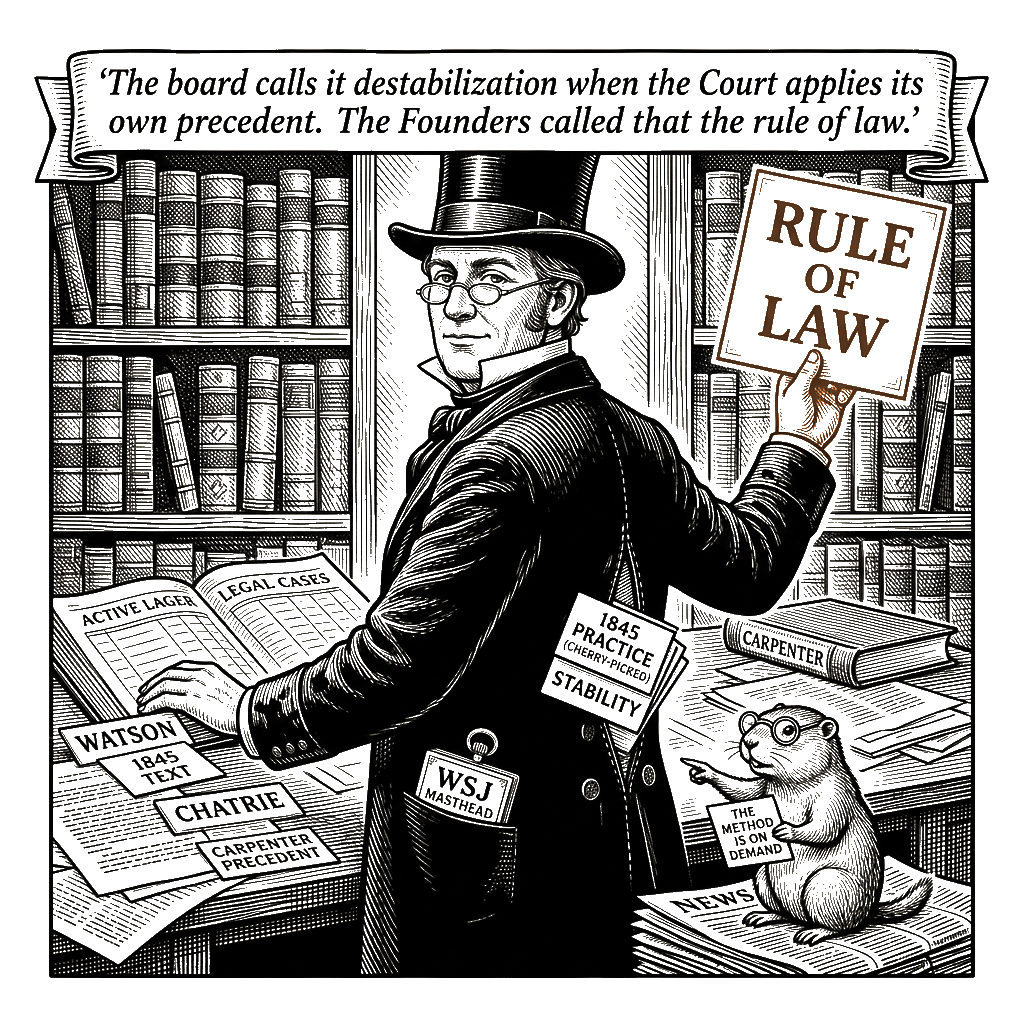
The Editorial Board wants conservative justices to abandon text and precedent for partisan outcomes. In its Monday editorial on Watson v. Republican National Committee and Chatriev. United States, the Wall Street Journal editorial board treats the application of statutory text and existing Fourth Amendment precedent as a betrayal because those methodologies produced outcomes the board dislikes. The board frames Justice Samuel Alito’s dissent in Watson as a defense of original meaning, when it is in fact a demand to override statutory text with cherry-picked nineteenth-century practice. It frames Justice Elena Kagan’s majority opinion in Chatrie as a destabilization of the Fourth Amendment, when it is in fact the routine application of the Court’s 2018 holding in Carpenter v. United States. The board’s complaint is not that the Court erred in its legal reasoning. The board’s complaint is that the justices applied their stated methodologies to cases where those methodologies do not produce the board’s preferred political outcome. The conservative legal movement’s methodology is whatever the case requires.
The board’s preferred outcome in Watson is that federal law requires mail-in ballots to be received by Election Day. The 1845 Election Day statute requires only that the election be “held” on that day. Justice Amy Coney Barrett’s majority opinion reads the text as written: the electorate makes its choice when it casts its ballot, not when the state finishes counting. Under standard textualism, the board loses. The board instead embraces Justice Alito’s dissent, which argues that the 1845 statute must be read in light of nineteenth-century dictionary definitions and the “original meaning” of an election. Alito insists that in the 1840s, an election meant the final collection of ballots. In 1845, civilian elections were conducted in person, often over multiple days, with voters casting ballots orally or via paper handed directly to election officials. Alito treats Civil War-era state practice as binding on the federal 1845 statute, while treating the same era’s in-person, multi-day voting practice as irrelevant. When Alito cites wartime practices to argue ballots had to be collected by Election Day, he cherry-picks: while the Civil War did introduce absentee voting for soldiers, multiple models of that very wartime absentee practice allowed ballots to be received after Election Day by design. When textualism produces an outcome the board dislikes, the board elevates Alito’s cherry-picked nineteenth-century practice over the statutory text. The board is not arguing that Barrett’s reading of the 1845 text is wrong on its own terms. The board is arguing that Barrett should have read it differently — and the only way to reach the board’s preferred reading is to treat the text as subordinate to the outcome.
Both opinions in Watson claim to be doing originalism. Both cite nineteenth-century practice. Both invoke the ordinary meaning of “election” in 1845. The disagreement is over what “election” denotes: the day the electorate votes, or the day officials collect ballots. That is the level-of-generality move — the choice of how broadly to characterize a contested term — that historians of originalism have identified as the technique’s unconstrained variable. The choice of what level to characterize a contested term, like the choice of which century to fix, is itself a methodological commitment, and it is the commitment that produces the result, not the result of an honest application of the method.
In Chatrie, the board complains that a 6-3 majority destabilizes Fourth Amendment law by requiring a warrant for a reverse-geofence search. The board quotes Alito’s dissent, joined by Justice Clarence Thomas and Justice Barrett, which argues that any cell-phone location information voluntarily disclosed to a third party falls outside the Fourth Amendment. This is merely a restatement of Alito’s dissent in Carpenter v. United States. The Carpenter majority, authored by Chief Justice John Roberts, held that the third-party doctrine does not apply to comprehensive digital location records. Chatrie applies Carpenter to reverse-geofence warrants, which are even more invasive because they sweep the data of thousands of entirely innocent people. The board treats this as a shock to the legal system. It is not a shock. It is Carpenter.
The board’s worry about “other digital paper trails” is the worry of every investigative apparatus that has ever discovered its preferred tool is constrained by the Fourth Amendment. The board calls that destabilization. The Founders called it the rule of law. If the board wants broader warrantless access to geofence data, its quarrel is with the Fourth Amendment, not with the Court that applied it. The board’s argument is that the justices who disagree with Carpenter should have voted to overturn it. Three of those justices are still on the Court. They did not have the votes. The board is not reporting a legal destabilization. The board is reporting that the Court followed its own precedent.
Alito’s “destabilizes” complaint is the same move the conservative legal movement has deployed against privacy rulings for two decades. In Dobbs v. Jackson Women’s Health Organization (2022), the majority overruled Roe v. Wade and Planned Parenthood v. Casey on grounds of “workability”; the joint dissent argued the majority was cherry-picking stare decisis factors to reach a desired outcome, and critics of originalism immediately identified Brown v. Board of Education (1954) as the precedent the same approach would compel them to overrule. “Stability” and “workability” are deployed as constraints when the result is conservative; they are discarded when the result is liberal.
The board’s framing — calling three of four Monday rulings “liberal wins” — treats the docket the way a box score treats a baseball game: each play scored, no account of which pitcher is on the mound. Barrett’s Watson majority is a 5-4 opinion written by a justice the conservative legal movement celebrated as its signature appointee, joined by the three Democratic-appointed justices. It is not a liberal win in the sense the term ordinarily denotes; it is a 5-4 ruling in which a conservative appointee assigned the majority reached an outcome the conservative legal movement disfavored. The conservative supermajority remains intact. The pattern — which rulings the supermajority lets go, which it decides — is the institutional reality the box-score framing conceals.
The per-justice update from one Monday: Barrett’s Watson majority shows that the conservative legal movement’s signature appointee can reach an outcome the movement disfavors when the originalist methodology, applied faithfully, points that way; Barrett’s joining of Alito’s Chatrie dissent shows that the same appointee will reach for the “stability” rhetoric when the originalist methodology would produce an outcome the movement disfavors. The methodology is on demand.
The board closes by suggesting that the good news is Congress can override Watson by revising the 1845 statute, and complains that the MAGA Supreme Court was a cliché. The board’s entire editorial rests on the premise that a conservative court must produce conservative political outcomes. When Barrett applies textualism to the mail-ballot receipt window, and when the Court applies Carpenter to geofence warrants, the board registers these as defeats because they expand the franchise and constrain police surveillance. The “MAGA Supreme Court” was never a description. It was an expectation. The Justices declined the assignment, and the board is now calling that a betrayal — which is the most honest sentence the editorial has produced. The methodology was never the principle. The result was.